

630
L.RJ. van Vuuren, J.W. Funke and L. Smith
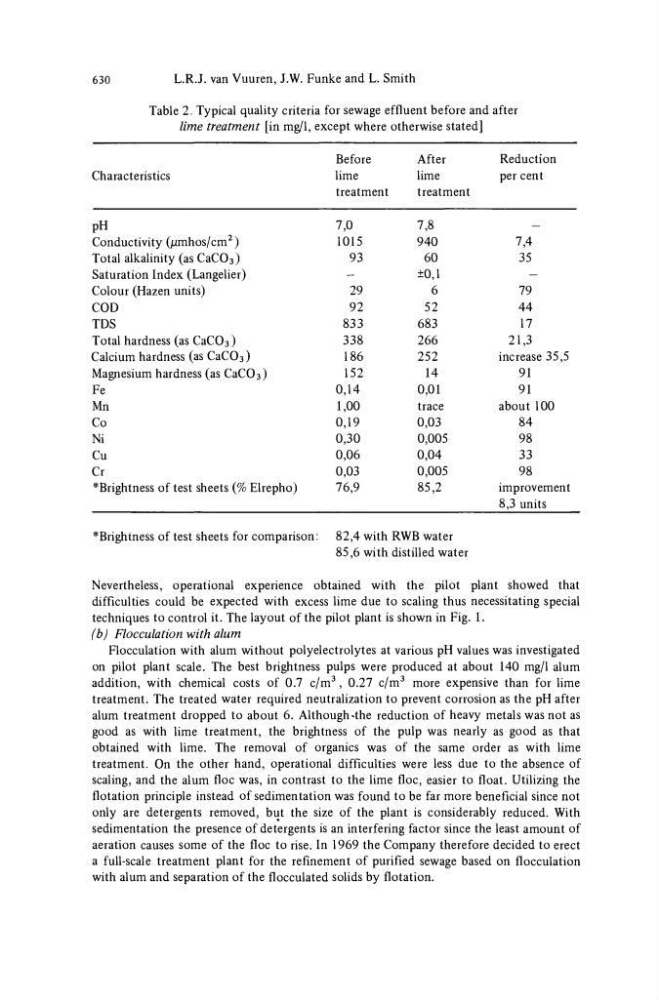
Table 2. Typical quality criteria for sewage effluent before and after
lime treatment [in mg/1, except where otherwise stated]
Characteristics
pH
Conductivity ^mhos/cm
2 )
Total alkalinity (as CaC0 3 )
Saturation Index (Langelier)
Colour (Hazen units)
COD
TDS
Total hardness (as CaC0 3 )
Calcium hardness (as CaC0 3 )
Magnesium hardness (as CaC0 3 )
Fe
Mn
Co
Ni
Cu
Cr
*Brightness of test sheets (% Elrepho)
*Brightness of test sheets for comparison:
Before
lime
treatment
7,0
1015
93
-
29
92
833
338
186
152
0,14
1,00
0,19
0,30
0,06
0,03
76,9
After
lime
treatment
7,8
940
60
±0,1
6
52
683
266
252
14
0,01
trace
0,03
0,005
0,04
0,005
85,2
82,4 with RWB water
85,6 with distilled water
Reduction
per cent
—
7,4
35
-
79
44
17
21,3
increase 35,5
91
91
about 100
84
98
33
98
improvement
8,3 units
Nevertheless, operational experience obtained with the pilot plant showed that
difficulties could be expected with excess lime due to scaling thus necessitating special
techniques to control it. The layout of the pilot plant is shown in Fig. 1.
(b) Flocculation with alum
Flocculation with alum without polyelectrolytes at various pH values was investigated
on pilot plant scale. The best brightness pulps were produced at about 140 mg/1 alum
addition, with chemical costs of 0.7 c/m
3 , 0.27 c/m
3 more expensive than for lime
treatment. The treated water required neutralization to prevent corrosion as the pH after
alum treatment dropped to about 6. Although4he reduction of heavy metals was not as
good as with lime treatment, the brightness of the pulp was nearly as good as that
obtained with lime. The removal of organics was of the same order as with lime
treatment. On the other hand, operational difficulties were less due to the absence of
scaling, and the alum floe was, in contrast to the lime floe, easier to float. Utilizing the
flotation principle instead of sedimentation was found to be far more beneficial since not
only are detergents removed, but the size of the plant is considerably reduced. With
sedimentation the presence of detergents is an interfering factor since the least amount of
aeration causes some of the floe to rise. In 1969 the Company therefore decided to erect
a full-scale treatment plant for the refinement of purified sewage based on flocculation
with alum and separation of the flocculated solids by flotation.