

628
L.R.J. van Vuuren, J.W. Funke and L. Smith
used in papermaking are:
(a) low organic content, which may otherwise cause slime growth throughout the pulp
and papermaking system;
(b) low phosphorus content for the same reason;
(c) low colour as cellulose is an excellent adsorbent for colour bodies;
(d) low hardness, since hard water reacts with rosins, by forming insoluble rosin soaps,
thereby interfering with the bleaching of pulp and with the sizing of bleached paper;
(e) absence of heavy metals, especially of Fe, Mn, Cu, which have a catalytic effect on
the decomposition of calcium hypochlorite bleach liquor of which iron especially is
adsorbed by cellulose from dilute solutions, thereby causing a substantial loss in
brightness or a tendency towards reversion in brightness.
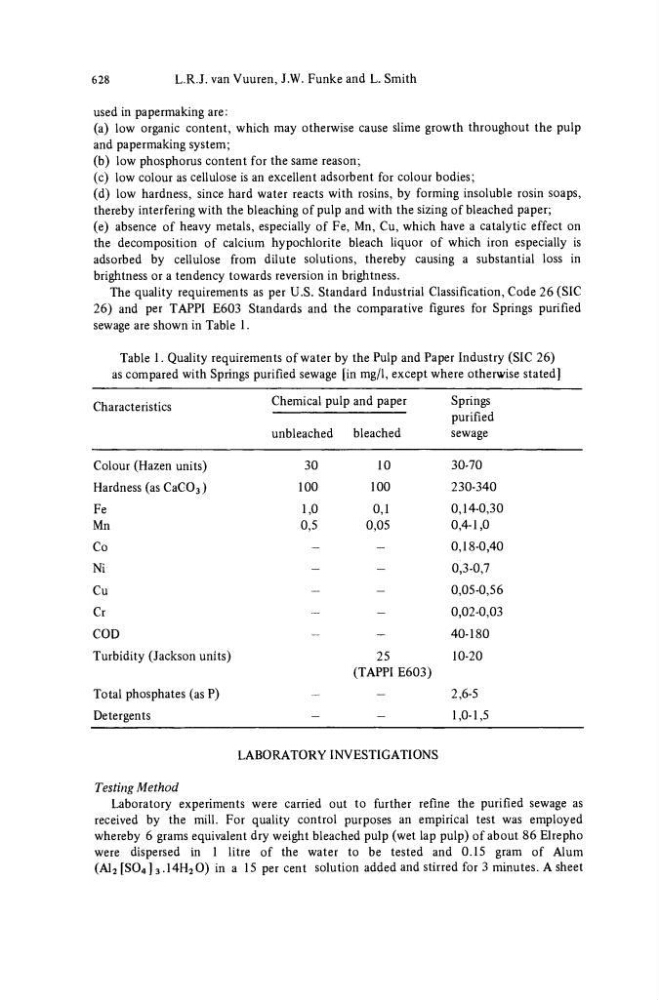
The quality requirements as per U.S. Standard Industrial Classification, Code 26 (SIC
26) and per TAPPI E603 Standards and the comparative figures for Springs purified
sewage are shown in Table 1.
Table 1. Quality requirements of water by the Pulp and Paper Industry (SIC 26)
as compared with Springs purified sewage [in mg/1, except where otherwise stated]
Characteristics
Colour (Hazen units)
Hardness (as CaC0 3 )
Fe
Mn
Co
Ni
Cu
Cr
COD
Turbidity (Jackson units)
Total phosphates (as P)
Detergents
Chemical pulp
unbleached
30
100
1,0
0,5
-
-
-
-
-
-
-
» and paper
bleached
10
100
0,1
0,05
-
-
-
-
-
25
(TAPPI E603)
-
-
Springs
purified
sewage
30-70
230-340
0,14-0,30
0,4-1,0
0,18-0,40
0,3-0,7
0,05-0,56
0,02-0,03
40-180
10-20
2,6-5
1,0-1,5
LABORATORY INVESTIGATIONS
Testing Method
Laboratory experiments were carried out to further refine the purified sewage as
received by the mill. For quality control purposes an empirical test was employed
whereby 6 grams equivalent dry weight bleached pulp (wet lap pulp) of about 86 Elrepho
were dispersed in 1 litre of the water to be tested and 0.15 gram of Alum
(Al 2 [S0 4 ] 3 .14H 2 0) in a 15 per cent solution added and stirred for 3 minutes. A sheet