

Treatment ofpolychlorinated biphenyl in water by ionizing radiation
611
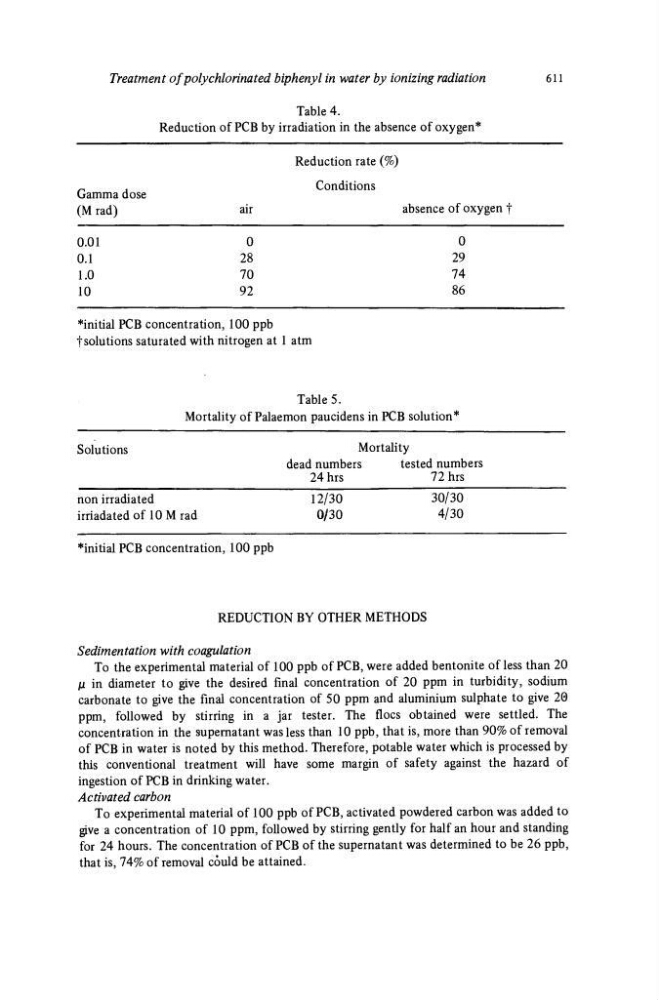
Table 4.
Reduction of PCB by irradiation in the absence of oxygen*
Gamma dose
(M rad)
0.01
0.1
1.0
10
air
0
28
70
92
Reduction rate (%)
Conditions
absence of oxygen f
0
29
74
86
^initial PCB concentration, 100 ppb
t solutions saturated with nitrogen at 1 atm
Table 5.
Mortality of Palaemon paucidens in PCB solution*
Solutions
Mortality
dead numbers
tested numbers
24 hrs
72 hrs
non irradiated
12/30
30/30
irriadated of 10 M rad
0/30
4/30
^initial PCB concentration, 100 ppb
REDUCTION BY OTHER METHODS
Sedimentation with coagulation
To the experimental material of 100 ppb of PCB, were added bentonite of less than 20
μ in diameter to give the desired final concentration of 20 ppm in turbidity, sodium
carbonate to give the final concentration of 50 ppm and aluminium sulphate to give 20
ppm, followed by stirring in a jar tester. The floes obtained were settled. The
concentration in the supernatant was less than 10 ppb, that is, more than 90% of removal
of PCB in water is noted by this method. Therefore, potable water which is processed by
this conventional treatment will have some margin of safety against the hazard of
ingestion of PCB in drinking water.
Activated carbon
To experimental material of 100 ppb of PCB, activated powdered carbon was added to
give a concentration of 10 ppm, followed by stirring gently for half an hour and standing
for 24 hours. The concentration of PCB of the supernatant was determined to be 26 ppb,
that is, 74% of removal could be attained.
611
Table 4.
Reduction of PCB by irradiation in the absence of oxygen*
Gamma dose
(M rad)
0.01
0.1
1.0
10
air
0
28
70
92
Reduction rate (%)
Conditions
absence of oxygen f
0
29
74
86
^initial PCB concentration, 100 ppb
t solutions saturated with nitrogen at 1 atm
Table 5.
Mortality of Palaemon paucidens in PCB solution*
Solutions
Mortality
dead numbers
tested numbers
24 hrs
72 hrs
non irradiated
12/30
30/30
irriadated of 10 M rad
0/30
4/30
^initial PCB concentration, 100 ppb
REDUCTION BY OTHER METHODS
Sedimentation with coagulation
To the experimental material of 100 ppb of PCB, were added bentonite of less than 20
μ in diameter to give the desired final concentration of 20 ppm in turbidity, sodium
carbonate to give the final concentration of 50 ppm and aluminium sulphate to give 20
ppm, followed by stirring in a jar tester. The floes obtained were settled. The
concentration in the supernatant was less than 10 ppb, that is, more than 90% of removal
of PCB in water is noted by this method. Therefore, potable water which is processed by
this conventional treatment will have some margin of safety against the hazard of
ingestion of PCB in drinking water.
Activated carbon
To experimental material of 100 ppb of PCB, activated powdered carbon was added to
give a concentration of 10 ppm, followed by stirring gently for half an hour and standing
for 24 hours. The concentration of PCB of the supernatant was determined to be 26 ppb,
that is, 74% of removal could be attained.