

568
A. Golomb
indication of membrane lifetime and performance characteristics. Some experiments were
conducted with rinse waters prepared by dilution of a Watts bath obtained from an
industrial source and in both cases the nickel rejections were of the order of 99+ per cent.
No significant deterioration in membrane properties occurred over a period of five
months for samples in contact with the test solutions.
RO tests were also made in the presence of selected organic addition agents. As
described by Jones and Kenez (1969), these fall into two broad categories, the so-called
semibright and bright nickel additives. Coumarin was selected as a representative of the
first system and a combination of sodium allyl sulphonate and N-allyl quinaldinium
bromide was chosen as representative of the second. The test solution was a simulated
rinse water at 1 per cent of Watts bath concentration. Table I summarizes the results of
RO tests with membranes after 20 weeks' storage in contact with the test solution.
In the presence of both types of organic addition agents, nickel rejection efficiencies
are again better than 99 per cent. However, the behaviour of the addition agents is quite
different. The retention of coumarin is low, suggesting coupled flow of this species with
water through the membrane. On the other hand, rejection of the sodium allyl
sulphonate/N-allyl quinaldinium bromide combination is the range 96-98 per cent. This
behaviour is typical of dissolved, highly dissociated ionic species.
4 0
35
i
30
25
§20<
Ld
I -
< 15
a:
lD
x
u. 10
5
10
20
30
40
50
PERCENTAGE WATTS BATH CONCENTRATION
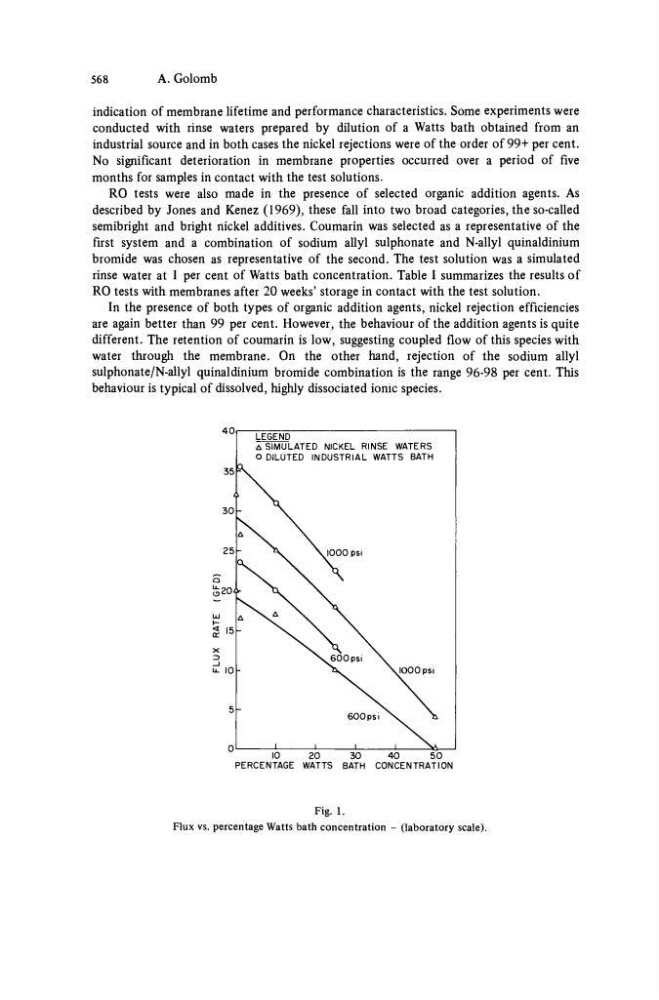
Fig. 1.
Flux vs. percentage Watts bath concentration - (laboratory scale).
LEGEND
Δ SIMULATED NICKEL RINSE WATERS
O DILUTED INDUSTRIAL WATTS BATH
1000 psi
1000 psi
A. Golomb
indication of membrane lifetime and performance characteristics. Some experiments were
conducted with rinse waters prepared by dilution of a Watts bath obtained from an
industrial source and in both cases the nickel rejections were of the order of 99+ per cent.
No significant deterioration in membrane properties occurred over a period of five
months for samples in contact with the test solutions.
RO tests were also made in the presence of selected organic addition agents. As
described by Jones and Kenez (1969), these fall into two broad categories, the so-called
semibright and bright nickel additives. Coumarin was selected as a representative of the
first system and a combination of sodium allyl sulphonate and N-allyl quinaldinium
bromide was chosen as representative of the second. The test solution was a simulated
rinse water at 1 per cent of Watts bath concentration. Table I summarizes the results of
RO tests with membranes after 20 weeks' storage in contact with the test solution.
In the presence of both types of organic addition agents, nickel rejection efficiencies
are again better than 99 per cent. However, the behaviour of the addition agents is quite
different. The retention of coumarin is low, suggesting coupled flow of this species with
water through the membrane. On the other hand, rejection of the sodium allyl
sulphonate/N-allyl quinaldinium bromide combination is the range 96-98 per cent. This
behaviour is typical of dissolved, highly dissociated ionic species.
4 0
35
i
30
25
§20<
Ld
I -
< 15
a:
lD
x
u. 10
5
10
20
30
40
50
PERCENTAGE WATTS BATH CONCENTRATION
Fig. 1.
Flux vs. percentage Watts bath concentration - (laboratory scale).
LEGEND
Δ SIMULATED NICKEL RINSE WATERS
O DILUTED INDUSTRIAL WATTS BATH
1000 psi
1000 psi