

The Operation of Plants Treating Mixed Industrial Wastes
557
be kept away from slaughterhouse wastes, because it may cause severe disturbances in
treatment operation. A shock load of blood may cause, among other nuisances, strong
foaming, and as much as a fivefold rise in sludge respiration. An economically designed
aeration system cannot keep up with this rise.
R>4 Substrate oxidized 1 Range of stable
o
CJR . n No overloading 7 operation, no
1
dS *
u or poisoning
J SSLT
%r
7sL 0JR>1 Overloading.
dS
J
substrate. '
oxidized
§-<°,"><
f
%g2&>
substr
-
liR
•^r<ό,R dS
/
substr. rernotal
Sfmg/lJ HfO
0,5
copperoniy
0,6 Hflfl
acetate any
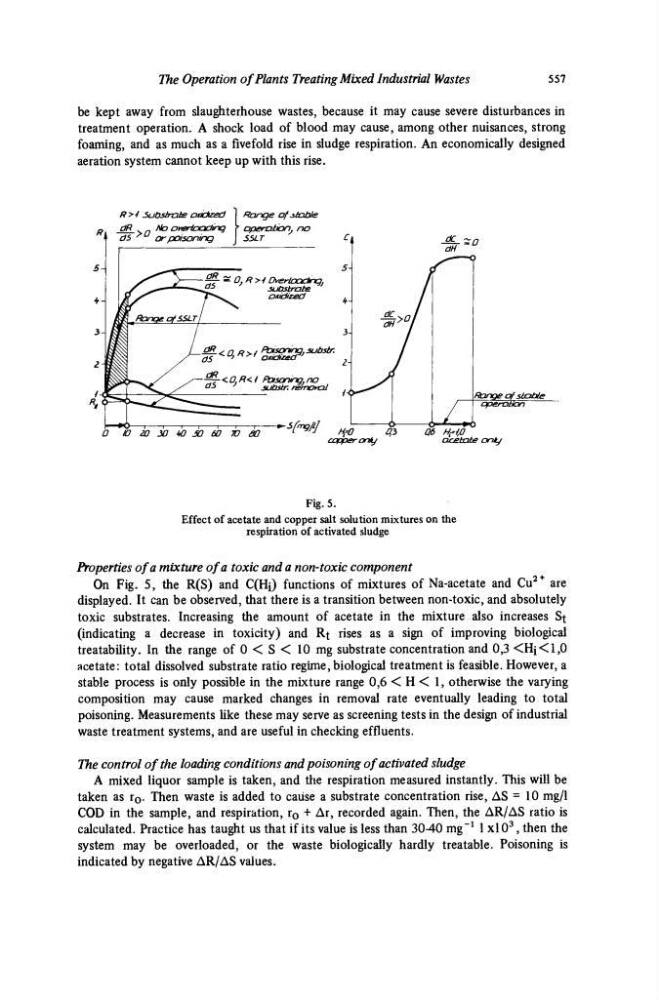
Fig. 5.
Effect of acetate and copper salt solution mixtures on the
respiration of activated sludge
Properties of a mixture of a toxic and a non-toxic component
On Fig. 5, the R(S) and C(H0 functions of mixtures of Na-acetate and Cu
2+ are
displayed. It can be observed, that there is a transition between non-toxic, and absolutely
toxic substrates. Increasing the amount of acetate in the mixture also increases St
(indicating a decrease in toxicity) and Rt rises as a sign of improving biological
treatability. In the range of 0 < S < 10 mg substrate concentration and 0,3 < H i < l , 0
acetate: total dissolved substrate ratio regime, biological treatment is feasible. However, a
stable process is only possible in the mixture range 0,6 < H < 1, otherwise the varying
composition may cause marked changes in removal rate eventually leading to total
poisoning. Measurements like these may serve as screening tests in the design of industrial
waste treatment systems, and are useful in checking effluents.
The control of the loading conditions and poisoning of activated sludge
A mixed liquor sample is taken, and the respiration measured instantly. This will be
taken as r 0 . Then waste is added to cause a substrate concentration rise, AS = 10 mg/1
COD in the sample, and respiration, r 0 + Ar, recorded again. Then, the AR/AS ratio is
calculated. Practice has taught us that if its value is less than 30-40 mg"
1 1 xlO
3 , then the
system may be overloaded, or the waste biologically hardly treatable. Poisoning is
indicated by negative AR/AS values.
557
be kept away from slaughterhouse wastes, because it may cause severe disturbances in
treatment operation. A shock load of blood may cause, among other nuisances, strong
foaming, and as much as a fivefold rise in sludge respiration. An economically designed
aeration system cannot keep up with this rise.
R>4 Substrate oxidized 1 Range of stable
o
CJR . n No overloading 7 operation, no
1
dS *
u or poisoning
J SSLT
%r
7sL 0JR>1 Overloading.
dS
J
substrate. '
oxidized
§-<°,"><
f
%g2&>
substr
-
liR
•^r<ό,R dS
/
substr. rernotal
Sfmg/lJ HfO
0,5
copperoniy
0,6 Hflfl
acetate any
Fig. 5.
Effect of acetate and copper salt solution mixtures on the
respiration of activated sludge
Properties of a mixture of a toxic and a non-toxic component
On Fig. 5, the R(S) and C(H0 functions of mixtures of Na-acetate and Cu
2+ are
displayed. It can be observed, that there is a transition between non-toxic, and absolutely
toxic substrates. Increasing the amount of acetate in the mixture also increases St
(indicating a decrease in toxicity) and Rt rises as a sign of improving biological
treatability. In the range of 0 < S < 10 mg substrate concentration and 0,3 < H i < l , 0
acetate: total dissolved substrate ratio regime, biological treatment is feasible. However, a
stable process is only possible in the mixture range 0,6 < H < 1, otherwise the varying
composition may cause marked changes in removal rate eventually leading to total
poisoning. Measurements like these may serve as screening tests in the design of industrial
waste treatment systems, and are useful in checking effluents.
The control of the loading conditions and poisoning of activated sludge
A mixed liquor sample is taken, and the respiration measured instantly. This will be
taken as r 0 . Then waste is added to cause a substrate concentration rise, AS = 10 mg/1
COD in the sample, and respiration, r 0 + Ar, recorded again. Then, the AR/AS ratio is
calculated. Practice has taught us that if its value is less than 30-40 mg"
1 1 xlO
3 , then the
system may be overloaded, or the waste biologically hardly treatable. Poisoning is
indicated by negative AR/AS values.