

550
P. Farkas
respiration [4, 5] :
and
R = ro
R = R(S) - lisi
ro
+ 1
(3)
where r(S) can be interpreted as the substrate concentration function of respiration, and
r 0 as its value at S = 0. Further, it should be noted, that substrate and endogenous
respiration are also functions of both S and the bacterial concentration in the sludge, X:
r s =r s (S) = Xk s (S)
r e = r e (S) = X2k e (S)
(4)
(5)
where k s is the specific value of substrate respiration, k e the endogenous decay constant,
z the oxygen equivalent of bacterial mass removed. In Equ. 3, the effect of bacterial
concentration is eliminated. The R(S) equations characterize the biological properties of
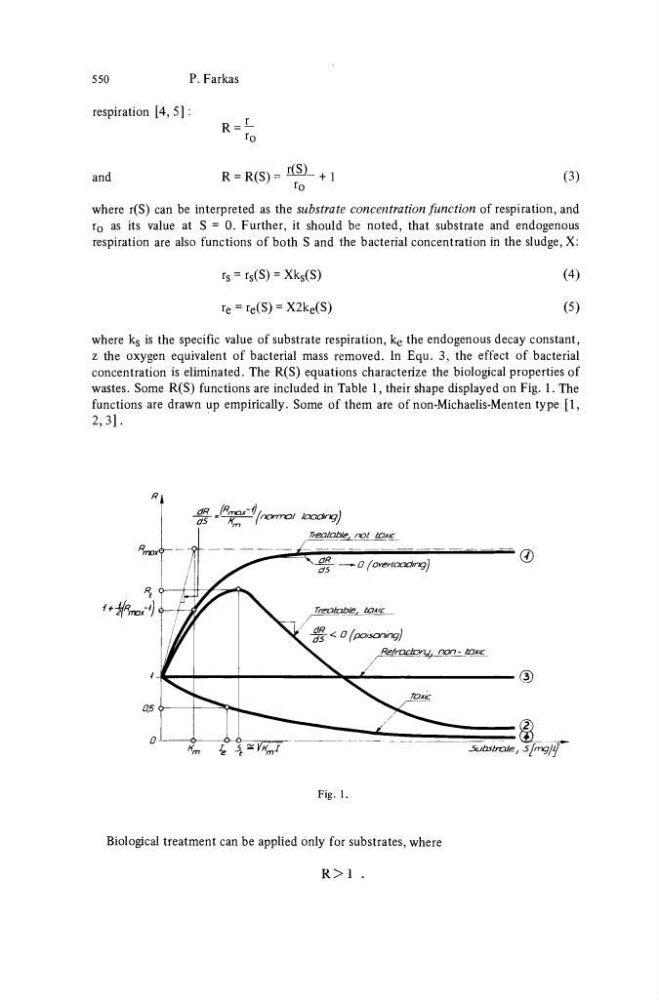
wastes. Some R(S) functions are included in Table 1, their shape displayed on Fig. 1. The
functions are drawn up empirically. Some of them are of non-Michaelis-Menten type [1,
2,3].
Substrate, 5[mg/lJ
Fig. 1.
Biological treatment can be applied only for substrates, where
R > 1 .
P. Farkas
respiration [4, 5] :
and
R = ro
R = R(S) - lisi
ro
+ 1
(3)
where r(S) can be interpreted as the substrate concentration function of respiration, and
r 0 as its value at S = 0. Further, it should be noted, that substrate and endogenous
respiration are also functions of both S and the bacterial concentration in the sludge, X:
r s =r s (S) = Xk s (S)
r e = r e (S) = X2k e (S)
(4)
(5)
where k s is the specific value of substrate respiration, k e the endogenous decay constant,
z the oxygen equivalent of bacterial mass removed. In Equ. 3, the effect of bacterial
concentration is eliminated. The R(S) equations characterize the biological properties of
wastes. Some R(S) functions are included in Table 1, their shape displayed on Fig. 1. The
functions are drawn up empirically. Some of them are of non-Michaelis-Menten type [1,
2,3].
Substrate, 5[mg/lJ
Fig. 1.
Biological treatment can be applied only for substrates, where
R > 1 .