

COST RELATIONSHIP OF BIOLOGICAL
AND THERMAL PROCESSES FOR THE
TREATMENT OF INDUSTRIAL EFFLUENTS
J. LOHMANN
Friedrich Uhde GmbH, 46 Dortmund, Deggingstr. 10 — 12, Fed. Rep. of Germany
In order to be able to compare the applicability of various treatment processes and to
show typical examples of where they are best used, we have examined the following
process steps for treating the wastewater from a plastics plant that is representative for a
broad section of this industry: (1) Activated sludge system, (2) Plastic trickling filter, (3)
Combination of a plastic trickling filter and activated sludge system, (4) High-rate
activated sludge system, (5) Incineration. The input data for calculating the incineration
stage were obtained from the wastewater composition. As the specific BOD reduction
costs are influenced to a large extent by the wastewater concentration, we have assumed
that various measures can be taken within the plant for varying the wastewater
concentration within wide limits.
Test data. A basin of 1.6m
3 volume using compressed-air aeration was used to test the
activated sludge process (1) and a tower of 10 m
3 volume filled with plastic packing for
the trickling filter process. The tyyo sections could be arranged in series to examine the
effect of combining the two processes. The design data for the high-rate activated sludge
system were obtained in a laboratory installation (2).
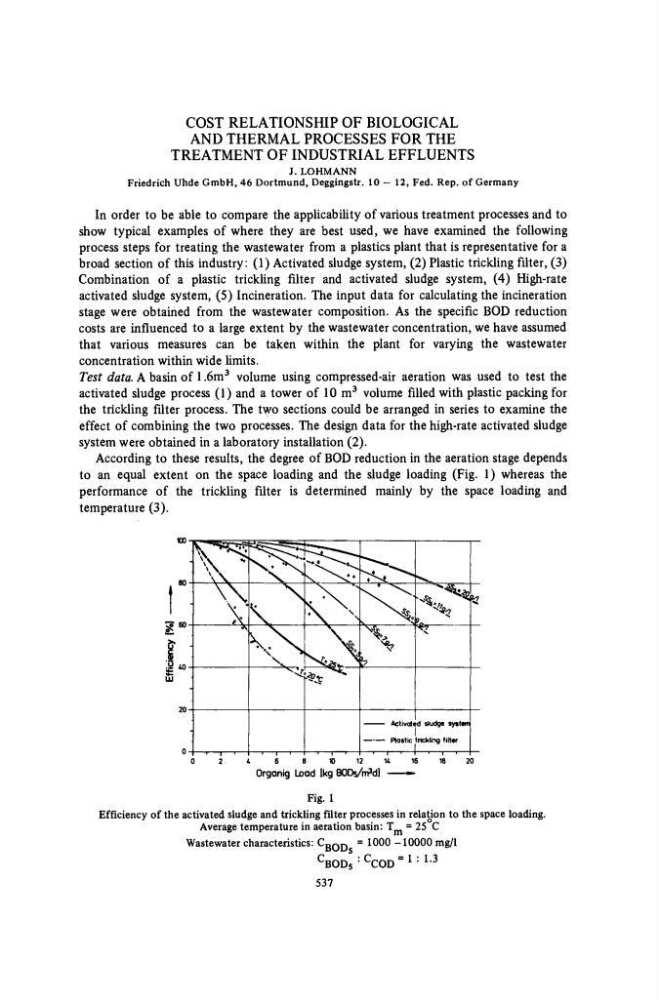
According to these results, the degree of BOD reduction in the aeration stage depends
to an equal extent on the space loading and the sludge loading (Fig. 1) whereas the
performance of the trickling filter is determined mainly by the space loading and
temperature (3).
1
Activated sludge system
|
I
I
I
Plastic trickling filter
0 - |
1
,
1 1
1
,
1
1 1 1 1 1
1 1 1 1
1 1 1
\0
2
I*
6
Θ
X)
12
14
16
18
20
Organig Load (kg BODs/nPdJ
-
Fig. 1
Efficiency of the activated sludge and trickling filter processes in relation to the space loading.
Average temperature in aeration basin: T = 25 C
Wastewater characteristics: C ί 0 D = 1000 -10000 mg/1
C BOD s
: C COD
= l : L 3
537
AND THERMAL PROCESSES FOR THE
TREATMENT OF INDUSTRIAL EFFLUENTS
J. LOHMANN
Friedrich Uhde GmbH, 46 Dortmund, Deggingstr. 10 — 12, Fed. Rep. of Germany
In order to be able to compare the applicability of various treatment processes and to
show typical examples of where they are best used, we have examined the following
process steps for treating the wastewater from a plastics plant that is representative for a
broad section of this industry: (1) Activated sludge system, (2) Plastic trickling filter, (3)
Combination of a plastic trickling filter and activated sludge system, (4) High-rate
activated sludge system, (5) Incineration. The input data for calculating the incineration
stage were obtained from the wastewater composition. As the specific BOD reduction
costs are influenced to a large extent by the wastewater concentration, we have assumed
that various measures can be taken within the plant for varying the wastewater
concentration within wide limits.
Test data. A basin of 1.6m
3 volume using compressed-air aeration was used to test the
activated sludge process (1) and a tower of 10 m
3 volume filled with plastic packing for
the trickling filter process. The tyyo sections could be arranged in series to examine the
effect of combining the two processes. The design data for the high-rate activated sludge
system were obtained in a laboratory installation (2).
According to these results, the degree of BOD reduction in the aeration stage depends
to an equal extent on the space loading and the sludge loading (Fig. 1) whereas the
performance of the trickling filter is determined mainly by the space loading and
temperature (3).
1
Activated sludge system
|
I
I
I
Plastic trickling filter
0 - |
1
,
1 1
1
,
1
1 1 1 1 1
1 1 1 1
1 1 1
\0
2
I*
6
Θ
X)
12
14
16
18
20
Organig Load (kg BODs/nPdJ
-
Fig. 1
Efficiency of the activated sludge and trickling filter processes in relation to the space loading.
Average temperature in aeration basin: T = 25 C
Wastewater characteristics: C ί 0 D = 1000 -10000 mg/1
C BOD s
: C COD
= l : L 3
537