

Discussion by Maurice A. Shapiro and Attila A. Sooky
Accepting the validity of the techniques developed to predict underflow concentration in terms of
feed rate, underflow rate, thickener area and the results of settling tests, they still do not allow a
description of the internal phenomena associated with thickening. Therefore any attempt at
developing a model based upon the basic phenomena which control the process is to be applauded.
A careful review of the paper reveals that as a first step the authors developed a digital computer
model to dynamically simulate the established and widely used settling tests. The "additional mathemical constant" which we take to be R (the ratio of the initial K to the final K value) and which it is
claimed relates to some basic properties of the sludge to be separated, appears to be determined only
by manipulating its value until a value is obtained in which the calculated settling curve closely
approximates the observed.
It would be of interest to illustrate the "closeness of fit" of the calculated and actual settling
curves. The attempt to estimate a parameter which is needed in the model but is unknown requires
additional clarification. Indeed, since R is needed for the use of the model a question arises as to the
effect on R of the recirculation of solids to the head of the process as proposed for the fourth stage of
the development of the simulation model, and how it will be possible to evaluate this effect.
The authors have presented very interesting and illuminating physical analogies of the thickening
process and provided a pictorial representation of the process. There is a need, however, for a better
definition of the "bound water" concept. The very variability of "bound water" content reported by
investigators is of importance. However, what may be more meaningful is the question whether the
reported measurements are truly comparable.
It is axiomatic that the validity and worthiness of any new design tool must be tested and verified
to determine its precision and accuracy. We presume that the meaning of verification as used in the
paper and as proposed for the third and fourth stages, and indeed for the model as a whole, relates to
the testing of the validity of the model as an applicable design tool which would permit greater
efficiency in operation of thickening processes in general and those related to activated sludge in
particular.
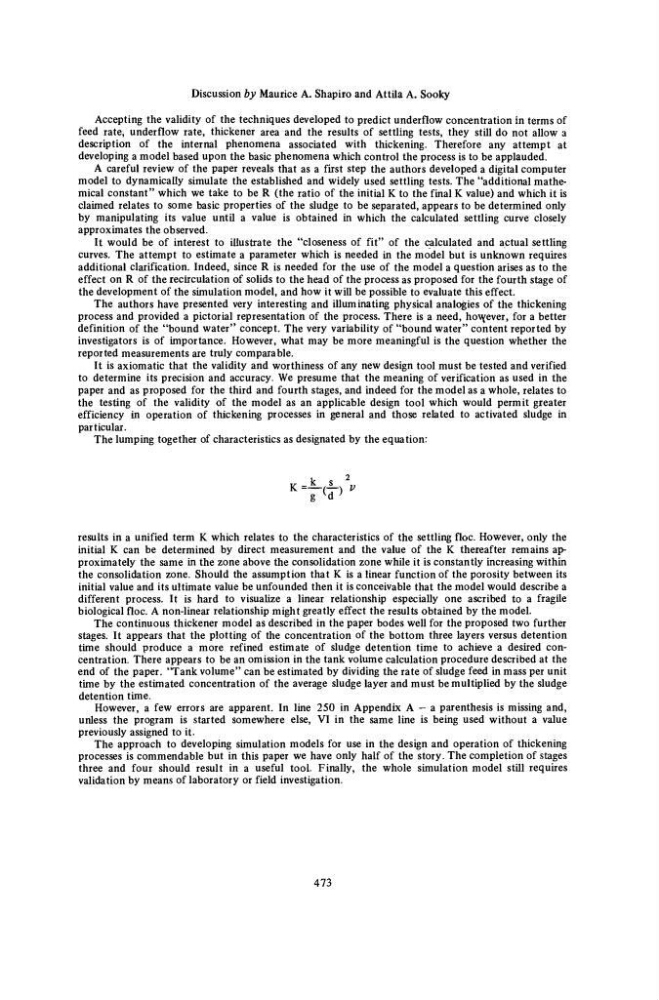
The lumping together of characteristics as designated by the equation:
k s
2
K=—(—) V
g
( d
}
results in a unified term K which relates to the characteristics of the settling floe. However, only the
initial K can be determined by direct measurement and the value of the K thereafter remains approximately the same in the zone above the consolidation zone while it is constantly increasing within
the consolidation zone. Should the assumption that K is a linear function of the porosity between its
initial value and its ultimate value be unfounded then it is conceivable that the model would describe a
different process. It is hard to visualize a linear relationship especially one ascribed to a fragile
biological floe. A non-linear relationship might greatly effect the results obtained by the model.
The continuous thickener model as described in the paper bodes well for the proposed two further
stages. It appears that the plotting of the concentration of the bottom three layers versus detention
time should produce a more refined estimate of sludge detention time to achieve a desired concentration. There appears to be an omission in the tank volume calculation procedure described at the
end of the paper. "Tank volume" can be estimated by dividing the rate of sludge feed in mass per unit
time by the estimated concentration of the average sludge layer and must be multiplied by the sludge
detention time.
However, a few errors are apparent. In line 250 in Appendix A - a parenthesis is missing and,
unless the program is started somewhere else, VI in the same line is being used without a value
previously assigned to it.
The approach to developing simulation models for use in the design and operation of thickening
processes is commendable but in this paper we have only half of the story. The completion of stages
three and four should result in a useful tool. Finally, the whole simulation model still requires
validation by means of laboratory or field investigation.
473
Accepting the validity of the techniques developed to predict underflow concentration in terms of
feed rate, underflow rate, thickener area and the results of settling tests, they still do not allow a
description of the internal phenomena associated with thickening. Therefore any attempt at
developing a model based upon the basic phenomena which control the process is to be applauded.
A careful review of the paper reveals that as a first step the authors developed a digital computer
model to dynamically simulate the established and widely used settling tests. The "additional mathemical constant" which we take to be R (the ratio of the initial K to the final K value) and which it is
claimed relates to some basic properties of the sludge to be separated, appears to be determined only
by manipulating its value until a value is obtained in which the calculated settling curve closely
approximates the observed.
It would be of interest to illustrate the "closeness of fit" of the calculated and actual settling
curves. The attempt to estimate a parameter which is needed in the model but is unknown requires
additional clarification. Indeed, since R is needed for the use of the model a question arises as to the
effect on R of the recirculation of solids to the head of the process as proposed for the fourth stage of
the development of the simulation model, and how it will be possible to evaluate this effect.
The authors have presented very interesting and illuminating physical analogies of the thickening
process and provided a pictorial representation of the process. There is a need, however, for a better
definition of the "bound water" concept. The very variability of "bound water" content reported by
investigators is of importance. However, what may be more meaningful is the question whether the
reported measurements are truly comparable.
It is axiomatic that the validity and worthiness of any new design tool must be tested and verified
to determine its precision and accuracy. We presume that the meaning of verification as used in the
paper and as proposed for the third and fourth stages, and indeed for the model as a whole, relates to
the testing of the validity of the model as an applicable design tool which would permit greater
efficiency in operation of thickening processes in general and those related to activated sludge in
particular.
The lumping together of characteristics as designated by the equation:
k s
2
K=—(—) V
g
( d
}
results in a unified term K which relates to the characteristics of the settling floe. However, only the
initial K can be determined by direct measurement and the value of the K thereafter remains approximately the same in the zone above the consolidation zone while it is constantly increasing within
the consolidation zone. Should the assumption that K is a linear function of the porosity between its
initial value and its ultimate value be unfounded then it is conceivable that the model would describe a
different process. It is hard to visualize a linear relationship especially one ascribed to a fragile
biological floe. A non-linear relationship might greatly effect the results obtained by the model.
The continuous thickener model as described in the paper bodes well for the proposed two further
stages. It appears that the plotting of the concentration of the bottom three layers versus detention
time should produce a more refined estimate of sludge detention time to achieve a desired concentration. There appears to be an omission in the tank volume calculation procedure described at the
end of the paper. "Tank volume" can be estimated by dividing the rate of sludge feed in mass per unit
time by the estimated concentration of the average sludge layer and must be multiplied by the sludge
detention time.
However, a few errors are apparent. In line 250 in Appendix A - a parenthesis is missing and,
unless the program is started somewhere else, VI in the same line is being used without a value
previously assigned to it.
The approach to developing simulation models for use in the design and operation of thickening
processes is commendable but in this paper we have only half of the story. The completion of stages
three and four should result in a useful tool. Finally, the whole simulation model still requires
validation by means of laboratory or field investigation.
473