

464
A.S. Anderson and R.C. Hanson
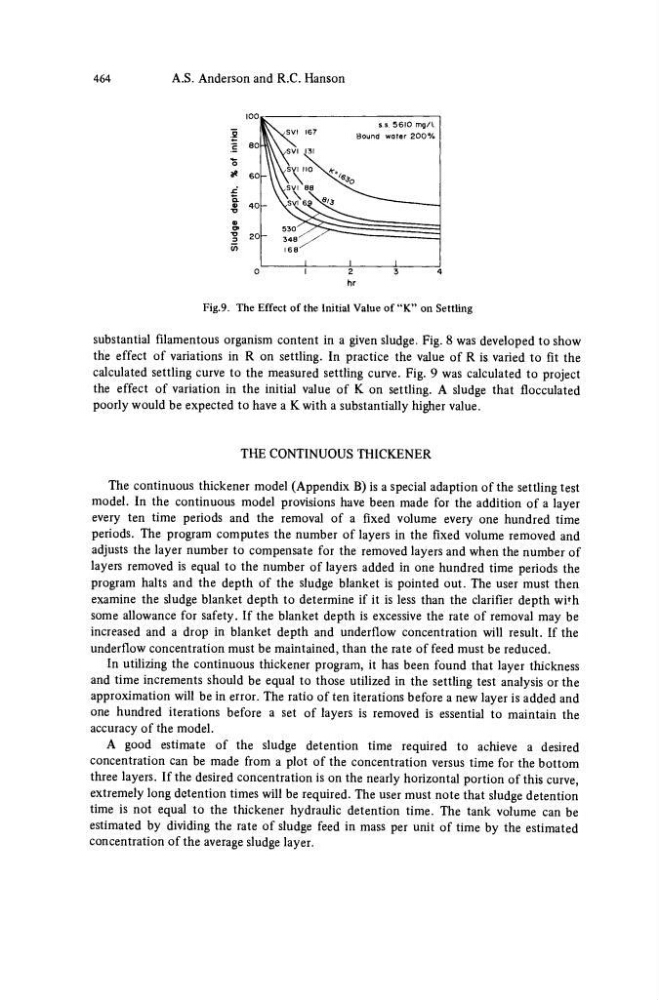
Fig.9. The Effect of the Initial Value of "K" on Settling
substantial filamentous organism content in a given sludge. Fig. 8 was developed to show
the effect of variations in R on settling. In practice the value of R is varied to fit the
calculated settling curve to the measured settling curve. Fig. 9 was calculated to project
the effect of variation in the initial value of K on settling. A sludge that flocculated
poorly would be expected to have a K with a substantially higher value.
THE CONTINUOUS THICKENER
The continuous thickener model (Appendix B) is a special adaption of the settling test
model. In the continuous model provisions have been made for the addition of a layer
every ten time periods and the removal of a fixed volume every one hundred time
periods. The program computes the number of layers in the fixed volume removed and
adjusts the layer number to compensate for the removed layers and when the number of
layers removed is equal to the number of layers added in one hundred time periods the
program halts and the depth of the sludge blanket is pointed out. The user must then
examine the sludge blanket depth to determine if it is less than the clarifier depth wi
+
h
some allowance for safety. If the blanket depth is excessive the rate of removal may be
increased and a drop in blanket depth and underflow concentration will result. If the
underflow concentration must be maintained, than the rate of feed must be reduced.
In utilizing the continuous thickener program, it has been found that layer thickness
and time increments should be equal to those utilized in the settling test analysis or the
approximation will be in error. The ratio often iterations before a new layer is added and
one hundred iterations before a set of layers is removed is essential to maintain the
accuracy of the model.
A good estimate of the sludge detention time required to achieve a desired
concentration can be made from a plot of the concentration versus time for the bottom
three layers. If the desired concentration is on the nearly horizontal portion of this curve,
extremely long detention times will be required. The user must note that sludge detention
time is not equal to the thickener hydraulic detention time. The tank volume can be
estimated by dividing the rate of sludge feed in mass per unit of time by the estimated
concentration of the average sludge layer.
A.S. Anderson and R.C. Hanson
Fig.9. The Effect of the Initial Value of "K" on Settling
substantial filamentous organism content in a given sludge. Fig. 8 was developed to show
the effect of variations in R on settling. In practice the value of R is varied to fit the
calculated settling curve to the measured settling curve. Fig. 9 was calculated to project
the effect of variation in the initial value of K on settling. A sludge that flocculated
poorly would be expected to have a K with a substantially higher value.
THE CONTINUOUS THICKENER
The continuous thickener model (Appendix B) is a special adaption of the settling test
model. In the continuous model provisions have been made for the addition of a layer
every ten time periods and the removal of a fixed volume every one hundred time
periods. The program computes the number of layers in the fixed volume removed and
adjusts the layer number to compensate for the removed layers and when the number of
layers removed is equal to the number of layers added in one hundred time periods the
program halts and the depth of the sludge blanket is pointed out. The user must then
examine the sludge blanket depth to determine if it is less than the clarifier depth wi
+
h
some allowance for safety. If the blanket depth is excessive the rate of removal may be
increased and a drop in blanket depth and underflow concentration will result. If the
underflow concentration must be maintained, than the rate of feed must be reduced.
In utilizing the continuous thickener program, it has been found that layer thickness
and time increments should be equal to those utilized in the settling test analysis or the
approximation will be in error. The ratio often iterations before a new layer is added and
one hundred iterations before a set of layers is removed is essential to maintain the
accuracy of the model.
A good estimate of the sludge detention time required to achieve a desired
concentration can be made from a plot of the concentration versus time for the bottom
three layers. If the desired concentration is on the nearly horizontal portion of this curve,
extremely long detention times will be required. The user must note that sludge detention
time is not equal to the thickener hydraulic detention time. The tank volume can be
estimated by dividing the rate of sludge feed in mass per unit of time by the estimated
concentration of the average sludge layer.