

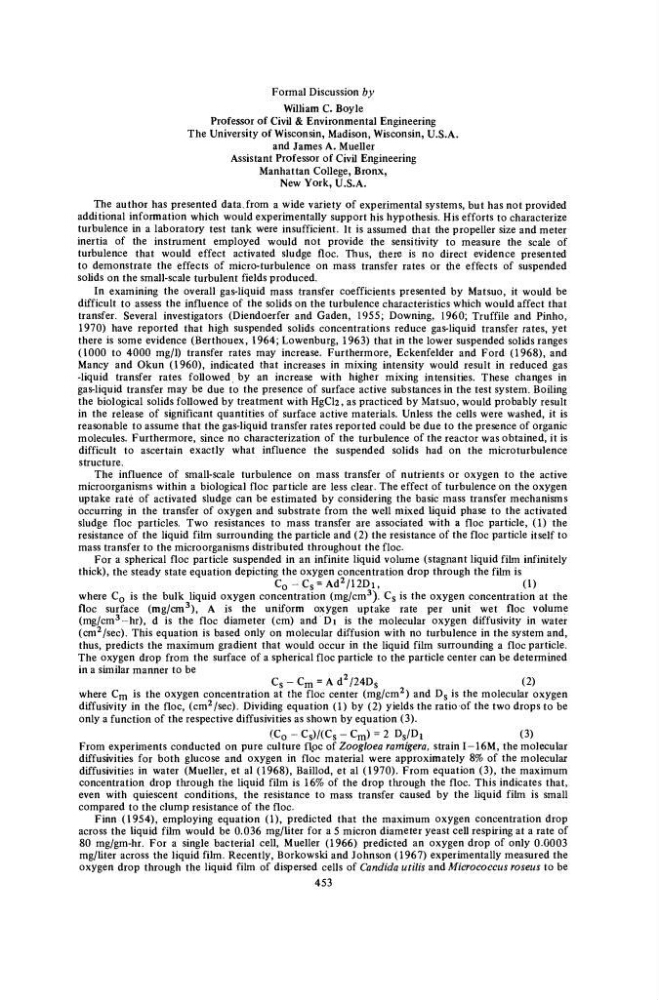
Formal Discussion by
William C. Boyle
Professor of Civil & Environmental Engineering
The University of Wisconsin, Madison, Wisconsin, U.S.A.
and James A. Mueller
Assistant Professor of Civil Engineering
Manhattan College, Bronx,
New York, U.S.A.
The author has presented data.from a wide variety of experimental systems, but has not provided
additional information which would experimentally support his hypothesis. His efforts to characterize
turbulence in a laboratory test tank were insufficient. It is assumed that the propeller size and meter
inertia of the instrument employed would not provide the sensitivity to measure the scale of
turbulence that would effect activated sludge floe. Thus, there is no direct evidence presented
to demonstrate the effects of micro-turbulence on mass transfer rates or the effects of suspended
solids on the small-scale turbulent fields produced.
In examining the overall gas-liquid mass transfer coefficients presented by Matsuo, it would be
difficult to assess the influence of the solids on the turbulence characteristics which would affect that
transfer. Several investigators (Diendoerfer and Gaden, 1955; Downing, 1960; Truffile and Pinho,
1970) have reported that high suspended solids concentrations reduce gas-liquid transfer rates, yet
there is some evidence (Berthouex, 1964; Lowenburg, 1963) that in the lower suspended solids ranges
(1000 to 4000 mg/1) transfer rates may increase. Furthermore, Eckenfelder and Ford (1968), and
Mancy and Okun (1960), indicated that increases in mixing intensity would result in reduced gas
-liquid transfer rates followed, by an increase with higher mixing intensities. These changes in
gas-liquid transfer may be due to the presence of surface active substances in the test system. Boiling
the biological solids followed by treatment with HgCh, as practiced by Matsuo, would probably result
in the release of significant quantities of surface active materials. Unless the cells were washed, it is
reasonable to assume that the gas-liquid transfer rates reported could be due to the presence of organic
molecules. Furthermore, since no characterization of the turbulence of the reactor was obtained, it is
difficult to ascertain exactly what influence the suspended solids had on the microturbulence
structure.
The influence of small-scale turbulence on mass transfer of nutrients or oxygen to the active
microorganisms within a biological floe particle are less clear. The effect of turbulence on the oxygen
uptake rate of activated sludge can be estimated by considering the basic mass transfer mechanisms
occurring in the transfer of oxygen and substrate from the well mixed liquid phase to the activated
sludge floe particles. Two resistances to mass transfer are associated with a floe particle, (1) the
resistance of the liquid film surrounding the particle and (2) the resistance of the floe particle itself to
mass transfer to the microorganisms distributed throughout the floe.
For a spherical floe particle suspended in an infinite liquid volume (stagnant liquid film infinitely
thick), the steady state equation depicting the oxygen concentration drop through the film is
C 0 - C ? = Ad
2 /12Di,
(1)
where C 0 is the bulk liquid oxygen concentration (mg/cm
3 ). C s is the oxygen concentration at the
floe surface (mg/cm
3 ), A is the uniform oxygen uptake rate per unit wet floe volume
(mg/cm
3 -hr), d is the floe diameter (cm) and Di is the molecular oxygen diffusivity in water
(cm
2 /sec). This equation is based only on molecular diffusion with no turbulence in the system and,
thus, predicts the maximum gradient that would occur in the liquid film surrounding a floe particle.
The oxygen drop from the surface of a spherical floe particle to the particle center can be determined
in a similar manner to be
C s -
C m = A d
2 /24D s
(2)
where C m is the oxygen concentration at the floe center (mg/cm
2 ) and D s is the molecular oxygen
diffusivity in the floe, (cm
2 /sec). Dividing equation (1) by (2) yields the ratio of the two drops to be
only a function of the respective diffusivities as shown by equation (3).
( C 0 - C s ) / ( C s - C m ) = 2 D s / D 1
(3)
From experiments conducted on pure culture flpc of Zoogloea ramigera, strain I-16M, the molecular
diffusivities for both glucose and oxygen in floe material were approximately 8% of the molecular
diffusivities in water (Mueller, et al (1968), Baillod, et al (1970). From equation (3), the maximum
concentration drop through the liquid film is 16% of the drop through the floe. This indicates that,
even with quiescent conditions, the resistance to mass transfer caused by the liquid film is small
compared to the clump resistance of the floe.
Finn (1954), employing equation (1), predicted that the maximum oxygen concentration drop
across the liquid film would be 0.036 mg/liter for a 5 micron diameter yeast cell respiring at a rate of
80 mg/gm-hr. For a single bacterial cell, Mueller (1966) predicted an oxygen drop of only 0.0003
mg/liter across the liquid film. Recently, Borkowski and Johnson (1967) experimentally measured the
oxygen drop through the liquid film of dispersed cells of Candida utilis and Micrococcus roseus to be
453
William C. Boyle
Professor of Civil & Environmental Engineering
The University of Wisconsin, Madison, Wisconsin, U.S.A.
and James A. Mueller
Assistant Professor of Civil Engineering
Manhattan College, Bronx,
New York, U.S.A.
The author has presented data.from a wide variety of experimental systems, but has not provided
additional information which would experimentally support his hypothesis. His efforts to characterize
turbulence in a laboratory test tank were insufficient. It is assumed that the propeller size and meter
inertia of the instrument employed would not provide the sensitivity to measure the scale of
turbulence that would effect activated sludge floe. Thus, there is no direct evidence presented
to demonstrate the effects of micro-turbulence on mass transfer rates or the effects of suspended
solids on the small-scale turbulent fields produced.
In examining the overall gas-liquid mass transfer coefficients presented by Matsuo, it would be
difficult to assess the influence of the solids on the turbulence characteristics which would affect that
transfer. Several investigators (Diendoerfer and Gaden, 1955; Downing, 1960; Truffile and Pinho,
1970) have reported that high suspended solids concentrations reduce gas-liquid transfer rates, yet
there is some evidence (Berthouex, 1964; Lowenburg, 1963) that in the lower suspended solids ranges
(1000 to 4000 mg/1) transfer rates may increase. Furthermore, Eckenfelder and Ford (1968), and
Mancy and Okun (1960), indicated that increases in mixing intensity would result in reduced gas
-liquid transfer rates followed, by an increase with higher mixing intensities. These changes in
gas-liquid transfer may be due to the presence of surface active substances in the test system. Boiling
the biological solids followed by treatment with HgCh, as practiced by Matsuo, would probably result
in the release of significant quantities of surface active materials. Unless the cells were washed, it is
reasonable to assume that the gas-liquid transfer rates reported could be due to the presence of organic
molecules. Furthermore, since no characterization of the turbulence of the reactor was obtained, it is
difficult to ascertain exactly what influence the suspended solids had on the microturbulence
structure.
The influence of small-scale turbulence on mass transfer of nutrients or oxygen to the active
microorganisms within a biological floe particle are less clear. The effect of turbulence on the oxygen
uptake rate of activated sludge can be estimated by considering the basic mass transfer mechanisms
occurring in the transfer of oxygen and substrate from the well mixed liquid phase to the activated
sludge floe particles. Two resistances to mass transfer are associated with a floe particle, (1) the
resistance of the liquid film surrounding the particle and (2) the resistance of the floe particle itself to
mass transfer to the microorganisms distributed throughout the floe.
For a spherical floe particle suspended in an infinite liquid volume (stagnant liquid film infinitely
thick), the steady state equation depicting the oxygen concentration drop through the film is
C 0 - C ? = Ad
2 /12Di,
(1)
where C 0 is the bulk liquid oxygen concentration (mg/cm
3 ). C s is the oxygen concentration at the
floe surface (mg/cm
3 ), A is the uniform oxygen uptake rate per unit wet floe volume
(mg/cm
3 -hr), d is the floe diameter (cm) and Di is the molecular oxygen diffusivity in water
(cm
2 /sec). This equation is based only on molecular diffusion with no turbulence in the system and,
thus, predicts the maximum gradient that would occur in the liquid film surrounding a floe particle.
The oxygen drop from the surface of a spherical floe particle to the particle center can be determined
in a similar manner to be
C s -
C m = A d
2 /24D s
(2)
where C m is the oxygen concentration at the floe center (mg/cm
2 ) and D s is the molecular oxygen
diffusivity in the floe, (cm
2 /sec). Dividing equation (1) by (2) yields the ratio of the two drops to be
only a function of the respective diffusivities as shown by equation (3).
( C 0 - C s ) / ( C s - C m ) = 2 D s / D 1
(3)
From experiments conducted on pure culture flpc of Zoogloea ramigera, strain I-16M, the molecular
diffusivities for both glucose and oxygen in floe material were approximately 8% of the molecular
diffusivities in water (Mueller, et al (1968), Baillod, et al (1970). From equation (3), the maximum
concentration drop through the liquid film is 16% of the drop through the floe. This indicates that,
even with quiescent conditions, the resistance to mass transfer caused by the liquid film is small
compared to the clump resistance of the floe.
Finn (1954), employing equation (1), predicted that the maximum oxygen concentration drop
across the liquid film would be 0.036 mg/liter for a 5 micron diameter yeast cell respiring at a rate of
80 mg/gm-hr. For a single bacterial cell, Mueller (1966) predicted an oxygen drop of only 0.0003
mg/liter across the liquid film. Recently, Borkowski and Johnson (1967) experimentally measured the
oxygen drop through the liquid film of dispersed cells of Candida utilis and Micrococcus roseus to be
453