

398
D.B. Cohen
Plant expansion costs based on conventional design parameters have been compared
with cost estimates for full scale pure oxygen system using 0 2 / 0 3 digestion of excess
sludge in place of the present method of aerobic digestion. If the estimated net savings
resulting from the new technology are amortized at 6% over ten years, the net savings to
the Metro Denver District exceed $700,000 per year.
A major emphasis of the large scale plant trial scheduled for 1972 will be the accurate
determination of benefit/cost ratios for each unit process affected by the new
technology.
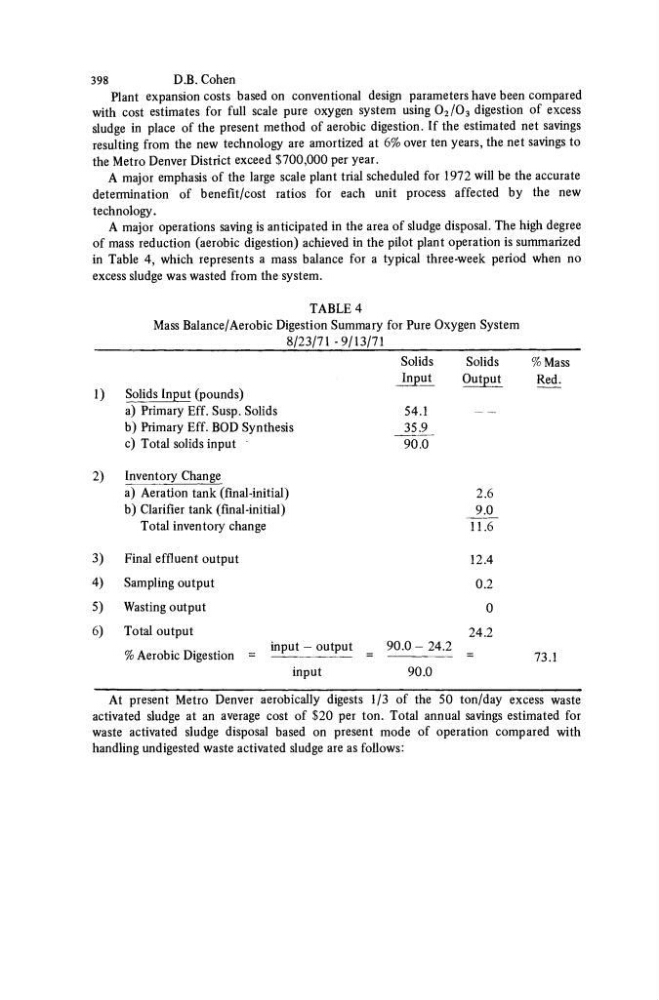
A major operations saving is anticipated in the area of sludge disposal. The high degree
of mass reduction (aerobic digestion) achieved in the pilot plant operation is summarized
in Table 4, which represents a mass balance for a typical three-week period when no
excess sludge was wasted from the system.
TABLE 4
Mass Balance/Aerobic Digestion Summary for Pure Oxygen System
8/23/71-9/13/71
1)
Solids Input (pounds)
a) Primary Eff. Susp. Solids
b) Primary Eff. BOD Synthesis
c) Total solids input
Solids
Input
54.1
35.9
90.0
Solids
Output
%Mass
Red.
2)
Inventory Change
a) Aeration tank (final-initial)
b) Clarifier tank (final-initial)
Total inventory change
2.6
9.0
11.6
3)
Final effluent output
4)
Sampling output
5)
Wasting output
6)
Total output
% Aerobic Digestion
input - output _ 90.0 - 24.2
input
90.0
12.4
0.2
0
24.2
73.1
At present Metro Denver aerobically digests 1/3 of the 50 ton/day excess waste
activated sludge at an average cost of $20 per ton. Total annual savings estimated for
waste activated sludge disposal based on present mode of operation compared with
handling undigested waste activated sludge are as follows:
D.B. Cohen
Plant expansion costs based on conventional design parameters have been compared
with cost estimates for full scale pure oxygen system using 0 2 / 0 3 digestion of excess
sludge in place of the present method of aerobic digestion. If the estimated net savings
resulting from the new technology are amortized at 6% over ten years, the net savings to
the Metro Denver District exceed $700,000 per year.
A major emphasis of the large scale plant trial scheduled for 1972 will be the accurate
determination of benefit/cost ratios for each unit process affected by the new
technology.
A major operations saving is anticipated in the area of sludge disposal. The high degree
of mass reduction (aerobic digestion) achieved in the pilot plant operation is summarized
in Table 4, which represents a mass balance for a typical three-week period when no
excess sludge was wasted from the system.
TABLE 4
Mass Balance/Aerobic Digestion Summary for Pure Oxygen System
8/23/71-9/13/71
1)
Solids Input (pounds)
a) Primary Eff. Susp. Solids
b) Primary Eff. BOD Synthesis
c) Total solids input
Solids
Input
54.1
35.9
90.0
Solids
Output
%Mass
Red.
2)
Inventory Change
a) Aeration tank (final-initial)
b) Clarifier tank (final-initial)
Total inventory change
2.6
9.0
11.6
3)
Final effluent output
4)
Sampling output
5)
Wasting output
6)
Total output
% Aerobic Digestion
input - output _ 90.0 - 24.2
input
90.0
12.4
0.2
0
24.2
73.1
At present Metro Denver aerobically digests 1/3 of the 50 ton/day excess waste
activated sludge at an average cost of $20 per ton. Total annual savings estimated for
waste activated sludge disposal based on present mode of operation compared with
handling undigested waste activated sludge are as follows: