

390
D.B. Cohen
production of about 30%, compared with the conventional operation. The savings
resulting from the reduced sludge production in · the "UNOX" system were most
significant, since they typically comprised 2/3 of the calculated total treatment cost
savings. For a 6 MGD plant total treatment cost savings were estimated by UNOX to be
between 10-25%, while for a 100 MGD plant, savings between 17-33% were estimated.
The increasing economies of scale were directly related to the price of oxygen which
ranged from $8/ton when more than 100 tons/day were used, to $30/ton for less than 10
tons/day.
A new "second generation" approach to the problem based on an "open" tank pure
oxygen technology has been conducted since March 1971 as a joint effort between the
Metropolitan Denver Sewage Disposal District No. 1 and Martin Marietta Company of
Denver, Colorado (M.M.C.). M.M.C. has developed a new type of diffuser capable of near
total oxygen transfer from the gaseous to the liquid state without the need for expensive
conversion of existing sewage treatment plants to hermetically sealed "respirometers".
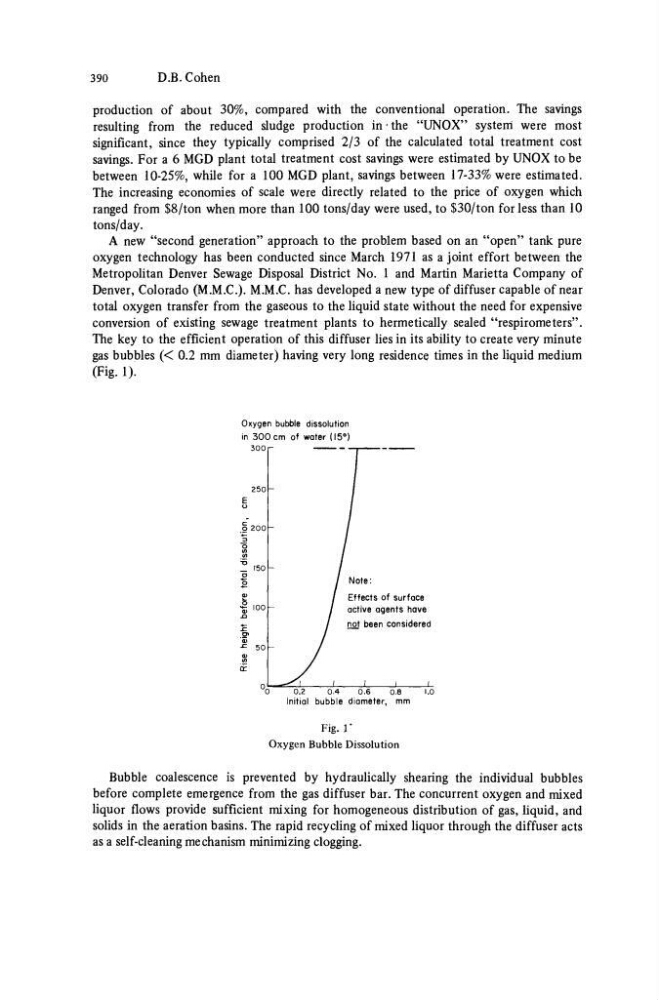
The key to the efficient operation of this diffuser lies in its ability to create very minute
gas bubbles (< 0.2 mm diameter) having very long residence times in the liquid medium
(Fig. 1).
Oxygen bubble dissolution
in 3 0 0 cm of water (15°)
300 r
0.2
0.4
0.6
0.8
Initial bubble diameter, mm
Fig. Γ
Oxygen Bubble Dissolution
Bubble coalescence is prevented by hydraulically shearing the individual bubbles
before complete emergence from the gas diffuser bar. The concurrent oxygen and mixed
liquor flows provide sufficient mixing for homogeneous distribution of gas, liquid, and
solids in the aeration basins. The rapid recycling of mixed liquor through the diffuser acts
as a self-cleaning mechanism minimizing clogging.
D.B. Cohen
production of about 30%, compared with the conventional operation. The savings
resulting from the reduced sludge production in · the "UNOX" system were most
significant, since they typically comprised 2/3 of the calculated total treatment cost
savings. For a 6 MGD plant total treatment cost savings were estimated by UNOX to be
between 10-25%, while for a 100 MGD plant, savings between 17-33% were estimated.
The increasing economies of scale were directly related to the price of oxygen which
ranged from $8/ton when more than 100 tons/day were used, to $30/ton for less than 10
tons/day.
A new "second generation" approach to the problem based on an "open" tank pure
oxygen technology has been conducted since March 1971 as a joint effort between the
Metropolitan Denver Sewage Disposal District No. 1 and Martin Marietta Company of
Denver, Colorado (M.M.C.). M.M.C. has developed a new type of diffuser capable of near
total oxygen transfer from the gaseous to the liquid state without the need for expensive
conversion of existing sewage treatment plants to hermetically sealed "respirometers".
The key to the efficient operation of this diffuser lies in its ability to create very minute
gas bubbles (< 0.2 mm diameter) having very long residence times in the liquid medium
(Fig. 1).
Oxygen bubble dissolution
in 3 0 0 cm of water (15°)
300 r
0.2
0.4
0.6
0.8
Initial bubble diameter, mm
Fig. Γ
Oxygen Bubble Dissolution
Bubble coalescence is prevented by hydraulically shearing the individual bubbles
before complete emergence from the gas diffuser bar. The concurrent oxygen and mixed
liquor flows provide sufficient mixing for homogeneous distribution of gas, liquid, and
solids in the aeration basins. The rapid recycling of mixed liquor through the diffuser acts
as a self-cleaning mechanism minimizing clogging.