

24
K.R. Imhoff and D. Albrecht
13
1.2
1.1
c 1.0
g
"Q.
o 0,9
(/)
D
o 0.8
Q
| 0.7
0>
* 0.6
0.5
0.4
0.
3
0
5
10
15
20
25
30
35
Water temperature [°C]
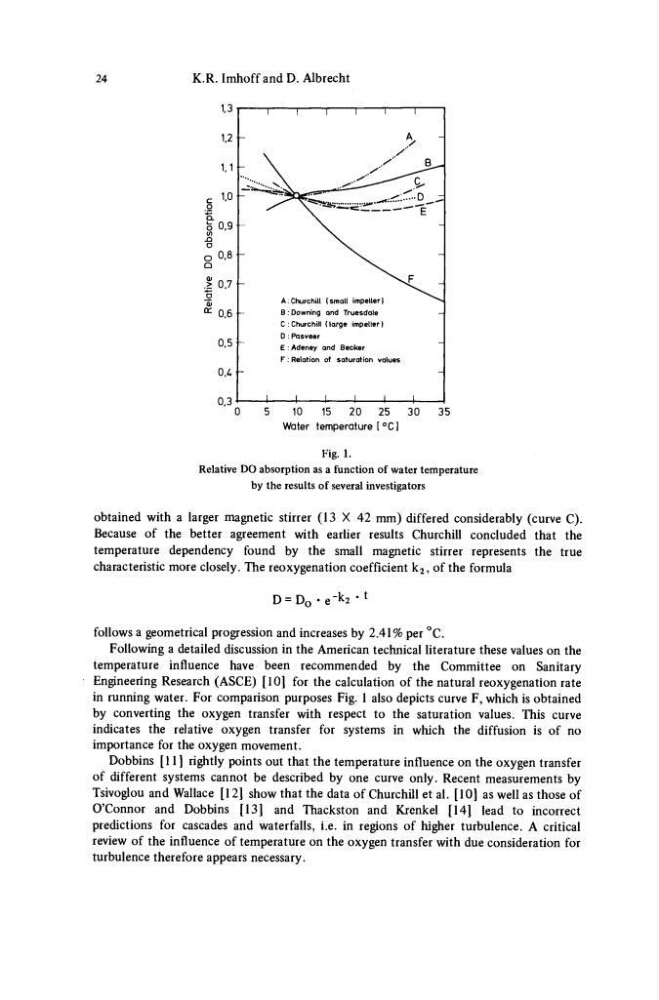
Fig. 1.
Relative DO absorption as a function of water temperature
by the results of several investigators
obtained with a larger magnetic stirrer (13 X 42 mm) differed considerably (curve C).
Because of the better agreement with earlier results Churchill concluded that the
temperature dependency found by the small magnetic stirrer represents the true
characteristic more closely. The reoxygenation coefficient k 2 , of the formula
D = D 0 -e"
k 2
e t
follows a geometrical progression and increases by 2.41% per °C.
Following a detailed discussion in the American technical literature these values on the
temperature influence have been recommended by the Committee on Sanitary
Engineering Research (ASCE) [10] for the calculation of the natural reoxygenation rate
in running water. For comparison purposes Fig. 1 also depicts curve F, which is obtained
by converting the oxygen transfer with respect to the saturation values. This curve
indicates the relative oxygen transfer for systems in which the diffusion is of no
importance for the oxygen movement.
Dobbins [11] rightly points out that the temperature influence on the oxygen transfer
of different systems cannot be described by one curve only. Recent measurements by
Tsivoglou and Wallace [12] show that the data of Churchill et al. [10] as well as those of
O'Connor and Dobbins [13] and Thackston and Krenkel [14] lead to incorrect
predictions for cascades and waterfalls, i.e. in regions of higher turbulence. A critical
review of the influence of temperature on the oxygen transfer with due consideration for
turbulence therefore appears necessary.
1
Γ
\
_ ^ > . . . > Λ
A
Γ
B
c
L
D
Γ
E
F
1
"Ί
1
1
1
/ '
s'
Churchill (small impeller)
Downing and Truesdale
Churchill (large impeller)
Pasveer
Adeney and Becker
Relation of saturation values
■J
1
1
1
B
^C
~~τΓ
sF
— I
J
\
■A
\
K.R. Imhoff and D. Albrecht
13
1.2
1.1
c 1.0
g
"Q.
o 0,9
(/)
D
o 0.8
Q
| 0.7
0>
* 0.6
0.5
0.4
0.
3
0
5
10
15
20
25
30
35
Water temperature [°C]
Fig. 1.
Relative DO absorption as a function of water temperature
by the results of several investigators
obtained with a larger magnetic stirrer (13 X 42 mm) differed considerably (curve C).
Because of the better agreement with earlier results Churchill concluded that the
temperature dependency found by the small magnetic stirrer represents the true
characteristic more closely. The reoxygenation coefficient k 2 , of the formula
D = D 0 -e"
k 2
e t
follows a geometrical progression and increases by 2.41% per °C.
Following a detailed discussion in the American technical literature these values on the
temperature influence have been recommended by the Committee on Sanitary
Engineering Research (ASCE) [10] for the calculation of the natural reoxygenation rate
in running water. For comparison purposes Fig. 1 also depicts curve F, which is obtained
by converting the oxygen transfer with respect to the saturation values. This curve
indicates the relative oxygen transfer for systems in which the diffusion is of no
importance for the oxygen movement.
Dobbins [11] rightly points out that the temperature influence on the oxygen transfer
of different systems cannot be described by one curve only. Recent measurements by
Tsivoglou and Wallace [12] show that the data of Churchill et al. [10] as well as those of
O'Connor and Dobbins [13] and Thackston and Krenkel [14] lead to incorrect
predictions for cascades and waterfalls, i.e. in regions of higher turbulence. A critical
review of the influence of temperature on the oxygen transfer with due consideration for
turbulence therefore appears necessary.
1
Γ
\
_ ^ > . . . > Λ
A
Γ
B
c
L
D
Γ
E
F
1
"Ί
1
1
1
/ '
s'
Churchill (small impeller)
Downing and Truesdale
Churchill (large impeller)
Pasveer
Adeney and Becker
Relation of saturation values
■J
1
1
1
B
^C
~~τΓ
sF
— I
J
\
■A
\