

354
D. Jenkins and D. Orhon
iii) sludge mass and viable cell number decay rates varied with growth rate,
have led the present authors to propose an alternate mechanism for contact stabilization
- i.e. that of growth/death rather than storage/metabolism. It is proposed that during
contact a rapid growth of microorganisms leads to an increase in activated sludge viable
fraction, followed by a death phase in stabilization which decreases the viable fraction.
While this postulate may appear to be merely the substitution of one explanation for
another, the results presented in this paper will show that this view of the process has
important implications for its design and performance.
THE KINETIC MODEL
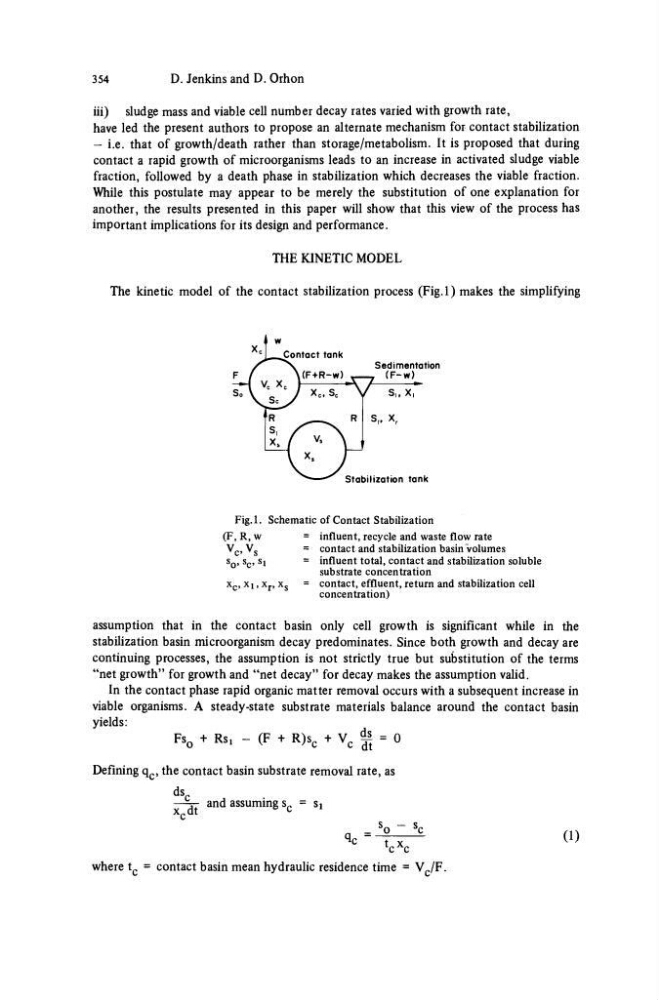
The kinetic model of the contact stabilization process (Fig.l) makes the simplifying
Sedimentation
( F - w )
Xc. s c * γ
s„ χΓ
Stabilization tank
Fig.l. Schematic of Contact Stabilization
(F, R, w
V V
c» s
SQ, Sc, S!
7Vf» ) Λ. 1 9 ^ T) ^C
influent, recycle and waste flow rate
contact and stabilization basin volumes
influent total, contact and stabilization soluble
substrate concentration
contact, effluent, return and stabilization cell
concentration)
assumption that in the contact basin only cell growth is significant while in the
stabilization basin microorganism decay predominates. Since both growth and decay are
continuing processes, the assumption is not strictly true but substitution of the terms
"net growth" for growth and "net decay" for decay makes the assumption valid.
In the contact phase rapid organic matter removal occurs with a subsequent increase in
viable organisms. A steady-state substrate materials balance around the contact basin
yields:
(F + R)s c + V c % = 0
Fs 0 + Rs,
Defining c^, the contact basin substrate removal rate, as
ds„
x c dt
and assuming s c = s t
«X° c t x
l c
x c
where t c = contact basin mean hydraulic residence time = V c /F.
(1)
D. Jenkins and D. Orhon
iii) sludge mass and viable cell number decay rates varied with growth rate,
have led the present authors to propose an alternate mechanism for contact stabilization
- i.e. that of growth/death rather than storage/metabolism. It is proposed that during
contact a rapid growth of microorganisms leads to an increase in activated sludge viable
fraction, followed by a death phase in stabilization which decreases the viable fraction.
While this postulate may appear to be merely the substitution of one explanation for
another, the results presented in this paper will show that this view of the process has
important implications for its design and performance.
THE KINETIC MODEL
The kinetic model of the contact stabilization process (Fig.l) makes the simplifying
Sedimentation
( F - w )
Xc. s c * γ
s„ χΓ
Stabilization tank
Fig.l. Schematic of Contact Stabilization
(F, R, w
V V
c» s
SQ, Sc, S!
7Vf» ) Λ. 1 9 ^ T) ^C
influent, recycle and waste flow rate
contact and stabilization basin volumes
influent total, contact and stabilization soluble
substrate concentration
contact, effluent, return and stabilization cell
concentration)
assumption that in the contact basin only cell growth is significant while in the
stabilization basin microorganism decay predominates. Since both growth and decay are
continuing processes, the assumption is not strictly true but substitution of the terms
"net growth" for growth and "net decay" for decay makes the assumption valid.
In the contact phase rapid organic matter removal occurs with a subsequent increase in
viable organisms. A steady-state substrate materials balance around the contact basin
yields:
(F + R)s c + V c % = 0
Fs 0 + Rs,
Defining c^, the contact basin substrate removal rate, as
ds„
x c dt
and assuming s c = s t
«X° c t x
l c
x c
where t c = contact basin mean hydraulic residence time = V c /F.
(1)