

Uncertainty in Interpreting Biological Growth Rates
349
4 times greater were predicted when steady-state entries were included in the
modelling of the raw carbon versus time data than when they were ignored.
(3) Steady-state data should be excluded from the modelling of the raw data for process
design.
(4) Biological reactor design should be based on a series of batch tests over a range of
microorganism levels bracketing the practical maximum level.
APPENDIX I
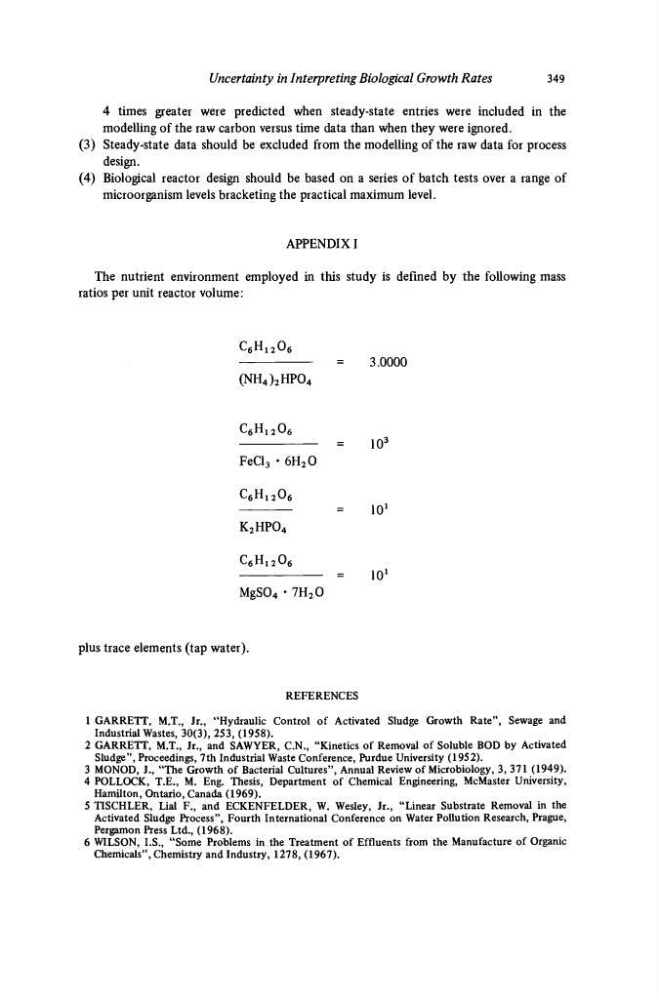
The nutrient environment employed in this study is defined by the following mass
ratios per unit reactor volume:
C 6 H 1 2 0 6
(NH 4 ) 2 HP0 4
CöHiaO«,
FeCl 3 · 6H 2 0
C 6 H 1 2 0 6
3.0000
K 2 HP0 4
C 6 H 1 2 0 6
10
3
10
1
10
1
MgS0 4 · 7H 2 0
plus trace elements (tap water).
REFERENCES
1 GARRETT, M.T., Jr., "Hydraulic Control of Activated Sludge Growth Rate", Sewage and
Industrial Wastes, 30(3), 253, (1958).
2 GARRETT, M.T., Jr., and SAWYER, C.N., "Kinetics of Removal of Soluble BOD by Activated
Sludge", Proceedings, 7th Industrial Waste Conference, Purdue University (1952).
3 MONOD, J., "The Growth of Bacterial Cultures", Annual Review of Microbiology, 3, 371 (1949).
4 POLLOCK, T.E., M. Eng. Thesis, Department of Chemical Engineering, McMaster University,
Hamilton, Ontario, Canada (1969).
5 TISCHLER, Lial F., and ECKENFELDER, W. Wesley, Jr., "Linear Substrate Removal in the
Activated Sludge Process", Fourth International Conference on Water Pollution Research, Prague,
Pergamon Press Ltd., (1968).
6 WILSON, I.S., "Some Problems in the Treatment of Effluents from the Manufacture of Organic
Chemicals", Chemistry and Industry, 1278, (1967).
349
4 times greater were predicted when steady-state entries were included in the
modelling of the raw carbon versus time data than when they were ignored.
(3) Steady-state data should be excluded from the modelling of the raw data for process
design.
(4) Biological reactor design should be based on a series of batch tests over a range of
microorganism levels bracketing the practical maximum level.
APPENDIX I
The nutrient environment employed in this study is defined by the following mass
ratios per unit reactor volume:
C 6 H 1 2 0 6
(NH 4 ) 2 HP0 4
CöHiaO«,
FeCl 3 · 6H 2 0
C 6 H 1 2 0 6
3.0000
K 2 HP0 4
C 6 H 1 2 0 6
10
3
10
1
10
1
MgS0 4 · 7H 2 0
plus trace elements (tap water).
REFERENCES
1 GARRETT, M.T., Jr., "Hydraulic Control of Activated Sludge Growth Rate", Sewage and
Industrial Wastes, 30(3), 253, (1958).
2 GARRETT, M.T., Jr., and SAWYER, C.N., "Kinetics of Removal of Soluble BOD by Activated
Sludge", Proceedings, 7th Industrial Waste Conference, Purdue University (1952).
3 MONOD, J., "The Growth of Bacterial Cultures", Annual Review of Microbiology, 3, 371 (1949).
4 POLLOCK, T.E., M. Eng. Thesis, Department of Chemical Engineering, McMaster University,
Hamilton, Ontario, Canada (1969).
5 TISCHLER, Lial F., and ECKENFELDER, W. Wesley, Jr., "Linear Substrate Removal in the
Activated Sludge Process", Fourth International Conference on Water Pollution Research, Prague,
Pergamon Press Ltd., (1968).
6 WILSON, I.S., "Some Problems in the Treatment of Effluents from the Manufacture of Organic
Chemicals", Chemistry and Industry, 1278, (1967).