

312
G. Söderlund
sewers constitutes a major source of pollution for the watercourses in USA (12), it is
interesting to note that the storm-water run-off contributes to the water pollution at least
the same extent as the mixed storm overflow (except as regards phosphorus). These
observations are based on the results in Table 1.
The contributions by two separate storms will be presented.
Individual storms
These two selected storms represent two different types of meteorological situations:
the first occurred after a very dry and hot summer, while the second was a moderate
rainfall at the end of October after a long rainy period. The first storm gave 25 mm,
divided between two heavy downpours and the second gave 8 mm, divided between three
showers.
As rainfall intensity flow in the storm-water sewers and concentrations of the
substances in the storm-water run-off were measured, factual data relating to these two
occasions can be presented.
Run-off coeffielen ts
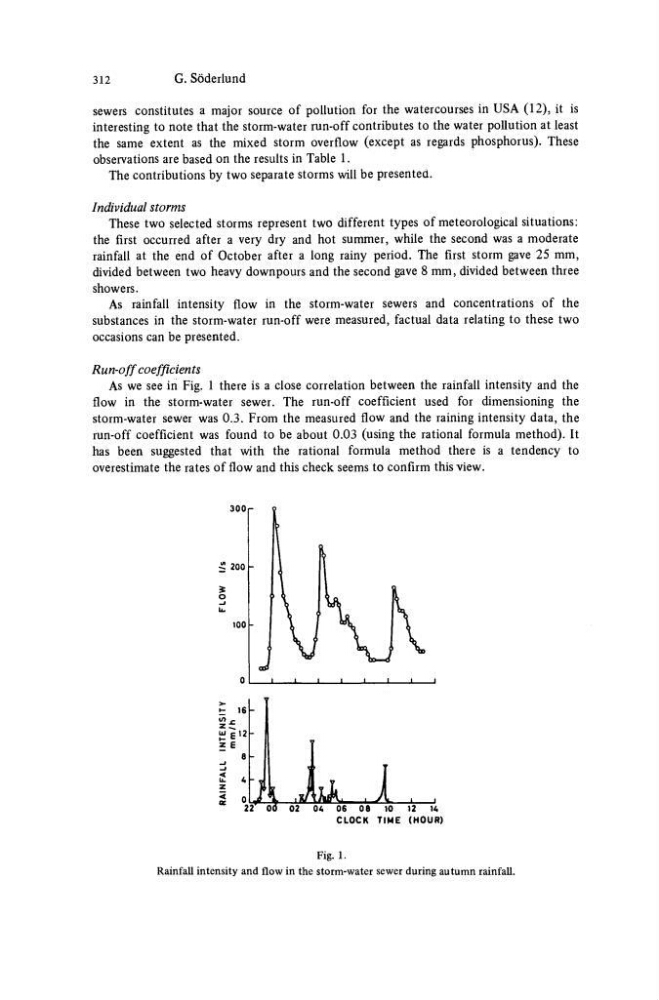
As we see in Fig. 1 there is a close correlation between the rainfall intensity and the
flow in the storm-water sewer. The run-off coefficient used for dimensioning the
storm-water sewer was 0.3. From the measured flow and the raining intensity data, the
run-off coefficient was found to be about 0.03 (using the rational formula method). It
has been suggested that with the rational formula method there is a tendency to
overestimate the rates of flow and this check seems to confirm this view.
300
^ 200
o
- I
u.
100
0
>■
ω ε 1 2
z E
8
_l
_l
2 «
Z
2 o
22 00 02 04 06 08
10 12 14
CLOCK TIME (HOUR)
Fig. 1.
Rainfall intensity and flow in the storm-water sewer during autumn rainfall.
A ,
G. Söderlund
sewers constitutes a major source of pollution for the watercourses in USA (12), it is
interesting to note that the storm-water run-off contributes to the water pollution at least
the same extent as the mixed storm overflow (except as regards phosphorus). These
observations are based on the results in Table 1.
The contributions by two separate storms will be presented.
Individual storms
These two selected storms represent two different types of meteorological situations:
the first occurred after a very dry and hot summer, while the second was a moderate
rainfall at the end of October after a long rainy period. The first storm gave 25 mm,
divided between two heavy downpours and the second gave 8 mm, divided between three
showers.
As rainfall intensity flow in the storm-water sewers and concentrations of the
substances in the storm-water run-off were measured, factual data relating to these two
occasions can be presented.
Run-off coeffielen ts
As we see in Fig. 1 there is a close correlation between the rainfall intensity and the
flow in the storm-water sewer. The run-off coefficient used for dimensioning the
storm-water sewer was 0.3. From the measured flow and the raining intensity data, the
run-off coefficient was found to be about 0.03 (using the rational formula method). It
has been suggested that with the rational formula method there is a tendency to
overestimate the rates of flow and this check seems to confirm this view.
300
^ 200
o
- I
u.
100
0
>■
ω ε 1 2
z E
8
_l
_l
2 «
Z
2 o
22 00 02 04 06 08
10 12 14
CLOCK TIME (HOUR)
Fig. 1.
Rainfall intensity and flow in the storm-water sewer during autumn rainfall.
A ,