

Self-Purification in Sewers
305
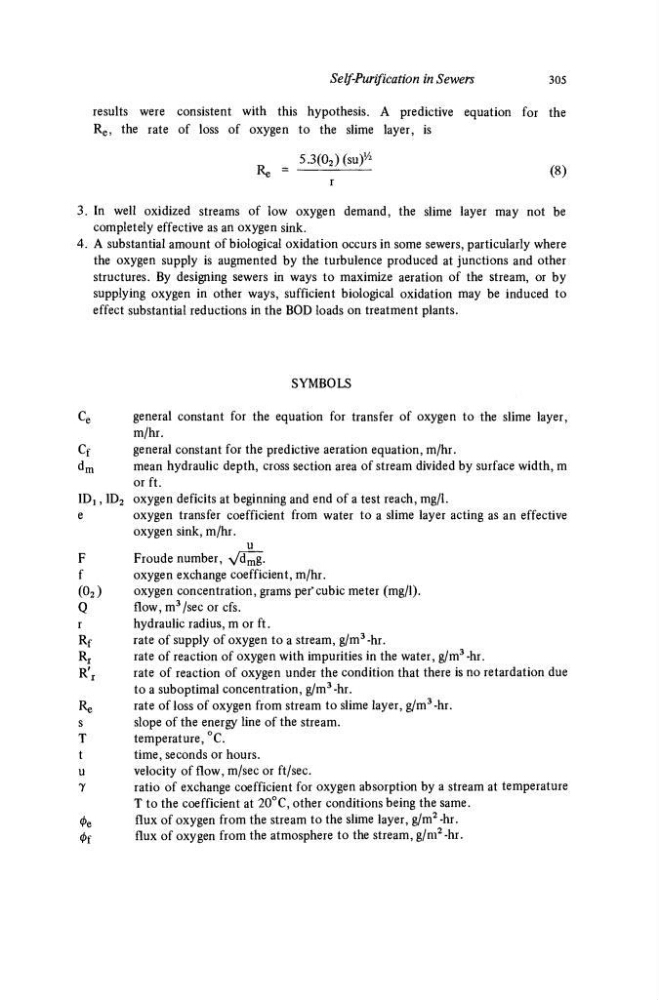
results were consistent with this hypothesis. A predictive equation for the
R e , the rate of loss of oxygen to the slime layer, is
, l^ilML
(8)
r
3. In well oxidized streams of low oxygen demand, the slime layer may not be
completely effective as an oxygen sink.
4. A substantial amount of biological oxidation occurs in some sewers, particularly where
the oxygen supply is augmented by the turbulence produced at junctions and other
structures. By designing sewers in ways to maximize aeration of the stream, or by
supplying oxygen in other ways, sufficient biological oxidation may be induced to
effect substantial reductions in the BOD loads on treatment plants.
SYMBOLS
C e
general constant for the equation for transfer of oxygen to the slime layer,
m/hr.
Cf
general constant for the predictive aeration equation, m/hr.
d m
mean hydraulic depth, cross section area of stream divided by surface width, m
or ft.
IDi, ID 2 oxygen deficits at beginning and end of a test reach, mg/1.
e
oxygen transfer coefficient from water to a slime layer acting as an effective
oxygen sink, m/hr.
u
F
Froude number, Vd m g·
f
oxygen exchange coefficient, m/hr.
(0 2 )
oxygen concentration, grams per*cubic meter (mg/1).
Q
flow, m
3 /sec or cfs.
r
hydraulic radius, m or ft.
Rf
rate of supply of oxygen to a stream, g/m
3 -hr.
R x
rate of reaction of oxygen with impurities in the water, g/m
3 -hr.
R' r
rate of reaction of oxygen under the condition that there is no retardation due
to a suboptimal concentration, g/m
3 -hr.
Re
rate of loss of oxygen from stream to slime layer, g/m
3 -hr.
s
slope of the energy line of the stream.
T
temperature, °C.
t
time, seconds or hours,
u
velocity of flow, m/sec or ft/sec.
7
ratio of exchange coefficient for oxygen absorption by a stream at temperature
T to the coefficient at 20°C, other conditions being the same.
0 e
flux of oxygen from the stream to the slime layer, g/m
2 -hr.
0 f
flux of oxygen from the atmosphere to the stream, g/m
2 -hr.
305
results were consistent with this hypothesis. A predictive equation for the
R e , the rate of loss of oxygen to the slime layer, is
, l^ilML
(8)
r
3. In well oxidized streams of low oxygen demand, the slime layer may not be
completely effective as an oxygen sink.
4. A substantial amount of biological oxidation occurs in some sewers, particularly where
the oxygen supply is augmented by the turbulence produced at junctions and other
structures. By designing sewers in ways to maximize aeration of the stream, or by
supplying oxygen in other ways, sufficient biological oxidation may be induced to
effect substantial reductions in the BOD loads on treatment plants.
SYMBOLS
C e
general constant for the equation for transfer of oxygen to the slime layer,
m/hr.
Cf
general constant for the predictive aeration equation, m/hr.
d m
mean hydraulic depth, cross section area of stream divided by surface width, m
or ft.
IDi, ID 2 oxygen deficits at beginning and end of a test reach, mg/1.
e
oxygen transfer coefficient from water to a slime layer acting as an effective
oxygen sink, m/hr.
u
F
Froude number, Vd m g·
f
oxygen exchange coefficient, m/hr.
(0 2 )
oxygen concentration, grams per*cubic meter (mg/1).
Q
flow, m
3 /sec or cfs.
r
hydraulic radius, m or ft.
Rf
rate of supply of oxygen to a stream, g/m
3 -hr.
R x
rate of reaction of oxygen with impurities in the water, g/m
3 -hr.
R' r
rate of reaction of oxygen under the condition that there is no retardation due
to a suboptimal concentration, g/m
3 -hr.
Re
rate of loss of oxygen from stream to slime layer, g/m
3 -hr.
s
slope of the energy line of the stream.
T
temperature, °C.
t
time, seconds or hours,
u
velocity of flow, m/sec or ft/sec.
7
ratio of exchange coefficient for oxygen absorption by a stream at temperature
T to the coefficient at 20°C, other conditions being the same.
0 e
flux of oxygen from the stream to the slime layer, g/m
2 -hr.
0 f
flux of oxygen from the atmosphere to the stream, g/m
2 -hr.