

282
D.K.B. Thistlethwayte and E.E. Goleb
sewage. The following refers directly to studies of sewer air components carried out in the
Public Health Engineering laboratories of the Civil Engineering School, University of New
South Wales, and in the field at selected sites in Eastern Australia, during the past three
years. The studies were undertaken partly because of this lack of direct data respecting
the realities, rather than the fancies, of this important environmental problem; partly as
an essential element of other studies concerned with techniques for the deodorization of
such air.
EXPERIMENTAL
Most of the work referred to here was carried out on samples drawn directly from the
air-way of one particular large outfall sewer of the Sydney (Australia) Sewerage System.
The Sampling Station was located at the mouth (intake) of an inverted siphon carrying a
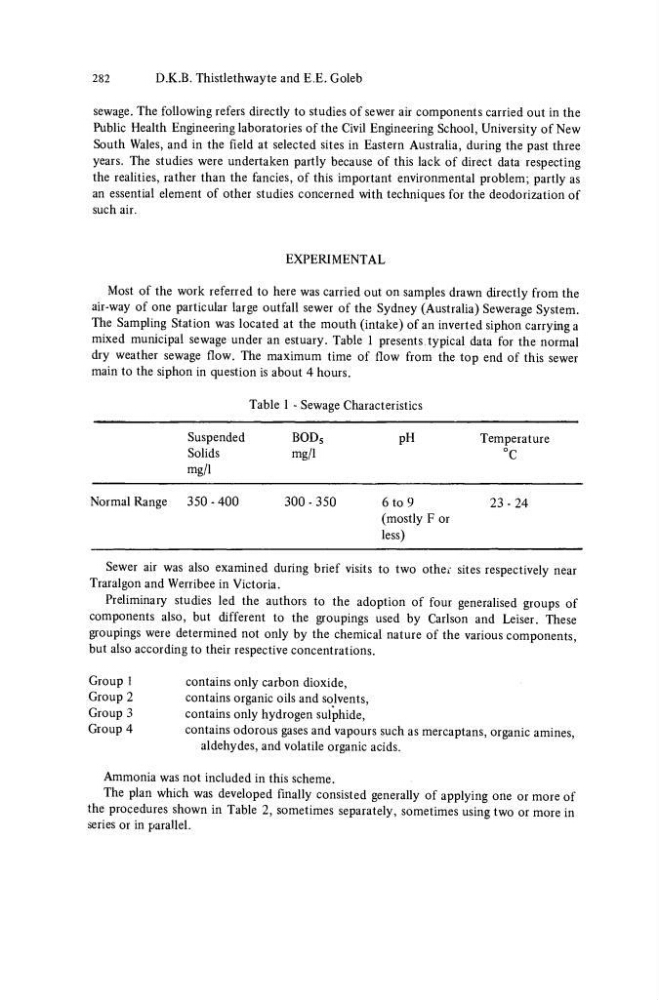
mixed municipal sewage under an estuary. Table 1 presents typical data for the normal
dry weather sewage flow. The maximum time of flow from the top end of this sewer
main to the siphon in question is about 4 hours.
Table 1 - Sewage Characteristics
Normal Range
Suspended
Solids
mg/1
350 - 400
BOD 5
mg/1
300 - 350
pH
6 to 9
(mostly F
less)
or
Temperature
°C
23-24
Sewer air was also examined during brief visits to two other sites respectively near
Traralgon and Werribee in Victoria.
Preliminary studies led the authors to the adoption of four generalised groups of
components also, but different to the groupings used by Carlson and Leiser. These
groupings were determined not only by the chemical nature of the various components,
but also according to their respective concentrations.
Group 1
contains only carbon dioxide,
Group 2
contains organic oils and solvents,
Group 3
contains only hydrogen sulphide,
Group 4
contains odorous gases and vapours such as mercaptans, organic amines,
aldehydes, and volatile organic acids.
Ammonia was not included in this scheme.
The plan which was developed finally consisted generally of applying one or more of
the procedures shown in Table 2, sometimes separately, sometimes using two or more in
series or in parallel.
D.K.B. Thistlethwayte and E.E. Goleb
sewage. The following refers directly to studies of sewer air components carried out in the
Public Health Engineering laboratories of the Civil Engineering School, University of New
South Wales, and in the field at selected sites in Eastern Australia, during the past three
years. The studies were undertaken partly because of this lack of direct data respecting
the realities, rather than the fancies, of this important environmental problem; partly as
an essential element of other studies concerned with techniques for the deodorization of
such air.
EXPERIMENTAL
Most of the work referred to here was carried out on samples drawn directly from the
air-way of one particular large outfall sewer of the Sydney (Australia) Sewerage System.
The Sampling Station was located at the mouth (intake) of an inverted siphon carrying a
mixed municipal sewage under an estuary. Table 1 presents typical data for the normal
dry weather sewage flow. The maximum time of flow from the top end of this sewer
main to the siphon in question is about 4 hours.
Table 1 - Sewage Characteristics
Normal Range
Suspended
Solids
mg/1
350 - 400
BOD 5
mg/1
300 - 350
pH
6 to 9
(mostly F
less)
or
Temperature
°C
23-24
Sewer air was also examined during brief visits to two other sites respectively near
Traralgon and Werribee in Victoria.
Preliminary studies led the authors to the adoption of four generalised groups of
components also, but different to the groupings used by Carlson and Leiser. These
groupings were determined not only by the chemical nature of the various components,
but also according to their respective concentrations.
Group 1
contains only carbon dioxide,
Group 2
contains organic oils and solvents,
Group 3
contains only hydrogen sulphide,
Group 4
contains odorous gases and vapours such as mercaptans, organic amines,
aldehydes, and volatile organic acids.
Ammonia was not included in this scheme.
The plan which was developed finally consisted generally of applying one or more of
the procedures shown in Table 2, sometimes separately, sometimes using two or more in
series or in parallel.