

Discussion by Nathan Buras, Ph.D., Associate Professor
The Lowdermilk Faculty of Agricultural Engineering
Technion - Israel Institute of Technology, Haifa, Israel.
This paper addresses itself to the general problem of water quality management in streams. The
important observation is made that uncertainties in the natural components of the system (e.g.,
hydrological uncertainty) give rise to non-steady (or irregular) boundary conditions of the stream flow
phenomena. When analyzing these phenomena, the authors indicate two possible courses of action:
either consider fixed channel boundaries and route through them stochastic hydrologic processes; or
consider the stream flow to transcend the boundaries of the riverbed so as to extend into the zone of
subsurface flow adjacent to the stream. The thrust of the paper is in the direction of the second
alternative.
The basic assumption is that analogous to the effluent and influent behaviour of streams in relation
to adjacent aquifers, pollutants carried by the streamflow behave in a similar manner. Observations
carried out along a stretch of approximately 4.5 km on river Yodo in Japan indicate that, in general,
there is a decrease in the direction of flow of both discharge and pollutant. In order to eliminate the
effect of degradation within the stretch, the pollutant measured was Cl". The results of these
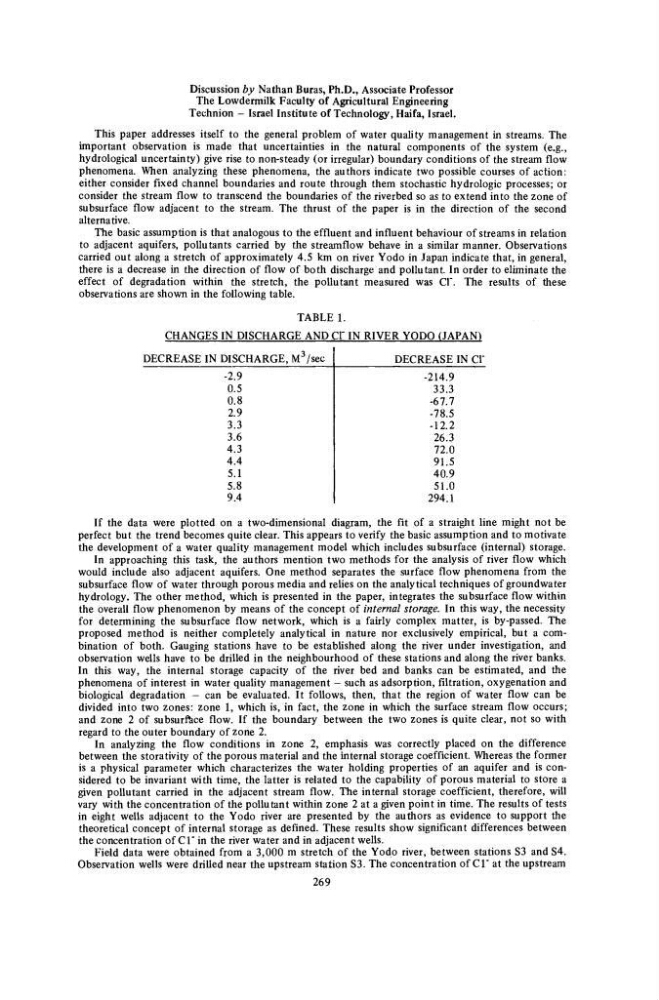
observations are shown in the following table.
TABLE 1.
CHANGES IN DISCHARGE AND Cl" IN RIVER YODO (JAPAN)
DECREASE IN DISCHARGE, M
3
/sec
-2.9
0.5
0.8
2.9
3.3
3.6
4.3
4.4
5.1
5.8
9.4
DECREASE IN Cl"
-214.9
33.3
-67.7
-78.5
-12.2
26.3
72.0
91.5
40.9
51.0
294.1
If the data were plotted on a two-dimensional diagram, the fit of a straight line might not be
perfect but the trend becomes quite clear. This appears to verify the basic assumption and to motivate
the development of a water quality management model which includes subsurface (internal) storage.
In approaching this task, the authors mention two methods for the analysis of river flow which
would include also adjacent aquifers. One method separates the surface flow phenomena from the
subsurface flow of water through porous media and relies on the analytical techniques of groundwater
hydrology. The other method, which is presented in the paper, integrates the subsurface flow within
the overall flow phenomenon by means of the concept of internal storage. In this way, the necessity
for determining the subsurface flow network, which is a fairly complex matter, is by-passed. The
proposed method is neither completely analytical in nature nor exclusively empirical, but a combination of both. Gauging stations have to be established along the river under investigation, and
observation wells have to be drilled in the neighbourhood of these stations and along the river banks.
In this way, the internal storage capacity of the river bed and banks can be estimated, and the
phenomena of interest in water quality management - such as adsorption, filtration, oxygenation and
biological degradation - can be evaluated. It follows, then, that the region of water flow can be
divided into two zones: zone 1, which is, in fact, the zone in which the surface stream flow occurs;
and zone 2 of subsurface flow. If the boundary between the two zones is quite clear, not so with
regard to the outer boundary of zone 2.
In analyzing the flow conditions in zone 2, emphasis was correctly placed on the difference
between the storativity of the porous material and the internal storage coefficient. Whereas the former
is a physical parameter which characterizes the water holding properties of an aquifer and is considered to be invariant with time, the latter is related to the capability of porous material to store a
given pollutant carried in the adjacent stream flow. The internal storage coefficient, therefore, will
vary with the concentration of the pollutant within zone 2 at a given point in time. The results of tests
in eight wells adjacent to the Yodo river are presented by the authors as evidence to support the
theoretical concept of internal storage as defined. These results show significant differences between
the concentration of Cl" in the river water and in adjacent wells.
Field data were obtained from a 3,000 m stretch of the Yodo river, between stations S3 and S4.
Observation wells were drilled near the upstream station S3. The concentration of Cl" at the upstream
269
The Lowdermilk Faculty of Agricultural Engineering
Technion - Israel Institute of Technology, Haifa, Israel.
This paper addresses itself to the general problem of water quality management in streams. The
important observation is made that uncertainties in the natural components of the system (e.g.,
hydrological uncertainty) give rise to non-steady (or irregular) boundary conditions of the stream flow
phenomena. When analyzing these phenomena, the authors indicate two possible courses of action:
either consider fixed channel boundaries and route through them stochastic hydrologic processes; or
consider the stream flow to transcend the boundaries of the riverbed so as to extend into the zone of
subsurface flow adjacent to the stream. The thrust of the paper is in the direction of the second
alternative.
The basic assumption is that analogous to the effluent and influent behaviour of streams in relation
to adjacent aquifers, pollutants carried by the streamflow behave in a similar manner. Observations
carried out along a stretch of approximately 4.5 km on river Yodo in Japan indicate that, in general,
there is a decrease in the direction of flow of both discharge and pollutant. In order to eliminate the
effect of degradation within the stretch, the pollutant measured was Cl". The results of these
observations are shown in the following table.
TABLE 1.
CHANGES IN DISCHARGE AND Cl" IN RIVER YODO (JAPAN)
DECREASE IN DISCHARGE, M
3
/sec
-2.9
0.5
0.8
2.9
3.3
3.6
4.3
4.4
5.1
5.8
9.4
DECREASE IN Cl"
-214.9
33.3
-67.7
-78.5
-12.2
26.3
72.0
91.5
40.9
51.0
294.1
If the data were plotted on a two-dimensional diagram, the fit of a straight line might not be
perfect but the trend becomes quite clear. This appears to verify the basic assumption and to motivate
the development of a water quality management model which includes subsurface (internal) storage.
In approaching this task, the authors mention two methods for the analysis of river flow which
would include also adjacent aquifers. One method separates the surface flow phenomena from the
subsurface flow of water through porous media and relies on the analytical techniques of groundwater
hydrology. The other method, which is presented in the paper, integrates the subsurface flow within
the overall flow phenomenon by means of the concept of internal storage. In this way, the necessity
for determining the subsurface flow network, which is a fairly complex matter, is by-passed. The
proposed method is neither completely analytical in nature nor exclusively empirical, but a combination of both. Gauging stations have to be established along the river under investigation, and
observation wells have to be drilled in the neighbourhood of these stations and along the river banks.
In this way, the internal storage capacity of the river bed and banks can be estimated, and the
phenomena of interest in water quality management - such as adsorption, filtration, oxygenation and
biological degradation - can be evaluated. It follows, then, that the region of water flow can be
divided into two zones: zone 1, which is, in fact, the zone in which the surface stream flow occurs;
and zone 2 of subsurface flow. If the boundary between the two zones is quite clear, not so with
regard to the outer boundary of zone 2.
In analyzing the flow conditions in zone 2, emphasis was correctly placed on the difference
between the storativity of the porous material and the internal storage coefficient. Whereas the former
is a physical parameter which characterizes the water holding properties of an aquifer and is considered to be invariant with time, the latter is related to the capability of porous material to store a
given pollutant carried in the adjacent stream flow. The internal storage coefficient, therefore, will
vary with the concentration of the pollutant within zone 2 at a given point in time. The results of tests
in eight wells adjacent to the Yodo river are presented by the authors as evidence to support the
theoretical concept of internal storage as defined. These results show significant differences between
the concentration of Cl" in the river water and in adjacent wells.
Field data were obtained from a 3,000 m stretch of the Yodo river, between stations S3 and S4.
Observation wells were drilled near the upstream station S3. The concentration of Cl" at the upstream
269