

A More Practice-Oriented
Ecosystem Simulation for
Water Pollution Research
Discussion by Walter F. J. Niemitzf
In the Federal Republic of Germany, the central problem associated with the pollution of rivers
and streams is drinking water supply depends upon surface water as a source to an increasing extent.
Preferentially, water is drawn from rivers with a low velocity and comparatively high volume of flow.
In rivers of this type, the processes decisive for self-purification and the metabolism of hazardous
substances take place in the flowing wave rather than at their bottom or banks.
If for experimental purposes, the conditions in such rivers are to be simulated on a technical scale,
it will of course be necessary to arrive at a compromise between the natural depth of such major rivers
which may be 2-3 m or even more and a minimal depth required to keep the influence of channel
bottom and walls within reasonable limits. It is interesting that the depth proposed by SANDERS and
FALCO
3 , namely 0.60 m, is exactly the same" as the one that has been proposed, some years ago,
for an artificial receiving water channel within a technical test field to be set up at Berlin-Marienfelde
for the Institute of Water, Soil, and Air Hygiene, Berlin-Dahlem.
In contrast to the simulator designed by the authors, which is more oriented towards applied basic
research, experiments to be performed at the Berlin-Marienfelde test field will be more practiceoriented. On account of the different objectives a brief outline is given of the design of the test field
and in particular, of the channel, to provide a basis for discussion.
The test field which has a size of approximately 3.5 hectares is close to a municipal sewage
treatment plant with a daily throughput capacity of 250,000 m
3 . The plant is designed for
mechanical/biological treatment of sewage up to a BOD 5 of about 15 mg/1. Although the sewage
contains a considerable proportion of industrial sewage, it is representative of municipal sewage.
Through separate pipes, raw sewage, mechanically treated, biologically purified and if required also
sewage from experimental plants operated on the test field may be introduced into the simulated
receiving water.
8
20 m
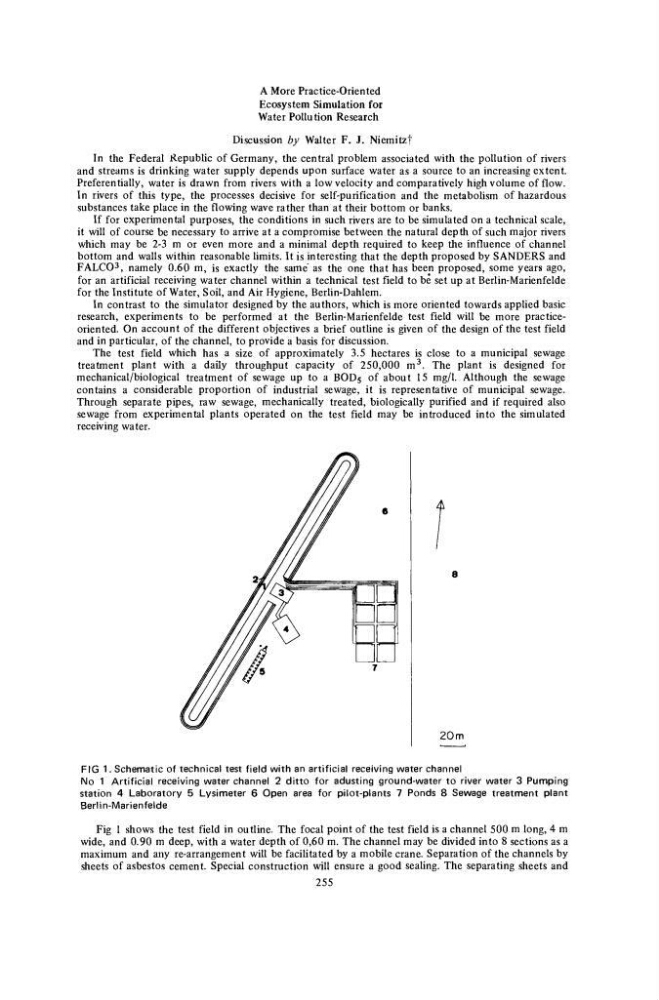
FIG 1. Schematic of technical test field with an artificial receiving water channel
No 1 Artificial receiving water channel 2 ditto for adusting ground-water to river water 3 Pumping
station 4 Laboratory 5 Lysimeter 6 Open area for pilot-plants 7 Ponds 8 Sewage treatment plant
Berlin-Marienfelde
Fig 1 shows the test field in outline. The focal point of the test field is a channel 500 m long, 4 m
wide, and 0.90 m deep, with a water depth of 0,60 m. The channel may be divided into 8 sections as a
maximum and any re-arrangement will be facilitated by a mobile crane. Separation of the channels by
sheets of asbestos cement. Special construction will ensure a good sealing. The separating sheets and
255
Ecosystem Simulation for
Water Pollution Research
Discussion by Walter F. J. Niemitzf
In the Federal Republic of Germany, the central problem associated with the pollution of rivers
and streams is drinking water supply depends upon surface water as a source to an increasing extent.
Preferentially, water is drawn from rivers with a low velocity and comparatively high volume of flow.
In rivers of this type, the processes decisive for self-purification and the metabolism of hazardous
substances take place in the flowing wave rather than at their bottom or banks.
If for experimental purposes, the conditions in such rivers are to be simulated on a technical scale,
it will of course be necessary to arrive at a compromise between the natural depth of such major rivers
which may be 2-3 m or even more and a minimal depth required to keep the influence of channel
bottom and walls within reasonable limits. It is interesting that the depth proposed by SANDERS and
FALCO
3 , namely 0.60 m, is exactly the same" as the one that has been proposed, some years ago,
for an artificial receiving water channel within a technical test field to be set up at Berlin-Marienfelde
for the Institute of Water, Soil, and Air Hygiene, Berlin-Dahlem.
In contrast to the simulator designed by the authors, which is more oriented towards applied basic
research, experiments to be performed at the Berlin-Marienfelde test field will be more practiceoriented. On account of the different objectives a brief outline is given of the design of the test field
and in particular, of the channel, to provide a basis for discussion.
The test field which has a size of approximately 3.5 hectares is close to a municipal sewage
treatment plant with a daily throughput capacity of 250,000 m
3 . The plant is designed for
mechanical/biological treatment of sewage up to a BOD 5 of about 15 mg/1. Although the sewage
contains a considerable proportion of industrial sewage, it is representative of municipal sewage.
Through separate pipes, raw sewage, mechanically treated, biologically purified and if required also
sewage from experimental plants operated on the test field may be introduced into the simulated
receiving water.
8
20 m
FIG 1. Schematic of technical test field with an artificial receiving water channel
No 1 Artificial receiving water channel 2 ditto for adusting ground-water to river water 3 Pumping
station 4 Laboratory 5 Lysimeter 6 Open area for pilot-plants 7 Ponds 8 Sewage treatment plant
Berlin-Marienfelde
Fig 1 shows the test field in outline. The focal point of the test field is a channel 500 m long, 4 m
wide, and 0.90 m deep, with a water depth of 0,60 m. The channel may be divided into 8 sections as a
maximum and any re-arrangement will be facilitated by a mobile crane. Separation of the channels by
sheets of asbestos cement. Special construction will ensure a good sealing. The separating sheets and
255