

248
W.M. Sanders III and J.W. Falco
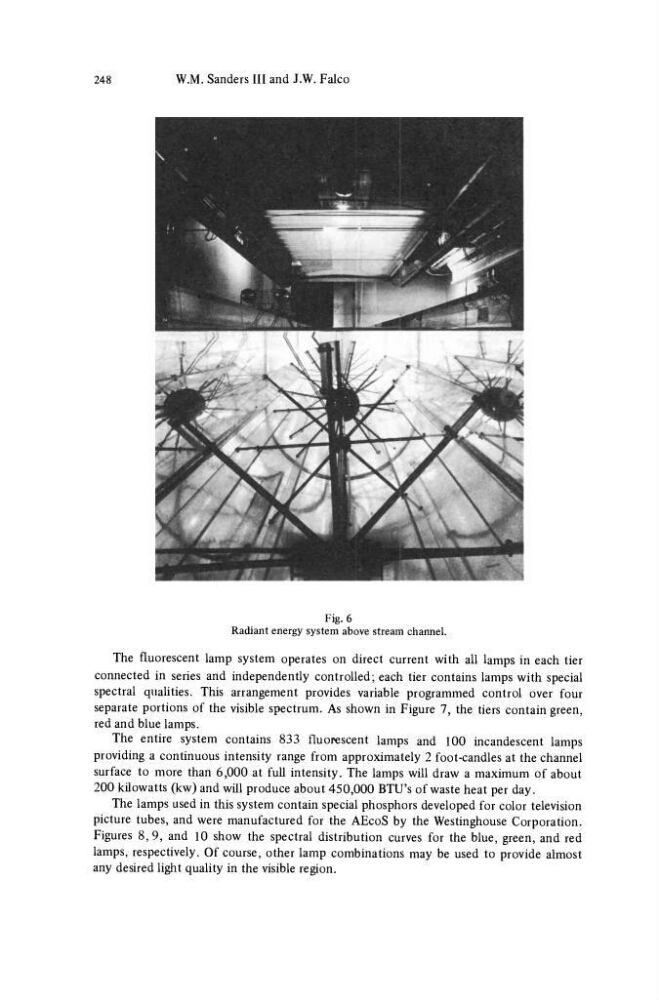
Fig. 6
Radiant energy system above stream channel.
The fluorescent lamp system operates on direct current with all lamps in each tier
connected in series and independently controlled; each tier contains lamps with special
spectral qualities. This arrangement provides variable programmed control over four
separate portions of the visible spectrum. As shown in Figure 7, the tiers contain green,
red and blue lamps.
The entire system contains 833 fluorescent lamps and 100 incandescent lamps
providing a continuous intensity range from approximately 2 foot-candles at the channel
surface to more than 6,000 at full intensity. The lamps will draw a maximum of about
200 kilowatts (kw) and will produce about 450,000 BTU's of waste heat per day.
The lamps used in this system contain special phosphors developed for color television
picture tubes, and were manufactured for the AEcoS by the Westinghouse Corporation.
Figures 8,9, and 10 show the spectral distribution curves for the blue, green, and red
lamps, respectively. Of course, other lamp combinations may be used to provide almost
any desired light quality in the visible region.
W.M. Sanders III and J.W. Falco
Fig. 6
Radiant energy system above stream channel.
The fluorescent lamp system operates on direct current with all lamps in each tier
connected in series and independently controlled; each tier contains lamps with special
spectral qualities. This arrangement provides variable programmed control over four
separate portions of the visible spectrum. As shown in Figure 7, the tiers contain green,
red and blue lamps.
The entire system contains 833 fluorescent lamps and 100 incandescent lamps
providing a continuous intensity range from approximately 2 foot-candles at the channel
surface to more than 6,000 at full intensity. The lamps will draw a maximum of about
200 kilowatts (kw) and will produce about 450,000 BTU's of waste heat per day.
The lamps used in this system contain special phosphors developed for color television
picture tubes, and were manufactured for the AEcoS by the Westinghouse Corporation.
Figures 8,9, and 10 show the spectral distribution curves for the blue, green, and red
lamps, respectively. Of course, other lamp combinations may be used to provide almost
any desired light quality in the visible region.