

Eu trophication in Jamaica Bay
237
summer-autumn data appear to indicate a less efficient population (as in Fig.l).
The decline of phytoplankton densities with the onset of summer and increased
temperatures did not correlate with turbidity levels. In fact the latter were lowest in late
autumn and early winter at times when the phytoplankton populations were increasing to
maximum values. This led to the hypothesis that heterotrophic activity is principally
responsible for low transparencies during the critical recreational period of June through
August, although other factors may prevail. The relatively high Zooplankton biomass
concentrations of two to six mg/£ during the summer compared to characteristic
phytoplankton densities of 0.1 to 0.5 mg/ß during this same period support this
hypothesis. Furthermore, present rates of BOD discharge to Jamaica Bay are relatively
high, being about 14 lbs. per acre per day (16 kg per hectare per day), and these
discharges are suspected to represent the basic cause of low transparency due to the
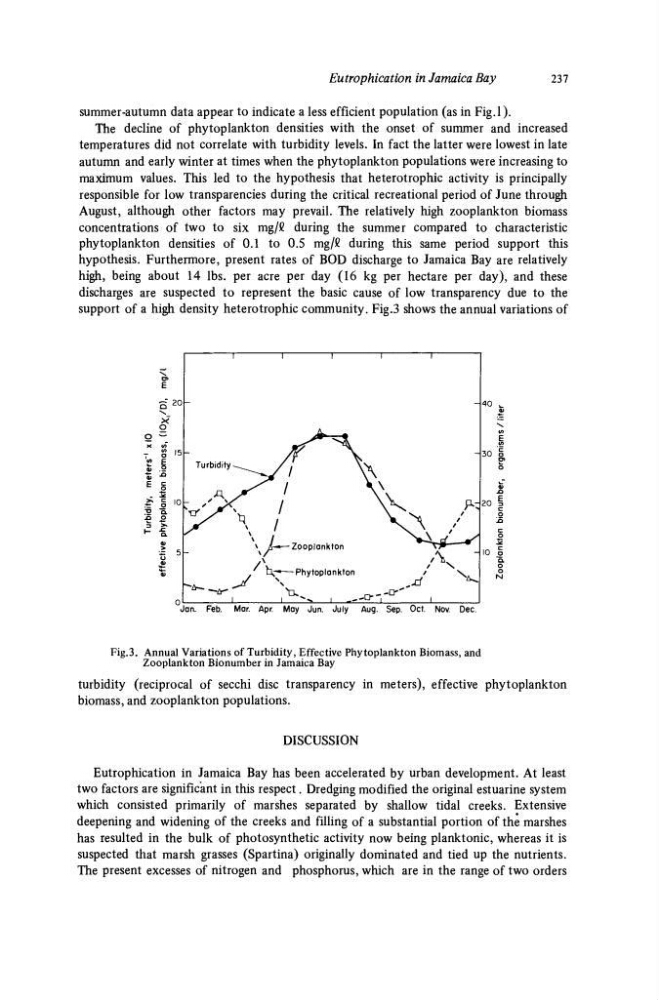
support of a high density heterotrophic community. Fig.3 shows the annual variations of
Jan. Feb. Mar. Apr. May Jun. July
Aug. Sep. Oct. Nov. Dec.
Fig.3. Annual Variations of Turbidity, Effective Phytoplankton Biomass, and
Zooplankton Bionumber in Jamaica Bay
turbidity (reciprocal of secchi disc transparency in meters), effective phytoplankton
biomass, and Zooplankton populations.
DISCUSSION
Eutrophication in Jamaica Bay has been accelerated by urban development. At least
two factors are significant in this respect. Dredging modified the original estuarine system
which consisted primarily of marshes separated by shallow tidal creeks. Extensive
deepening and widening of the creeks and filling of a substantial portion of the marshes
has resulted in the bulk of photosynthetic activity now being planktonic, whereas it is
suspected that marsh grasses (Spartina) originally dominated and tied up the nutrients.
The present excesses of nitrogen and phosphorus, which are in the range of two orders
237
summer-autumn data appear to indicate a less efficient population (as in Fig.l).
The decline of phytoplankton densities with the onset of summer and increased
temperatures did not correlate with turbidity levels. In fact the latter were lowest in late
autumn and early winter at times when the phytoplankton populations were increasing to
maximum values. This led to the hypothesis that heterotrophic activity is principally
responsible for low transparencies during the critical recreational period of June through
August, although other factors may prevail. The relatively high Zooplankton biomass
concentrations of two to six mg/£ during the summer compared to characteristic
phytoplankton densities of 0.1 to 0.5 mg/ß during this same period support this
hypothesis. Furthermore, present rates of BOD discharge to Jamaica Bay are relatively
high, being about 14 lbs. per acre per day (16 kg per hectare per day), and these
discharges are suspected to represent the basic cause of low transparency due to the
support of a high density heterotrophic community. Fig.3 shows the annual variations of
Jan. Feb. Mar. Apr. May Jun. July
Aug. Sep. Oct. Nov. Dec.
Fig.3. Annual Variations of Turbidity, Effective Phytoplankton Biomass, and
Zooplankton Bionumber in Jamaica Bay
turbidity (reciprocal of secchi disc transparency in meters), effective phytoplankton
biomass, and Zooplankton populations.
DISCUSSION
Eutrophication in Jamaica Bay has been accelerated by urban development. At least
two factors are significant in this respect. Dredging modified the original estuarine system
which consisted primarily of marshes separated by shallow tidal creeks. Extensive
deepening and widening of the creeks and filling of a substantial portion of the marshes
has resulted in the bulk of photosynthetic activity now being planktonic, whereas it is
suspected that marsh grasses (Spartina) originally dominated and tied up the nutrients.
The present excesses of nitrogen and phosphorus, which are in the range of two orders