

Eutrophication in Jamaica Bay
233
ANALYSIS
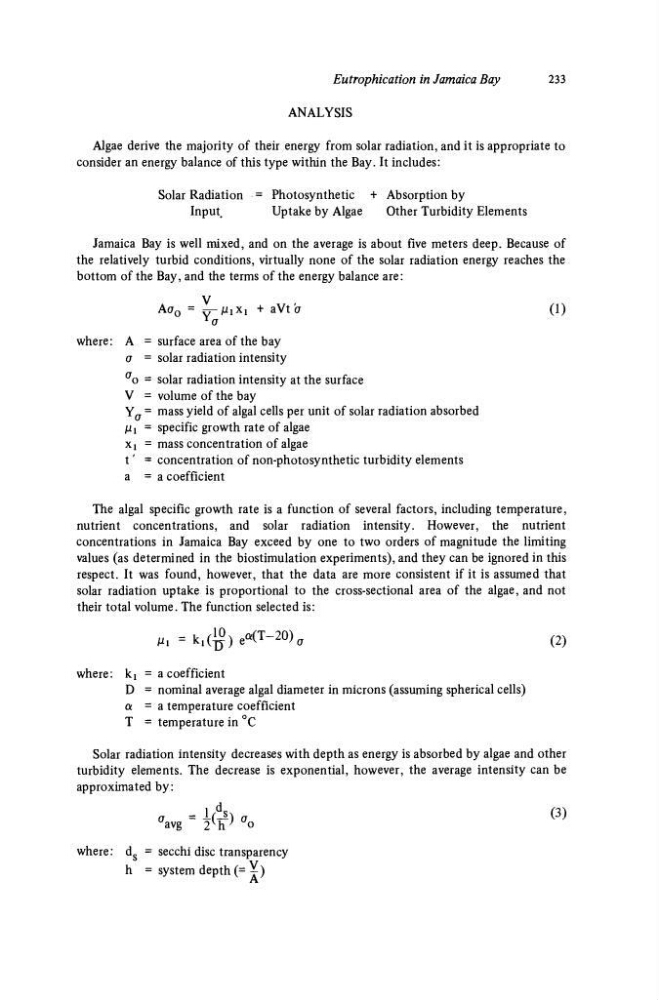
Algae derive the majority of their energy from solar radiation, and it is appropriate to
consider an energy balance of this type within the Bay. It includes:
Solar Radiation = Photosynthetic + Absorption by
Input
Uptake by Algae
Other Turbidity Elements
Jamaica Bay is well mixed, and on the average is about five meters deep. Because of
the relatively turbid conditions, virtually none of the solar radiation energy reaches the
bottom of the Bay, and the terms of the energy balance are:
V
Ασ 0 = ^-μ λ χ χ
+ aVt'a
(1)
where: A = surface area of the bay
σ = solar radiation intensity
σ ο = solar radiation intensity at the surface
V = volume of the bay
Y = mass yield of algal cells per unit of solar radiation absorbed
μ! = specific growth rate of algae
X! = mass concentration of algae
t ' = concentration of non-photosynthetic turbidity elements
a = a coefficient
The algal specific growth rate is a function of several factors, including temperature,
nutrient concentrations, and solar radiation intensity. However, the nutrient
concentrations in Jamaica Bay exceed by one to two orders of magnitude the limiting
values (as determined in the biostimulation experiments), and they can be ignored in this
respect. It was found, however, that the data are more consistent if it is assumed that
solar radiation uptake is proportional to the cross-sectional area of the algae, and not
their total volume. The function selected is:
Hi - k . ( i ? ) e « C r - 2 ° ) a
(2)
where: ki = a coefficient
D = nominal average algal diameter in microns (assuming spherical cells)
a = a temperature coefficient
T = temperature in °C
Solar radiation intensity decreases with depth as energy is absorbed by algae and other
turbidity elements. The decrease is exponential, however, the average intensity can be
approximated by:
a avg
2
l h
; °o
where: d = secchi disc transparency
v
h = system depth (= τ-)
Ά
233
ANALYSIS
Algae derive the majority of their energy from solar radiation, and it is appropriate to
consider an energy balance of this type within the Bay. It includes:
Solar Radiation = Photosynthetic + Absorption by
Input
Uptake by Algae
Other Turbidity Elements
Jamaica Bay is well mixed, and on the average is about five meters deep. Because of
the relatively turbid conditions, virtually none of the solar radiation energy reaches the
bottom of the Bay, and the terms of the energy balance are:
V
Ασ 0 = ^-μ λ χ χ
+ aVt'a
(1)
where: A = surface area of the bay
σ = solar radiation intensity
σ ο = solar radiation intensity at the surface
V = volume of the bay
Y = mass yield of algal cells per unit of solar radiation absorbed
μ! = specific growth rate of algae
X! = mass concentration of algae
t ' = concentration of non-photosynthetic turbidity elements
a = a coefficient
The algal specific growth rate is a function of several factors, including temperature,
nutrient concentrations, and solar radiation intensity. However, the nutrient
concentrations in Jamaica Bay exceed by one to two orders of magnitude the limiting
values (as determined in the biostimulation experiments), and they can be ignored in this
respect. It was found, however, that the data are more consistent if it is assumed that
solar radiation uptake is proportional to the cross-sectional area of the algae, and not
their total volume. The function selected is:
Hi - k . ( i ? ) e « C r - 2 ° ) a
(2)
where: ki = a coefficient
D = nominal average algal diameter in microns (assuming spherical cells)
a = a temperature coefficient
T = temperature in °C
Solar radiation intensity decreases with depth as energy is absorbed by algae and other
turbidity elements. The decrease is exponential, however, the average intensity can be
approximated by:
a avg
2
l h
; °o
where: d = secchi disc transparency
v
h = system depth (= τ-)
Ά