

222
H. Leventer
Tilapia aurea fish and coliform bacteria
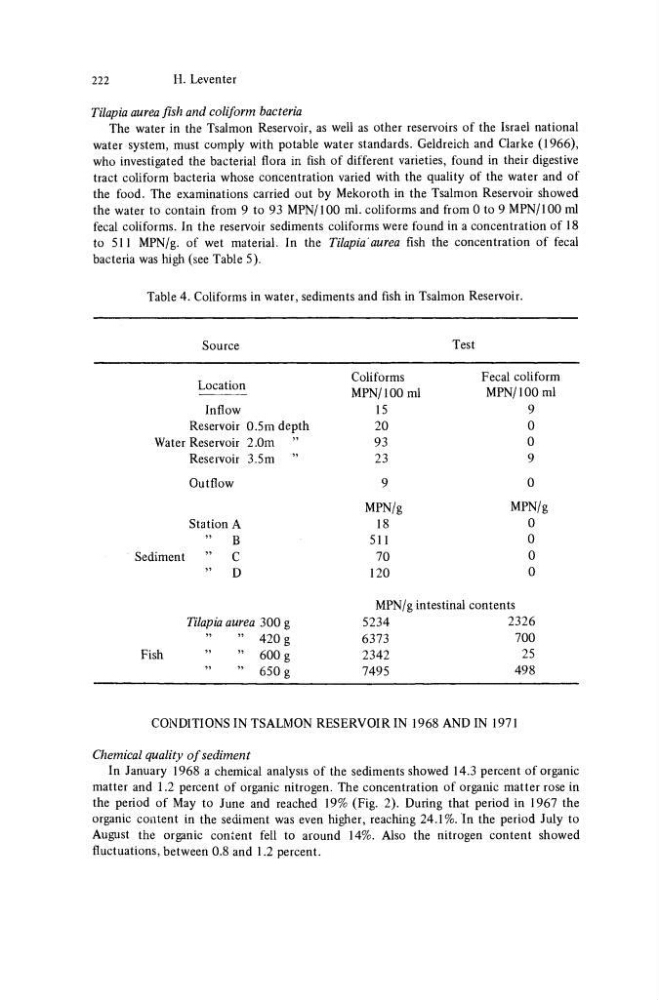
The water in the Tsalmon Reservoir, as well as other reservoirs of the Israel national
water system, must comply with potable water standards. Geldreich and Clarke (1966),
who investigated the bacterial flora in fish of different varieties, found in their digestive
tract coliform bacteria whose concentration varied with the quality of the water and of
the food. The examinations carried out by Mekoroth in the Tsalmon Reservoir showed
the water to contain from 9 to 93 MPN/100 ml. conforms and from 0 to 9 MPN/100 ml
fecal coliforms. In the reservoir sediments coliforms were found in a concentration of 18
to 511 MPN/g. of wet material. In the Tilapia aurea fish the concentration of fecal
bacteria was high (see Table 5).
Table 4. Coliforms in water, sediments and fish in Tsalmon Reservoir.
Source
Location
Inflow
Reservoir
Water Reservoir
Reservoir
Outflow
Station A
"
B
Sediment
" C
"
D
0.5m depth
2.0m "
3.5m "
Tilapia aurea 300 g
5?
5
?
Fish
»5
»
>
420 g
600 g
650 g
Coliforms
MPN/100 ml
15
20
93
23
9
MPN/g
18
511
70
120
Test
Fecal coliform
MPN/100 ml
9
0
0
9
0
MPN/g
0
0
0
0
MPN/g intestinal contents
5234
6373
2342
7495
2326
700
25
498
CONDITIONS IN TSALMON RESERVOIR IN 1968 AND IN 1971
Chemical quality of sediment
In January 1968 a chemical analysis of the sediments showed 14.3 percent of organic
matter and 1.2 percent of organic nitrogen. The concentration of organic matter rose in
the period of May to June and reached 19% (Fig. 2). During that period in 1967 the
organic content in the sediment was even higher, reaching 24.1%. In the period July to
August the organic content fell to around 14%. Also the nitrogen content showed
fluctuations, between 0.8 and 1.2 percent.
H. Leventer
Tilapia aurea fish and coliform bacteria
The water in the Tsalmon Reservoir, as well as other reservoirs of the Israel national
water system, must comply with potable water standards. Geldreich and Clarke (1966),
who investigated the bacterial flora in fish of different varieties, found in their digestive
tract coliform bacteria whose concentration varied with the quality of the water and of
the food. The examinations carried out by Mekoroth in the Tsalmon Reservoir showed
the water to contain from 9 to 93 MPN/100 ml. conforms and from 0 to 9 MPN/100 ml
fecal coliforms. In the reservoir sediments coliforms were found in a concentration of 18
to 511 MPN/g. of wet material. In the Tilapia aurea fish the concentration of fecal
bacteria was high (see Table 5).
Table 4. Coliforms in water, sediments and fish in Tsalmon Reservoir.
Source
Location
Inflow
Reservoir
Water Reservoir
Reservoir
Outflow
Station A
"
B
Sediment
" C
"
D
0.5m depth
2.0m "
3.5m "
Tilapia aurea 300 g
5?
5
?
Fish
»5
»
>
420 g
600 g
650 g
Coliforms
MPN/100 ml
15
20
93
23
9
MPN/g
18
511
70
120
Test
Fecal coliform
MPN/100 ml
9
0
0
9
0
MPN/g
0
0
0
0
MPN/g intestinal contents
5234
6373
2342
7495
2326
700
25
498
CONDITIONS IN TSALMON RESERVOIR IN 1968 AND IN 1971
Chemical quality of sediment
In January 1968 a chemical analysis of the sediments showed 14.3 percent of organic
matter and 1.2 percent of organic nitrogen. The concentration of organic matter rose in
the period of May to June and reached 19% (Fig. 2). During that period in 1967 the
organic content in the sediment was even higher, reaching 24.1%. In the period July to
August the organic content fell to around 14%. Also the nitrogen content showed
fluctuations, between 0.8 and 1.2 percent.