

Eutrophication Control of Tsalmon Reservoir
219
capacity in 6 months. Under Israeli conditions, the female is capable of spawning between
May and October, depending on temperature. Every 35 to 45 days the female can lay 300
to 400 eggs. Tilapia is a tropical and subtropical fish and cannot survive in temperatures
below 10°C. In Israel, T. aurea is bred as a supplementary fish in the carp fishponds, the
combined stocks being highly efficient and contributing to increased harvests,
(b) Introduction of the fish into the reservoir and its development. In the spring of 1969
a population of 30,000 units of Tilapia aurea was introduced into the reservoir, all of
1968 birth and of an average weight of 80 g.
During the period of 1969 to 1971 other varieties of fish were brought in by the water
from Lake Kinneret, including: T. zillii, T. galilea, T. Simonis, Ciarias lazera,
Acanthobrama terra sanctae and Blennius sp. Of all these only single fishes, except for T.
zillii were found. In 1970 about a year after the introduction of the T. aurea population,
specimens of the fish began to be taken from the reservoir.
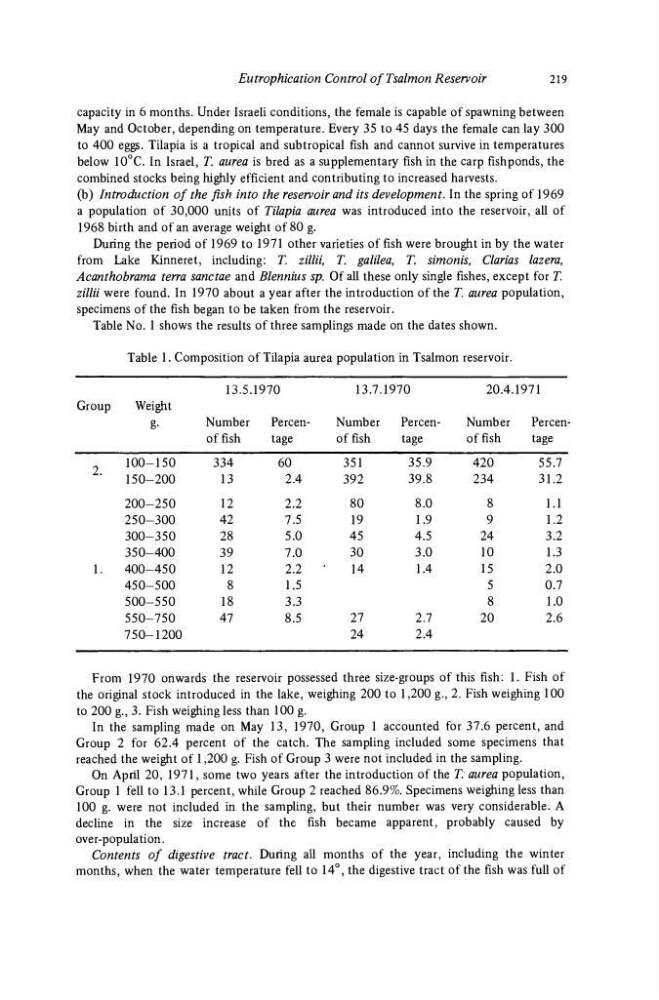
Table No. 1 shows the results of three samplings made on the dates shown.
Table 1. Composition of Tilapia aurea population in Tsalmon reservoir.
13.5.1970
13.7.1970
20.4.1971
Group
Weight
g.
Number
PercenNumber
PercenNumber
Percenoffish
tage
offish
tage
offish
tage
100-150
150-200
200-250
250-300
300-350
350-400
1. 400-450
450-500
500-550
550-750
750-1200
334
13
12
42
28
39
12
8
18
47
60
2.4
2.2
7.5
5.0
7.0
2.2
1.5
3.3
8.5
351
392
80
19
45
30
14
27
24
35.9
39.8
8.0
1.9
4.5
3.0
1.4
2.7
2.4
420
234
8
9
24
10
15
5
8
20
55.7
31.2
1.1
1.2
3.2
1.3
2.0
0.7
1.0
2.6
From 1970 onwards the reservoir possessed three size-groups of this fish: 1. Fish of
the original stock introduced in the lake, weighing 200 to 1,200 g., 2. Fish weighing 100
to 200 g., 3. Fish weighing less than 100 g.
In the sampling made on May 13, 1970, Group 1 accounted for 37.6 percent, and
Group 2 for 62.4 percent of the catch. The sampling included some specimens that
reached the weight of 1,200 g. Fish of Group 3 were not included in the sampling.
On April 20, 1971, some two years after the introduction of the T: aurea population,
Group 1 fell to 13.1 percent, while Group 2 reached 86.9%. Specimens weighing less than
100 g. were not included in the sampling, but their number was very considerable. A
decline in the size increase of the fish became apparent, probably caused by
over-population.
Contents of digestive tract. During all months of the year, including the winter
months, when the water temperature fell to 14°, the digestive tract of the fish was full of
219
capacity in 6 months. Under Israeli conditions, the female is capable of spawning between
May and October, depending on temperature. Every 35 to 45 days the female can lay 300
to 400 eggs. Tilapia is a tropical and subtropical fish and cannot survive in temperatures
below 10°C. In Israel, T. aurea is bred as a supplementary fish in the carp fishponds, the
combined stocks being highly efficient and contributing to increased harvests,
(b) Introduction of the fish into the reservoir and its development. In the spring of 1969
a population of 30,000 units of Tilapia aurea was introduced into the reservoir, all of
1968 birth and of an average weight of 80 g.
During the period of 1969 to 1971 other varieties of fish were brought in by the water
from Lake Kinneret, including: T. zillii, T. galilea, T. Simonis, Ciarias lazera,
Acanthobrama terra sanctae and Blennius sp. Of all these only single fishes, except for T.
zillii were found. In 1970 about a year after the introduction of the T. aurea population,
specimens of the fish began to be taken from the reservoir.
Table No. 1 shows the results of three samplings made on the dates shown.
Table 1. Composition of Tilapia aurea population in Tsalmon reservoir.
13.5.1970
13.7.1970
20.4.1971
Group
Weight
g.
Number
PercenNumber
PercenNumber
Percenoffish
tage
offish
tage
offish
tage
100-150
150-200
200-250
250-300
300-350
350-400
1. 400-450
450-500
500-550
550-750
750-1200
334
13
12
42
28
39
12
8
18
47
60
2.4
2.2
7.5
5.0
7.0
2.2
1.5
3.3
8.5
351
392
80
19
45
30
14
27
24
35.9
39.8
8.0
1.9
4.5
3.0
1.4
2.7
2.4
420
234
8
9
24
10
15
5
8
20
55.7
31.2
1.1
1.2
3.2
1.3
2.0
0.7
1.0
2.6
From 1970 onwards the reservoir possessed three size-groups of this fish: 1. Fish of
the original stock introduced in the lake, weighing 200 to 1,200 g., 2. Fish weighing 100
to 200 g., 3. Fish weighing less than 100 g.
In the sampling made on May 13, 1970, Group 1 accounted for 37.6 percent, and
Group 2 for 62.4 percent of the catch. The sampling included some specimens that
reached the weight of 1,200 g. Fish of Group 3 were not included in the sampling.
On April 20, 1971, some two years after the introduction of the T: aurea population,
Group 1 fell to 13.1 percent, while Group 2 reached 86.9%. Specimens weighing less than
100 g. were not included in the sampling, but their number was very considerable. A
decline in the size increase of the fish became apparent, probably caused by
over-population.
Contents of digestive tract. During all months of the year, including the winter
months, when the water temperature fell to 14°, the digestive tract of the fish was full of