

The Filtration of Coliform Bacteria in Sand Dunes
153
A
T 1o
7
-
o
ξ 1o
3
-
S
1z
UJ
D
i to
LL
l
r-AVEl
o
O
-
° 0
Δ
^
\
'
*AGE INFLUENT
A χ Λ Δ A Δ
Δ
f \ οΔ" *
b
°
o
o J
TAP WATER - o
^ T ~ r u . s T
I , I
°'
2 M M9C,2
-
A
Λ
^
Δ
Α WATER
HYDRAULIC LOAD - 1.2 m/day
i
4
6
δ
ϊο
_^Λ
12
t (hours)
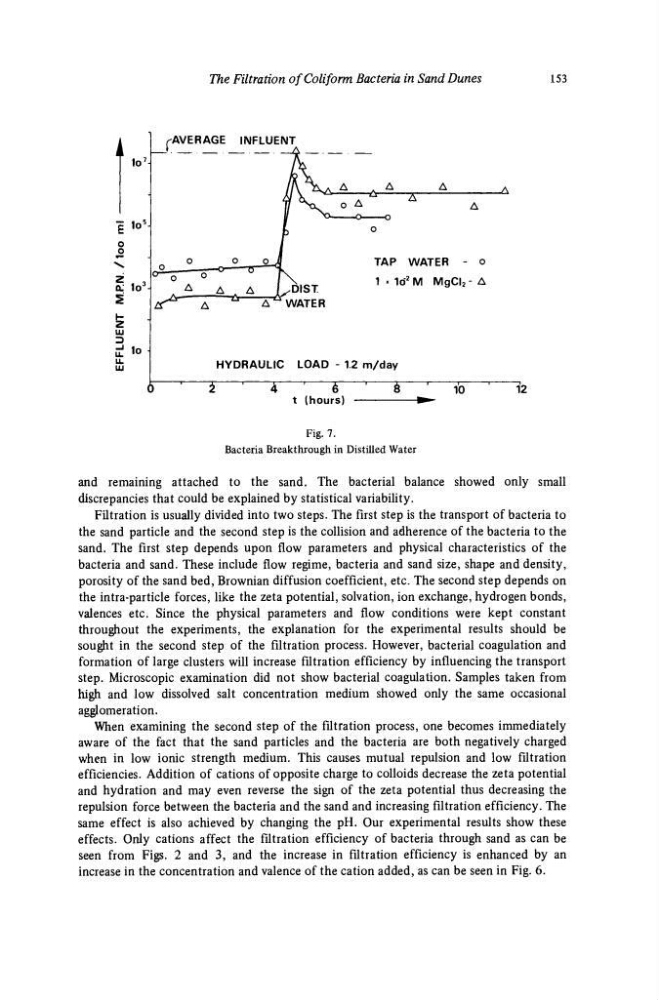
Fig. 7.
Bacteria Breakthrough in Distilled Water
and remaining attached to the sand. The bacterial balance showed only small
discrepancies that could be explained by statistical variability.
Filtration is usually divided into two steps. The first step is the transport of bacteria to
the sand particle and the second step is the collision and adherence of the bacteria to the
sand. The first step depends upon flow parameters and physical characteristics of the
bacteria and sand. These include flow regime, bacteria and sand size, shape and density,
porosity of the sand bed, Brownian diffusion coefficient, etc. The second step depends on
the intra-particle forces, like the zeta potential, solvation, ion exchange, hydrogen bonds,
valences etc. Since the physical parameters and flow conditions were kept constant
throughout the experiments, the explanation for the experimental results should be
sought in the second step of the filtration process. However, bacterial coagulation and
formation of large clusters will increase filtration efficiency by influencing the transport
step. Microscopic examination did not show bacterial coagulation. Samples taken from
high and low dissolved salt concentration medium showed only the same occasional
agglomeration.
When examining the second step of the filtration process, one becomes immediately
aware of the fact that the sand particles and the bacteria are both negatively charged
when in low ionic strength medium. This causes mutual repulsion and low filtration
efficiencies. Addition of cations of opposite charge to colloids decrease the zeta potential
and hydration and may even reverse the sign of the zeta potential thus decreasing the
repulsion force between the bacteria and the sand and increasing filtration efficiency. The
same effect is also achieved by changing the pH. Our experimental results show these
effects. Only cations affect the filtration efficiency of bacteria through sand as can be
seen from Figs. 2 and 3, and the increase in filtration efficiency is enhanced by an
increase in the concentration and valence of the cation added, as can be seen in Fig. 6.
153
A
T 1o
7
-
o
ξ 1o
3
-
S
1z
UJ
D
i to
LL
l
r-AVEl
o
O
-
° 0
Δ
^
\
'
*AGE INFLUENT
A χ Λ Δ A Δ
Δ
f \ οΔ" *
b
°
o
o J
TAP WATER - o
^ T ~ r u . s T
I , I
°'
2 M M9C,2
-
A
Λ
^
Δ
Α WATER
HYDRAULIC LOAD - 1.2 m/day
i
4
6
δ
ϊο
_^Λ
12
t (hours)
Fig. 7.
Bacteria Breakthrough in Distilled Water
and remaining attached to the sand. The bacterial balance showed only small
discrepancies that could be explained by statistical variability.
Filtration is usually divided into two steps. The first step is the transport of bacteria to
the sand particle and the second step is the collision and adherence of the bacteria to the
sand. The first step depends upon flow parameters and physical characteristics of the
bacteria and sand. These include flow regime, bacteria and sand size, shape and density,
porosity of the sand bed, Brownian diffusion coefficient, etc. The second step depends on
the intra-particle forces, like the zeta potential, solvation, ion exchange, hydrogen bonds,
valences etc. Since the physical parameters and flow conditions were kept constant
throughout the experiments, the explanation for the experimental results should be
sought in the second step of the filtration process. However, bacterial coagulation and
formation of large clusters will increase filtration efficiency by influencing the transport
step. Microscopic examination did not show bacterial coagulation. Samples taken from
high and low dissolved salt concentration medium showed only the same occasional
agglomeration.
When examining the second step of the filtration process, one becomes immediately
aware of the fact that the sand particles and the bacteria are both negatively charged
when in low ionic strength medium. This causes mutual repulsion and low filtration
efficiencies. Addition of cations of opposite charge to colloids decrease the zeta potential
and hydration and may even reverse the sign of the zeta potential thus decreasing the
repulsion force between the bacteria and the sand and increasing filtration efficiency. The
same effect is also achieved by changing the pH. Our experimental results show these
effects. Only cations affect the filtration efficiency of bacteria through sand as can be
seen from Figs. 2 and 3, and the increase in filtration efficiency is enhanced by an
increase in the concentration and valence of the cation added, as can be seen in Fig. 6.