

The Vims Problem in the Windhoek Waste Water Reclamation Project
135
Goreangab Dam supply.
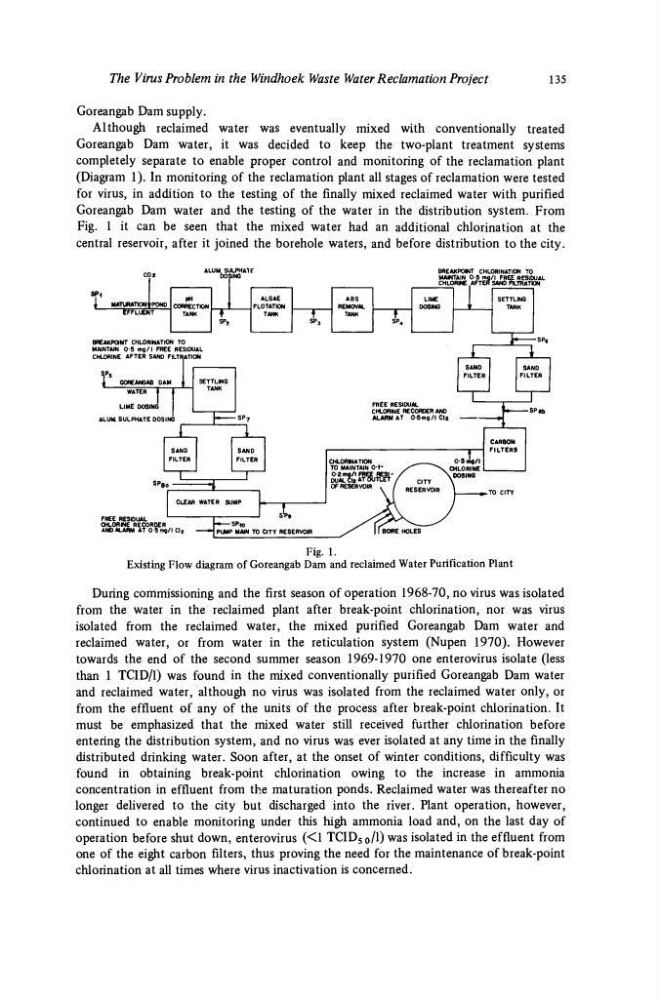
Although reclaimed water was eventually mixed with conventionally treated
Goreangab Dam water, it was decided to keep the two-plant treatment systems
completely separate to enable proper control and monitoring of the reclamation plant
(Diagram 1). In monitoring of the reclamation plant all stages of reclamation were tested
for virus, in addition to the testing of the finally mixed reclaimed water with purified
Goreangab Dam water and the testing of the water in the distribution system. From
Fig. 1 it can be seen that the mixed water had an additional chlorination at the
central reservoir, after it joined the borehole waters, and before distribution to the city.
Sfl
MATURATlONfrPON O
EFFLUEN T
PH
CORRECTIO N
TAN K
BREAKPOIN T CHLORINATIO N T O
ALGA E
FLOTATIO N
TAN K
ABS
REMOVA L
TAN K
LIM E
DOSIN G
SETTLIN G
TAN K
BREAKPOIN T CHLORINATIO N TO
MAINTAI N 05 m g /
l FRE E RESIDUA L
CHLORIN E AFTE R SAN D FILTRATIO N
SP6
XL
GOREANGA B DA M
W A T E R
j
LIM E DOSIN G
ALU M SULPHAT E DOSIN G
SETTLIN G
TAN K
SAN D
FILTE R
SAN D
FILTE R
FRE E RESIDUA L
CHLORIN E RECORDE R AN D
ALAR M AT 0 5 m g / I C l
2
SAN D
FILTE R
SAN D
FILTE R
S P80 ■
CLEA R WATE R SUM P
FRE E RESIDUA L
CHLORW E RECORDE R
AND ALAR M A T 0 5 m g / I C I
z
CHLORINATIO N
TO MAINTAI N 0 - 1 "
ssatmm
OF RESERVOI R
* — S P - K
)
PUM P MAI N TO CIT Y RESERVOI R
Fig. 1.
Existing Flow diagram of Goreangab Dam and reclaimed Water Purification Plant
During commissioning and the first season of operation 1968-70, no virus was isolated
from the water in the reclaimed plant after break-point chlorination, nor was virus
isolated from the reclaimed water, the mixed purified Goreangab Dam water and
reclaimed water, or from water in the reticulation system (Nupen 1970). However
towards the end of the second summer season 1969-1970 one enterovirus isolate (less
than 1 TCID/1) was found in the mixed conventionally purified Goreangab Dam water
and reclaimed water, although no virus was isolated from the reclaimed water only, or
from the effluent of any of the units of the process after break-point chlorination. It
must be emphasized that the mixed water still received further chlorination before
entering the distribution system, and no virus was ever isolated at any time in the finally
distributed drinking water. Soon after, at the onset of winter conditions, difficulty was
found in obtaining break-point chlorination owing to the increase in ammonia
concentration in effluent from the maturation ponds. Reclaimed water was thereafter no
longer delivered to the city but discharged into the river. Plant operation, however,
continued to enable monitoring under this high ammonia load and, on the last day of
operation before shut down, enterovirus (<1 TCID 50 /1) was isolated in the effluent from
one of the eight carbon filters^ thus proving the need for the maintenance of break-point
chlorination at all times where virus inactivation is concerned.
135
Goreangab Dam supply.
Although reclaimed water was eventually mixed with conventionally treated
Goreangab Dam water, it was decided to keep the two-plant treatment systems
completely separate to enable proper control and monitoring of the reclamation plant
(Diagram 1). In monitoring of the reclamation plant all stages of reclamation were tested
for virus, in addition to the testing of the finally mixed reclaimed water with purified
Goreangab Dam water and the testing of the water in the distribution system. From
Fig. 1 it can be seen that the mixed water had an additional chlorination at the
central reservoir, after it joined the borehole waters, and before distribution to the city.
Sfl
MATURATlONfrPON O
EFFLUEN T
PH
CORRECTIO N
TAN K
BREAKPOIN T CHLORINATIO N T O
ALGA E
FLOTATIO N
TAN K
ABS
REMOVA L
TAN K
LIM E
DOSIN G
SETTLIN G
TAN K
BREAKPOIN T CHLORINATIO N TO
MAINTAI N 05 m g /
l FRE E RESIDUA L
CHLORIN E AFTE R SAN D FILTRATIO N
SP6
XL
GOREANGA B DA M
W A T E R
j
LIM E DOSIN G
ALU M SULPHAT E DOSIN G
SETTLIN G
TAN K
SAN D
FILTE R
SAN D
FILTE R
FRE E RESIDUA L
CHLORIN E RECORDE R AN D
ALAR M AT 0 5 m g / I C l
2
SAN D
FILTE R
SAN D
FILTE R
S P80 ■
CLEA R WATE R SUM P
FRE E RESIDUA L
CHLORW E RECORDE R
AND ALAR M A T 0 5 m g / I C I
z
CHLORINATIO N
TO MAINTAI N 0 - 1 "
ssatmm
OF RESERVOI R
* — S P - K
)
PUM P MAI N TO CIT Y RESERVOI R
Fig. 1.
Existing Flow diagram of Goreangab Dam and reclaimed Water Purification Plant
During commissioning and the first season of operation 1968-70, no virus was isolated
from the water in the reclaimed plant after break-point chlorination, nor was virus
isolated from the reclaimed water, the mixed purified Goreangab Dam water and
reclaimed water, or from water in the reticulation system (Nupen 1970). However
towards the end of the second summer season 1969-1970 one enterovirus isolate (less
than 1 TCID/1) was found in the mixed conventionally purified Goreangab Dam water
and reclaimed water, although no virus was isolated from the reclaimed water only, or
from the effluent of any of the units of the process after break-point chlorination. It
must be emphasized that the mixed water still received further chlorination before
entering the distribution system, and no virus was ever isolated at any time in the finally
distributed drinking water. Soon after, at the onset of winter conditions, difficulty was
found in obtaining break-point chlorination owing to the increase in ammonia
concentration in effluent from the maturation ponds. Reclaimed water was thereafter no
longer delivered to the city but discharged into the river. Plant operation, however,
continued to enable monitoring under this high ammonia load and, on the last day of
operation before shut down, enterovirus (<1 TCID 50 /1) was isolated in the effluent from
one of the eight carbon filters^ thus proving the need for the maintenance of break-point
chlorination at all times where virus inactivation is concerned.