

102
A. Pälfi
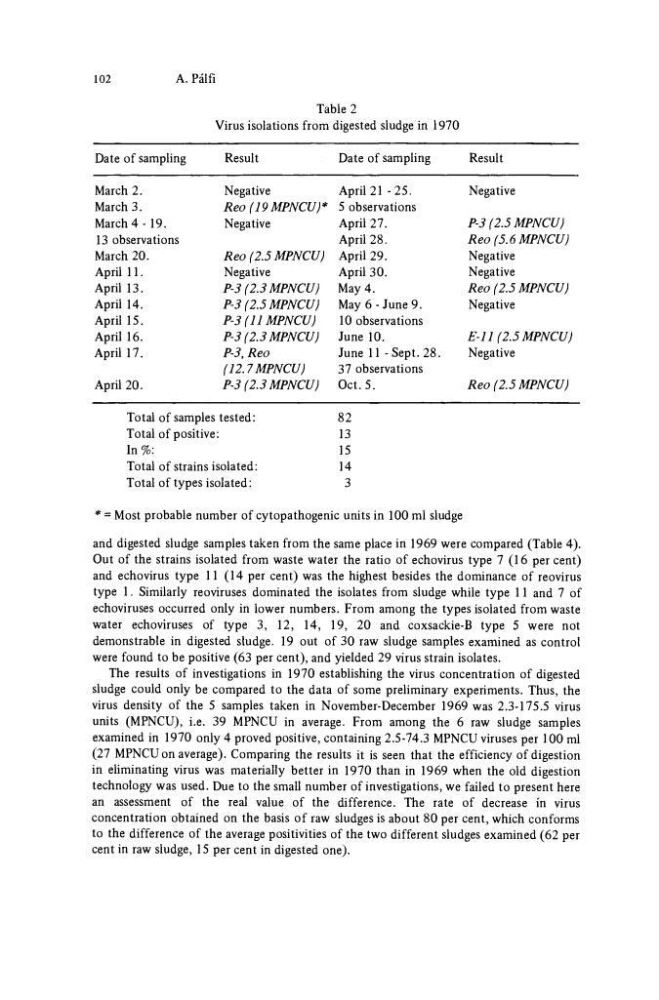
Table 2
Virus isolations from digested sludge in 1970
Date of sampling
March 2.
March 3.
March 4 - 19.
13 observations
March 20.
April 11.
April 13.
April 14.
April 15.
April 16.
April 17.
April 20.
Total of samples
Result
Negative
Reo (19 MPNCU)*
Negative
Reo (2.5 MPNCU)
Negative
P-3 (2.3 MPNCU)
P-3 (2.5 MPNCU)
P-3 (11 MPNCU)
P-3 (2.3 MPNCU)
P-3 y Reo
(12.7 MPNCU)
P-3 (2.3 MPNCU)
; tested:
Date of sampling
April 21 -25.
5 observations
April 27.
April 28.
April 29.
April 30.
May 4.
May 6 -June 9.
10 observations
June 10.
June 11 -Sept. 28.
37 observations
Oct. 5.
82
Result
Negative
P-3 (2.5 MPNCU)
Reo (5.6MPNCU)
Negative
Negative
Reo (2.5 MPNCU)
Negative
E-l 1(2.5 MPNCU)
Negative
Reo (2.5 MPNCU)
Total of positive:
13
In%:
15
Total of strains isolated:
14
Total of types isolated:
3
* = Most probable number of cytopathogenic units in 100 ml sludge
and digested sludge samples taken from the same place in 1969 were compared (Table 4).
Out of the strains isolated from waste water the ratio of echovirus type 7 (16 per cent)
and echovirus type 11 (14 per cent) was the highest besides the dominance of reovirus
type 1. Similarly reoviruses dominated the isolates from sludge while type 11 and 7 of
echoviruses occurred only in lower numbers. From among the types isolated from waste
water echoviruses of type 3, 12, 14, 19, 20 and coxsackie-B type 5 were not
demonstrable in digested sludge. 19 out of 30 raw sludge samples examined as control
were found to be positive (63 per cent), and yielded 29 virus strain isolates.
The results of investigations in 1970 establishing the virus concentration of digested
sludge could only be compared to the data of some preliminary experiments. Thus, the
virus density of the 5 samples taken in November-December 1969 was 2.3-175.5 virus
units (MPNCU), i.e. 39 MPNCU in average. From among the 6 raw sludge samples
examined in 1970 only 4 proved positive, containing 2.5-74.3 MPNCU viruses per 100 ml
(27 MPNCU on average). Comparing the results it is seen that the efficiency of digestion
in eliminating virus was materially better in 1970 than in 1969 when the old digestion
technology was used. Due to the small number of investigations, we failed to present here
an assessment of the real value of the difference. The rate of decrease in virus
concentration obtained on the basis of raw sludges is about 80 per cent, which conforms
to the difference of the average positivities of the two different sludges examined (62 per
cent in raw sludge, 15 per cent in digested one).
A. Pälfi
Table 2
Virus isolations from digested sludge in 1970
Date of sampling
March 2.
March 3.
March 4 - 19.
13 observations
March 20.
April 11.
April 13.
April 14.
April 15.
April 16.
April 17.
April 20.
Total of samples
Result
Negative
Reo (19 MPNCU)*
Negative
Reo (2.5 MPNCU)
Negative
P-3 (2.3 MPNCU)
P-3 (2.5 MPNCU)
P-3 (11 MPNCU)
P-3 (2.3 MPNCU)
P-3 y Reo
(12.7 MPNCU)
P-3 (2.3 MPNCU)
; tested:
Date of sampling
April 21 -25.
5 observations
April 27.
April 28.
April 29.
April 30.
May 4.
May 6 -June 9.
10 observations
June 10.
June 11 -Sept. 28.
37 observations
Oct. 5.
82
Result
Negative
P-3 (2.5 MPNCU)
Reo (5.6MPNCU)
Negative
Negative
Reo (2.5 MPNCU)
Negative
E-l 1(2.5 MPNCU)
Negative
Reo (2.5 MPNCU)
Total of positive:
13
In%:
15
Total of strains isolated:
14
Total of types isolated:
3
* = Most probable number of cytopathogenic units in 100 ml sludge
and digested sludge samples taken from the same place in 1969 were compared (Table 4).
Out of the strains isolated from waste water the ratio of echovirus type 7 (16 per cent)
and echovirus type 11 (14 per cent) was the highest besides the dominance of reovirus
type 1. Similarly reoviruses dominated the isolates from sludge while type 11 and 7 of
echoviruses occurred only in lower numbers. From among the types isolated from waste
water echoviruses of type 3, 12, 14, 19, 20 and coxsackie-B type 5 were not
demonstrable in digested sludge. 19 out of 30 raw sludge samples examined as control
were found to be positive (63 per cent), and yielded 29 virus strain isolates.
The results of investigations in 1970 establishing the virus concentration of digested
sludge could only be compared to the data of some preliminary experiments. Thus, the
virus density of the 5 samples taken in November-December 1969 was 2.3-175.5 virus
units (MPNCU), i.e. 39 MPNCU in average. From among the 6 raw sludge samples
examined in 1970 only 4 proved positive, containing 2.5-74.3 MPNCU viruses per 100 ml
(27 MPNCU on average). Comparing the results it is seen that the efficiency of digestion
in eliminating virus was materially better in 1970 than in 1969 when the old digestion
technology was used. Due to the small number of investigations, we failed to present here
an assessment of the real value of the difference. The rate of decrease in virus
concentration obtained on the basis of raw sludges is about 80 per cent, which conforms
to the difference of the average positivities of the two different sludges examined (62 per
cent in raw sludge, 15 per cent in digested one).