

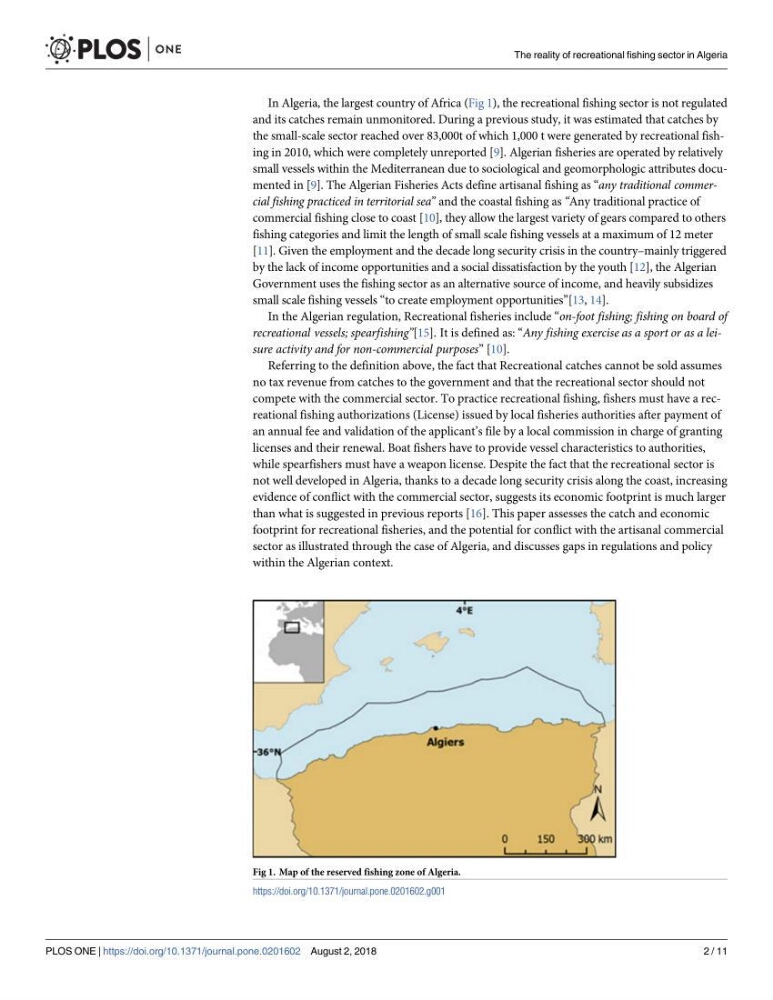
In Algeria, the largest country of Africa (Fig 1), the recreational fishing sector is not regulated
and its catches remain unmonitored. During a previous study, it was estimated that catches by
the small-scale sector reached over 83,000t of which 1,000 t were generated by recreational fishing in 2010, which were completely unreported [9]. Algerian fisheries are operated by relatively
small vessels within the Mediterranean due to sociological and geomorphologic attributes documented in [9]. The Algerian Fisheries Acts define artisanal fishing as “any traditional commercial fishing practiced in territorial sea” and the coastal fishing as “Any traditional practice of
commercial fishing close to coast [10], they allow the largest variety of gears compared to others
fishing categories and limit the length of small scale fishing vessels at a maximum of 12 meter
[11]. Given the employment and the decade long security crisis in the country–mainly triggered
by the lack of income opportunities and a social dissatisfaction by the youth [12], the Algerian
Government uses the fishing sector as an alternative source of income, and heavily subsidizes
small scale fishing vessels “to create employment opportunities”[13, 14].
In the Algerian regulation, Recreational fisheries include “on-foot fishing; fishing on board of
recreational vessels; spearfishing”[15]. It is defined as: “Any fishing exercise as a sport or as a leisure activity and for non-commercial purposes” [10].
Referring to the definition above, the fact that Recreational catches cannot be sold assumes
no tax revenue from catches to the government and that the recreational sector should not
compete with the commercial sector. To practice recreational fishing, fishers must have a recreational fishing authorizations (License) issued by local fisheries authorities after payment of
an annual fee and validation of the applicant’s file by a local commission in charge of granting
licenses and their renewal. Boat fishers have to provide vessel characteristics to authorities,
while spearfishers must have a weapon license. Despite the fact that the recreational sector is
not well developed in Algeria, thanks to a decade long security crisis along the coast, increasing
evidence of conflict with the commercial sector, suggests its economic footprint is much larger
than what is suggested in previous reports [16]. This paper assesses the catch and economic
footprint for recreational fisheries, and the potential for conflict with the artisanal commercial
sector as illustrated through the case of Algeria, and discusses gaps in regulations and policy
within the Algerian context.
Fig 1. Map of the reserved fishing zone of Algeria.
https://doi.org/10.1371/journal.pone.0201602.g001
The reality of recreational fishing sector in Algeria
PLOS ONE | https://doi.org/10.1371/journal.pone.0201602 August 2, 2018
2 / 11
and its catches remain unmonitored. During a previous study, it was estimated that catches by
the small-scale sector reached over 83,000t of which 1,000 t were generated by recreational fishing in 2010, which were completely unreported [9]. Algerian fisheries are operated by relatively
small vessels within the Mediterranean due to sociological and geomorphologic attributes documented in [9]. The Algerian Fisheries Acts define artisanal fishing as “any traditional commercial fishing practiced in territorial sea” and the coastal fishing as “Any traditional practice of
commercial fishing close to coast [10], they allow the largest variety of gears compared to others
fishing categories and limit the length of small scale fishing vessels at a maximum of 12 meter
[11]. Given the employment and the decade long security crisis in the country–mainly triggered
by the lack of income opportunities and a social dissatisfaction by the youth [12], the Algerian
Government uses the fishing sector as an alternative source of income, and heavily subsidizes
small scale fishing vessels “to create employment opportunities”[13, 14].
In the Algerian regulation, Recreational fisheries include “on-foot fishing; fishing on board of
recreational vessels; spearfishing”[15]. It is defined as: “Any fishing exercise as a sport or as a leisure activity and for non-commercial purposes” [10].
Referring to the definition above, the fact that Recreational catches cannot be sold assumes
no tax revenue from catches to the government and that the recreational sector should not
compete with the commercial sector. To practice recreational fishing, fishers must have a recreational fishing authorizations (License) issued by local fisheries authorities after payment of
an annual fee and validation of the applicant’s file by a local commission in charge of granting
licenses and their renewal. Boat fishers have to provide vessel characteristics to authorities,
while spearfishers must have a weapon license. Despite the fact that the recreational sector is
not well developed in Algeria, thanks to a decade long security crisis along the coast, increasing
evidence of conflict with the commercial sector, suggests its economic footprint is much larger
than what is suggested in previous reports [16]. This paper assesses the catch and economic
footprint for recreational fisheries, and the potential for conflict with the artisanal commercial
sector as illustrated through the case of Algeria, and discusses gaps in regulations and policy
within the Algerian context.
Fig 1. Map of the reserved fishing zone of Algeria.
https://doi.org/10.1371/journal.pone.0201602.g001
The reality of recreational fishing sector in Algeria
PLOS ONE | https://doi.org/10.1371/journal.pone.0201602 August 2, 2018
2 / 11