

56
Liquid Water in Organisms and their Environment
0.4
I
I
Matric Potential (J/kg)
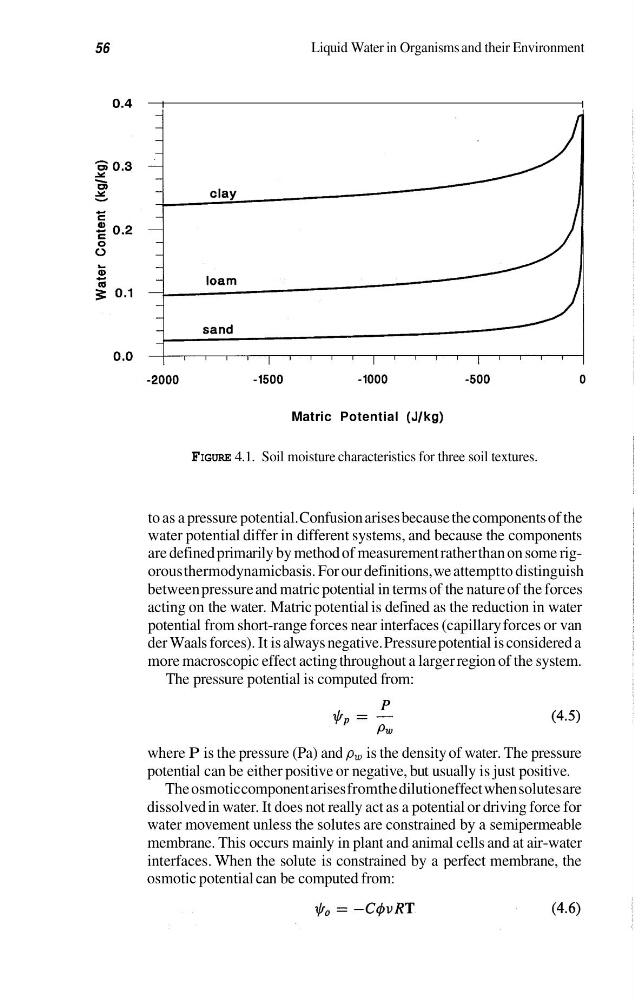
FIGURE 4.1. Soil moisture characteristics for three soil textures.
to as a pressure potential. Confusion arises because the components of the
water potential differ in different systems, and because the components
are defined primarily by method of measurement rather than on some rigorous thermodynamic basis. For our definitions, we attempt to distinguish
between pressure and matric potential in terms of the nature of the forces
acting on the water. Matric potential is defined as the reduction in water
potential from short-range forces near interfaces (capillary forces or van
der Waals forces). It is always negative. Pressure potential is considered a
more macroscopic effect acting throughout a larger region of the system.
The pressure potential is computed from:
where P is the pressure (Pa) and p, is the density of water. The pressure
potential can be either positive or negative, but usually is just positive.
The osmotic component arises fromthe dilution effect when solutes are
dissolved in water. It does not really act as a potential or driving force for
water movement unless the solutes are constrained by a semipermeable
membrane. This occurs mainly in plant and animal cells and at air-water
interfaces. When the solute is constrained by a perfect membrane, the
osmotic potential can be computed from:
Liquid Water in Organisms and their Environment
0.4
I
I
Matric Potential (J/kg)
FIGURE 4.1. Soil moisture characteristics for three soil textures.
to as a pressure potential. Confusion arises because the components of the
water potential differ in different systems, and because the components
are defined primarily by method of measurement rather than on some rigorous thermodynamic basis. For our definitions, we attempt to distinguish
between pressure and matric potential in terms of the nature of the forces
acting on the water. Matric potential is defined as the reduction in water
potential from short-range forces near interfaces (capillary forces or van
der Waals forces). It is always negative. Pressure potential is considered a
more macroscopic effect acting throughout a larger region of the system.
The pressure potential is computed from:
where P is the pressure (Pa) and p, is the density of water. The pressure
potential can be either positive or negative, but usually is just positive.
The osmotic component arises fromthe dilution effect when solutes are
dissolved in water. It does not really act as a potential or driving force for
water movement unless the solutes are constrained by a semipermeable
membrane. This occurs mainly in plant and animal cells and at air-water
interfaces. When the solute is constrained by a perfect membrane, the
osmotic potential can be computed from: