

Spatial and Temporal Variation of Atmospheric Water Vapor
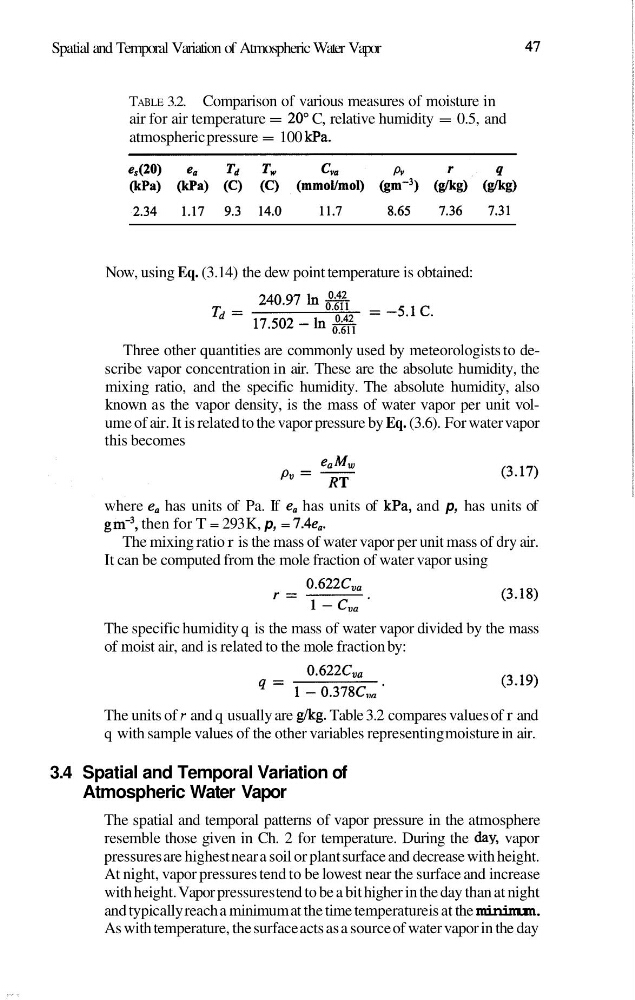
TABLE 3.2. Comparison of various measures of moisture in
air for air temperature = 20" C, relative humidity = 0.5, and
atmospheric pressure = 100 Ha.
Now, using Eq. (3.14) the dew point temperature is obtained:
Three other quantities are commonly used by meteorologists to describe vapor concentration in air. These are the absolute humidity, the
mixing ratio, and the specific humidity. The absolute humidity, also
known as the vapor density, is the mass of water vapor per unit volume of air. It is related to the vapor pressure by Eq. (3.6). For water vapor
this becomes
where ea has units of Pa. If ea has units of kPa, and p, has units of
gm-3, then for T = 293 K, p, = 7.4ea.
The mixing ratio r is the mass of water vapor per unit mass of dry air.
It can be computed from the mole fraction of water vapor using
The specific humidity q is the mass of water vapor divided by the mass
of moist air, and is related to the mole fraction by:
The units of r and q usually are gkg. Table 3.2 compares values of r and
q with sample values of the other variables representing moisture in air.
3.4 Spatial and Temporal Variation of
Atmospheric Water Vapor
The spatial and temporal patterns of vapor pressure in the atmosphere
resemble those given in Ch. 2 for temperature. During the day, vapor
pressures are highest near a soil or plant surface and decrease with height.
At night, vapor pressures tend to be lowest near the surface and increase
with height. Vapor pressures tend to be a bit higher in the day than at night
and typically reach a minimum at the time temperature is at the minimum.
As with temperature, the surface acts as a source of water vapor in the day
TABLE 3.2. Comparison of various measures of moisture in
air for air temperature = 20" C, relative humidity = 0.5, and
atmospheric pressure = 100 Ha.
Now, using Eq. (3.14) the dew point temperature is obtained:
Three other quantities are commonly used by meteorologists to describe vapor concentration in air. These are the absolute humidity, the
mixing ratio, and the specific humidity. The absolute humidity, also
known as the vapor density, is the mass of water vapor per unit volume of air. It is related to the vapor pressure by Eq. (3.6). For water vapor
this becomes
where ea has units of Pa. If ea has units of kPa, and p, has units of
gm-3, then for T = 293 K, p, = 7.4ea.
The mixing ratio r is the mass of water vapor per unit mass of dry air.
It can be computed from the mole fraction of water vapor using
The specific humidity q is the mass of water vapor divided by the mass
of moist air, and is related to the mole fraction by:
The units of r and q usually are gkg. Table 3.2 compares values of r and
q with sample values of the other variables representing moisture in air.
3.4 Spatial and Temporal Variation of
Atmospheric Water Vapor
The spatial and temporal patterns of vapor pressure in the atmosphere
resemble those given in Ch. 2 for temperature. During the day, vapor
pressures are highest near a soil or plant surface and decrease with height.
At night, vapor pressures tend to be lowest near the surface and increase
with height. Vapor pressures tend to be a bit higher in the day than at night
and typically reach a minimum at the time temperature is at the minimum.
As with temperature, the surface acts as a source of water vapor in the day