

Water Vapor: Saturation Conditions
41
spheric pressure is elevation. A relationship, which is accurate enough
for biophysical calculations, is
p, = 101.3 exp (-A)
8200
where A is the altitude in meters above sea level and pa is in kPa.
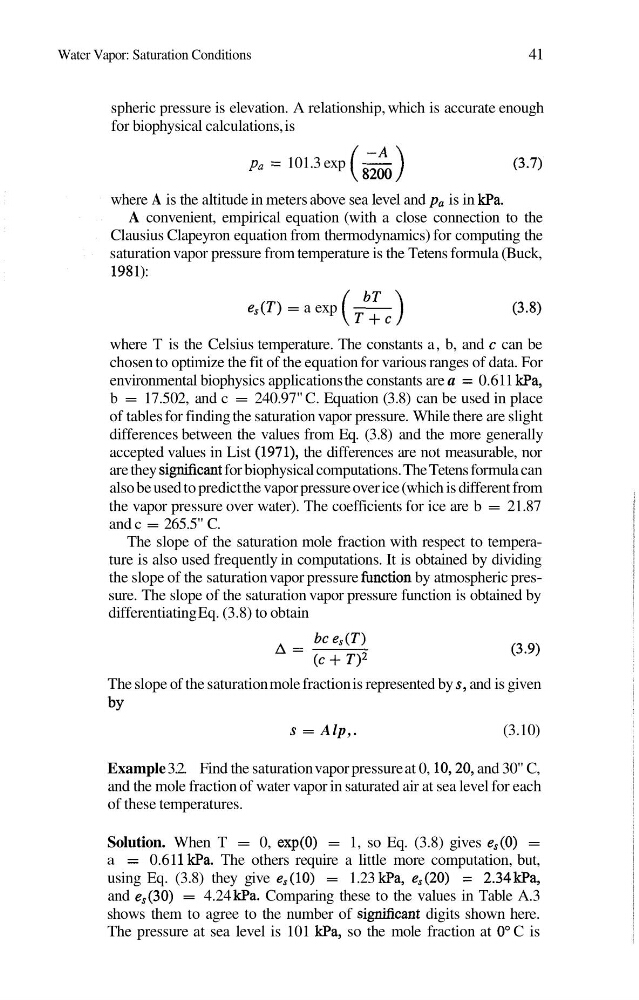
A convenient, empirical equation (with a close connection to the
Clausius Clapeyron equation from thermodynamics) for computing the
saturation vapor pressure from temperature is the Tetens formula (Buck,
198 1):
es(T) = a exp -
( T " f c )
where T is the Celsius temperature. The constants a, b, and c can be
chosen to optimize the fit of the equation for various ranges of data. For
environmental biophysics applications the constants are a = 0.61 1 kPa,
b = 17.502, and c = 240.97" C. Equation (3.8) can be used in place
of tables for finding the saturation vapor pressure. While there are slight
differences between the values from Eq. (3.8) and the more generally
accepted values in List (1971), the differences are not measurable, nor
are they sigmficant for biophysical computations. The Tetens formula can
also be used to predict the vapor pressure over ice (which is different from
the vapor pressure over water). The coefficients for ice are b = 21.87
and c = 265.5" C.
The slope of the saturation mole fraction with respect to temperature is also used frequently in computations. It is obtained by dividing
the slope of the saturation vapor pressure function by atmospheric pressure. The slope of the saturation vapor pressure function is obtained by
differentiating Eq. (3.8) to obtain
The slope of the saturation mole fraction is represented by s, and is given
by
s = A l p , .
(3.10)
Example 3.2. Find the saturation vapor pressure at 0, 10,20, and 30" C,
and the mole fraction of water vapor in saturated air at sea level for each
of these temperatures.
Solution. When T = 0, exp(0) = 1, so Eq. (3.8) gives es(0) =
a = 0.61 1 kPa. The others require a little more computation, but,
using Eq. (3.8) they give es(lO) = 1.23 kPa, es(20) = 2.34 kPa,
and es(30) = 4.24 kPa. Comparing these to the values in Table A.3
shows them to agree to the number of sigmficant digits shown here.
The pressure at sea level is 101 kPa, so the mole fraction at 0" C is
41
spheric pressure is elevation. A relationship, which is accurate enough
for biophysical calculations, is
p, = 101.3 exp (-A)
8200
where A is the altitude in meters above sea level and pa is in kPa.
A convenient, empirical equation (with a close connection to the
Clausius Clapeyron equation from thermodynamics) for computing the
saturation vapor pressure from temperature is the Tetens formula (Buck,
198 1):
es(T) = a exp -
( T " f c )
where T is the Celsius temperature. The constants a, b, and c can be
chosen to optimize the fit of the equation for various ranges of data. For
environmental biophysics applications the constants are a = 0.61 1 kPa,
b = 17.502, and c = 240.97" C. Equation (3.8) can be used in place
of tables for finding the saturation vapor pressure. While there are slight
differences between the values from Eq. (3.8) and the more generally
accepted values in List (1971), the differences are not measurable, nor
are they sigmficant for biophysical computations. The Tetens formula can
also be used to predict the vapor pressure over ice (which is different from
the vapor pressure over water). The coefficients for ice are b = 21.87
and c = 265.5" C.
The slope of the saturation mole fraction with respect to temperature is also used frequently in computations. It is obtained by dividing
the slope of the saturation vapor pressure function by atmospheric pressure. The slope of the saturation vapor pressure function is obtained by
differentiating Eq. (3.8) to obtain
The slope of the saturation mole fraction is represented by s, and is given
by
s = A l p , .
(3.10)
Example 3.2. Find the saturation vapor pressure at 0, 10,20, and 30" C,
and the mole fraction of water vapor in saturated air at sea level for each
of these temperatures.
Solution. When T = 0, exp(0) = 1, so Eq. (3.8) gives es(0) =
a = 0.61 1 kPa. The others require a little more computation, but,
using Eq. (3.8) they give es(lO) = 1.23 kPa, es(20) = 2.34 kPa,
and es(30) = 4.24 kPa. Comparing these to the values in Table A.3
shows them to agree to the number of sigmficant digits shown here.
The pressure at sea level is 101 kPa, so the mole fraction at 0" C is