

38
Water Vapor and Other Gases
3.1 Specifying Gas Concentration
Concentrations of the main atmospheric constituents are often expressed
as percentages or volume fractions. For mainly historical reasons, which
have to do with methods of measurement, water vapor concentration is
expressed in a number of different ways. For reasons that will become
clearer as we get farther into the subject, there is a substantial advantage
to expressing concentrations of all gases in terms of mole fraction (moles
of substance per mole of air), and fluxes as moles per square meter per
second. The relationship between density or concentration and amount
of substance j in a gas is
where n j is the number of moles, V is the volume of gas, and Mi is the
molecular mass. Since the mole fraction of j is the ratio of moles of gas
j to moles of air:
Here, Ma is the molecular mass of air and Mj is the molecular mass of
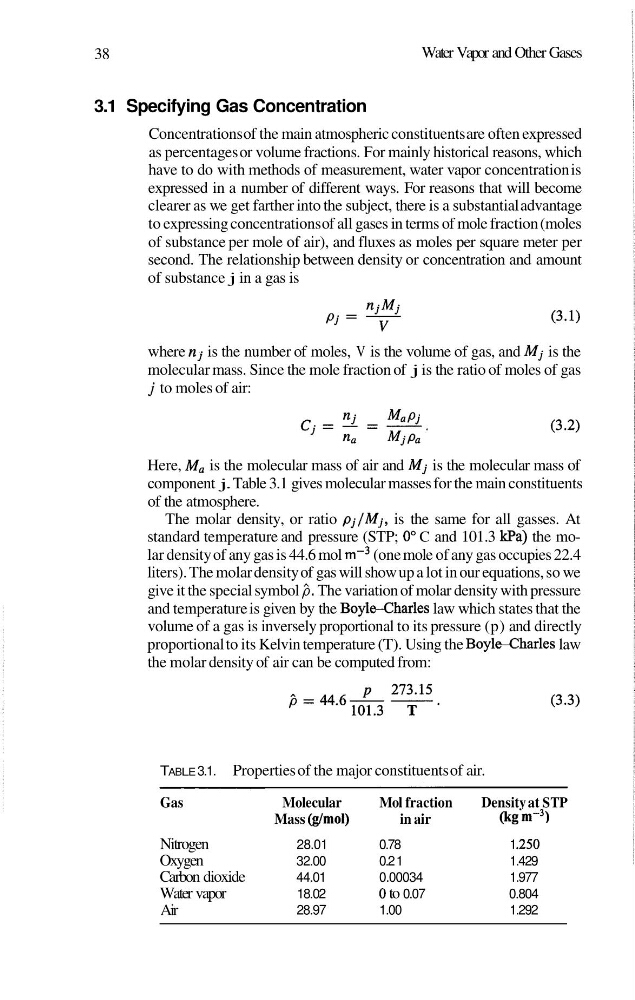
component j. Table 3.1 gives molecular masses for the main constituents
of the atmosphere.
The molar density, or ratio pj/Mj, is the same for all gasses. At
standard temperature and pressure (STP; 0" C and 101.3 kPa) the molar density of any gas is 44.6 mol m-3 (one mole of any gas occupies 22.4
liters). The molar density of gas will show up a lot in our equations, so we
give it the special symbol j3. The variation of molar density with pressure
and temperature is given by the Boyldharles law which states that the
volume of a gas is inversely proportional to its pressure (p) and directly
proportional to its Kelvin temperature (T). Using the Boyldharles law
the molar density of air can be computed from:
TABLE 3.1. Properties of the major constituents of air.
- -
Gas
Molecular
Mol fraction
Density at STP
Mass (glmol)
in air
(kg m-3)
Nitrogen
28.01
0.78
1 .250
Oxygen
32.00
0.2 1
1.429
Carbon dioxide
44.01
0.00034
1.977
Water vapor
18.02
0 to 0.07
0.804
Air
28.97
1.00
1.292
Water Vapor and Other Gases
3.1 Specifying Gas Concentration
Concentrations of the main atmospheric constituents are often expressed
as percentages or volume fractions. For mainly historical reasons, which
have to do with methods of measurement, water vapor concentration is
expressed in a number of different ways. For reasons that will become
clearer as we get farther into the subject, there is a substantial advantage
to expressing concentrations of all gases in terms of mole fraction (moles
of substance per mole of air), and fluxes as moles per square meter per
second. The relationship between density or concentration and amount
of substance j in a gas is
where n j is the number of moles, V is the volume of gas, and Mi is the
molecular mass. Since the mole fraction of j is the ratio of moles of gas
j to moles of air:
Here, Ma is the molecular mass of air and Mj is the molecular mass of
component j. Table 3.1 gives molecular masses for the main constituents
of the atmosphere.
The molar density, or ratio pj/Mj, is the same for all gasses. At
standard temperature and pressure (STP; 0" C and 101.3 kPa) the molar density of any gas is 44.6 mol m-3 (one mole of any gas occupies 22.4
liters). The molar density of gas will show up a lot in our equations, so we
give it the special symbol j3. The variation of molar density with pressure
and temperature is given by the Boyldharles law which states that the
volume of a gas is inversely proportional to its pressure (p) and directly
proportional to its Kelvin temperature (T). Using the Boyldharles law
the molar density of air can be computed from:
TABLE 3.1. Properties of the major constituents of air.
- -
Gas
Molecular
Mol fraction
Density at STP
Mass (glmol)
in air
(kg m-3)
Nitrogen
28.01
0.78
1 .250
Oxygen
32.00
0.2 1
1.429
Carbon dioxide
44.01
0.00034
1.977
Water vapor
18.02
0 to 0.07
0.804
Air
28.97
1.00
1.292