

Temperature
germination stage of a seed. A period of time, usually an hour or a day, is
chosen and the average temperature over that time period is determined.
The average temperature determines the rate of germination for that time
period (Fig. 2.7) and this rate is multiplied by the time period, giving the
amount of development which has occurred. The total development is
the sum of the products of rate and time for each time period. The total
time taken to complete a developmental stage is the time required for the
sum of the development increments to reach unity. This is similar to the
problem in physics where we are interested in determining the distance
traveled by an object which moves at varying speed. There we would
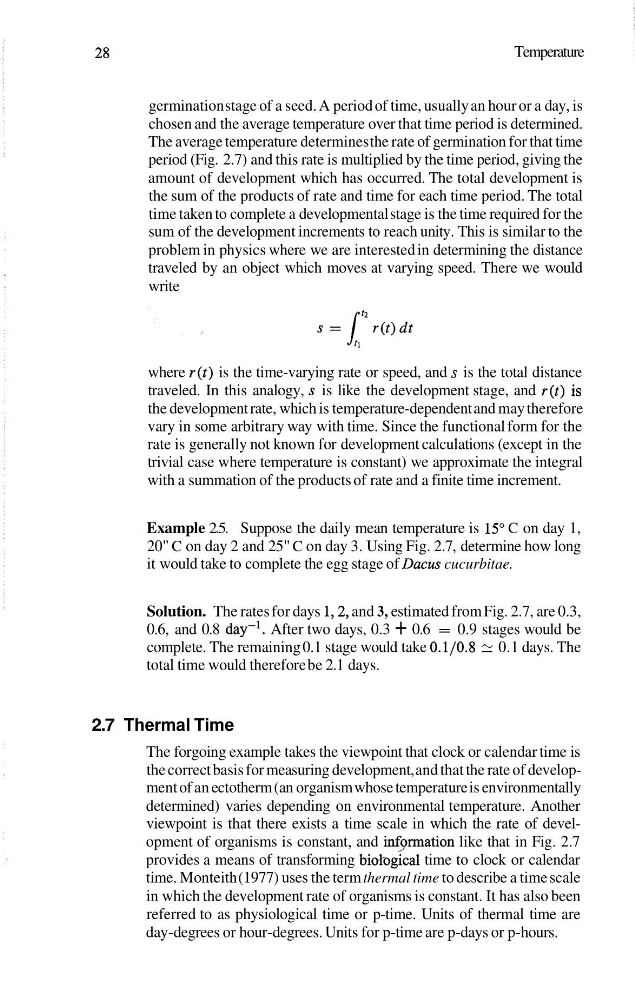
write
where r ( t ) is the time-varying rate or speed, and s is the total distance
traveled. In this analogy, s is like the development stage, and r ( t ) is
the development rate, which is temperature-dependent and may therefore
vary in some arbitrary way with time. Since the functional form for the
rate is generally not known for development calculations (except in the
trivial case where temperature is constant) we approximate the integral
with a summation of the products of rate and a finite time increment.
Example 2.5. Suppose the daily mean temperature is 15" C on day 1,
20" C on day 2 and 25" C on day 3. Using Fig. 2.7, determine how long
it would take to complete the egg stage of Dacus cucurbitae.
Solution. The rates for days 1,2, and 3, estimated from Fig. 2.7, are 0.3,
0.6, and 0.8 day-'. After two days, 0.3 + 0.6 = 0.9 stages would be
complete. The remaining 0.1 stage would take 0.1/0.8 1 : 0.1 days. The
total time would therefore be 2.1 days.
2.7 Thermal Time
The forgoing example takes the viewpoint that clock or calendar time is
the correct basis for measuring development, and that the rate of development of an ectotherm (an organism whose temperature is environmentally
determined) varies depending on environmental temperature. Another
viewpoint is that there exists a time scale in which the rate of development of organisms is constant, and infyrmation like that in Fig. 2.7
provides a means of transforming biological time to clock or calendar
time. Monteith (1977) uses the term thermal time to describe a time scale
in which the development rate of organisms is constant. It has also been
referred to as physiological time or p-time. Units of thermal time are
day-degrees or hour-degrees. Units for p-time are p-days or p-hours.
germination stage of a seed. A period of time, usually an hour or a day, is
chosen and the average temperature over that time period is determined.
The average temperature determines the rate of germination for that time
period (Fig. 2.7) and this rate is multiplied by the time period, giving the
amount of development which has occurred. The total development is
the sum of the products of rate and time for each time period. The total
time taken to complete a developmental stage is the time required for the
sum of the development increments to reach unity. This is similar to the
problem in physics where we are interested in determining the distance
traveled by an object which moves at varying speed. There we would
write
where r ( t ) is the time-varying rate or speed, and s is the total distance
traveled. In this analogy, s is like the development stage, and r ( t ) is
the development rate, which is temperature-dependent and may therefore
vary in some arbitrary way with time. Since the functional form for the
rate is generally not known for development calculations (except in the
trivial case where temperature is constant) we approximate the integral
with a summation of the products of rate and a finite time increment.
Example 2.5. Suppose the daily mean temperature is 15" C on day 1,
20" C on day 2 and 25" C on day 3. Using Fig. 2.7, determine how long
it would take to complete the egg stage of Dacus cucurbitae.
Solution. The rates for days 1,2, and 3, estimated from Fig. 2.7, are 0.3,
0.6, and 0.8 day-'. After two days, 0.3 + 0.6 = 0.9 stages would be
complete. The remaining 0.1 stage would take 0.1/0.8 1 : 0.1 days. The
total time would therefore be 2.1 days.
2.7 Thermal Time
The forgoing example takes the viewpoint that clock or calendar time is
the correct basis for measuring development, and that the rate of development of an ectotherm (an organism whose temperature is environmentally
determined) varies depending on environmental temperature. Another
viewpoint is that there exists a time scale in which the rate of development of organisms is constant, and infyrmation like that in Fig. 2.7
provides a means of transforming biological time to clock or calendar
time. Monteith (1977) uses the term thermal time to describe a time scale
in which the development rate of organisms is constant. It has also been
referred to as physiological time or p-time. Units of thermal time are
day-degrees or hour-degrees. Units for p-time are p-days or p-hours.