

Temperature
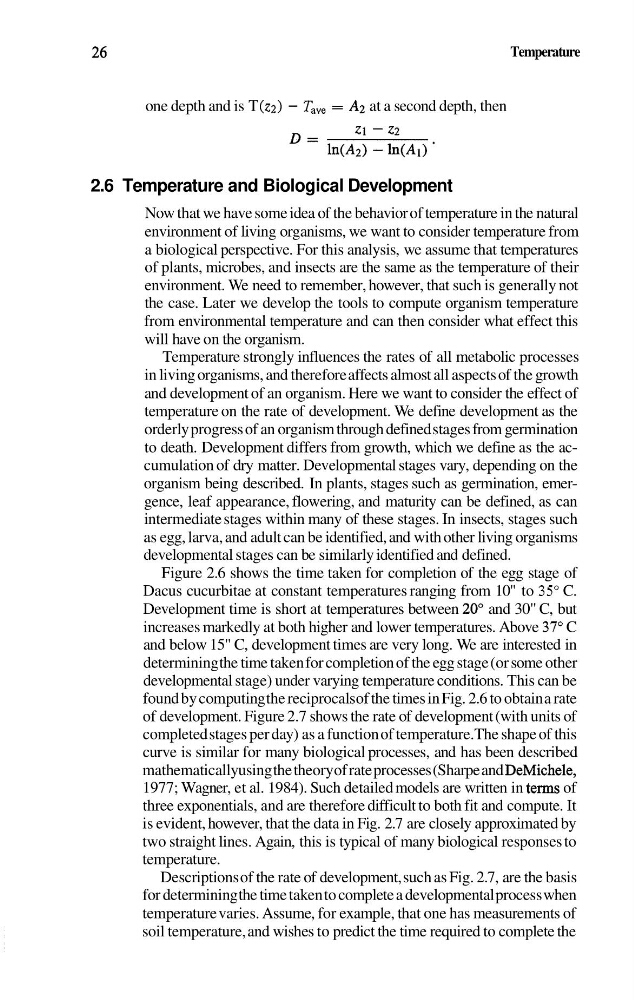
one depth and is T (z2) - Tave = A2 at a second depth, then
2.6 Temperature and Biological Development
Now that we have some idea of the behavior of temperature in the natural
environment of living organisms, we want to consider temperature from
a biological perspective. For this analysis, we assume that temperatures
of plants, microbes, and insects are the same as the temperature of their
environment. We need to remember, however, that such is generally not
the case. Later we develop the tools to compute organism temperature
from environmental temperature and can then consider what effect this
will have on the organism.
Temperature strongly influences the rates of all metabolic processes
in living organisms, and therefore affects almost all aspects of the growth
and development of an organism. Here we want to consider the effect of
temperature on the rate of development. We define development as the
orderly progress of an organism through defined stages from germination
to death. Development differs from growth, which we define as the accumulation of dry matter. Developmental stages vary, depending on the
organism being described. In plants, stages such as germination, emergence, leaf appearance, flowering, and maturity can be defined, as can
intermediate stages within many of these stages. In insects, stages such
as egg, larva, and adult can be identified, and with other living organisms
developmental stages can be similarly identified and defined.
Figure 2.6 shows the time taken for completion of the egg stage of
Dacus cucurbitae at constant temperatures ranging from 10" to 35" C.
Development time is short at temperatures between 20" and 30" C, but
increases markedly at both higher and lower temperatures. Above 37" C
and below 15" C, development times are very long. We are interested in
determining the time taken for completion of the egg stage (or some other
developmental stage) under varying temperature conditions. This can be
found by computing the reciprocals of the times in Fig. 2.6 to obtain a rate
of development. Figure 2.7 shows the rate of development (with units of
completed stages per day) as a function of temperature. The shape of this
curve is similar for many biological processes, and has been described
mathematically using the theory of rate processes (Sharpe and DeMichele,
1977; Wagner, et al. 1984). Such detailed models are written in tenns of
three exponentials, and are therefore difficult to both fit and compute. It
is evident, however, that the data in Fig. 2.7 are closely approximated by
two straight lines. Again, this is typical of many biological responses to
temperature.
Descriptions of the rate of development, such as Fig. 2.7, are the basis
for determining the time taken to complete a developmental process when
temperature varies. Assume, for example, that one has measurements of
soil temperature, and wishes to predict the time required to complete the
one depth and is T (z2) - Tave = A2 at a second depth, then
2.6 Temperature and Biological Development
Now that we have some idea of the behavior of temperature in the natural
environment of living organisms, we want to consider temperature from
a biological perspective. For this analysis, we assume that temperatures
of plants, microbes, and insects are the same as the temperature of their
environment. We need to remember, however, that such is generally not
the case. Later we develop the tools to compute organism temperature
from environmental temperature and can then consider what effect this
will have on the organism.
Temperature strongly influences the rates of all metabolic processes
in living organisms, and therefore affects almost all aspects of the growth
and development of an organism. Here we want to consider the effect of
temperature on the rate of development. We define development as the
orderly progress of an organism through defined stages from germination
to death. Development differs from growth, which we define as the accumulation of dry matter. Developmental stages vary, depending on the
organism being described. In plants, stages such as germination, emergence, leaf appearance, flowering, and maturity can be defined, as can
intermediate stages within many of these stages. In insects, stages such
as egg, larva, and adult can be identified, and with other living organisms
developmental stages can be similarly identified and defined.
Figure 2.6 shows the time taken for completion of the egg stage of
Dacus cucurbitae at constant temperatures ranging from 10" to 35" C.
Development time is short at temperatures between 20" and 30" C, but
increases markedly at both higher and lower temperatures. Above 37" C
and below 15" C, development times are very long. We are interested in
determining the time taken for completion of the egg stage (or some other
developmental stage) under varying temperature conditions. This can be
found by computing the reciprocals of the times in Fig. 2.6 to obtain a rate
of development. Figure 2.7 shows the rate of development (with units of
completed stages per day) as a function of temperature. The shape of this
curve is similar for many biological processes, and has been described
mathematically using the theory of rate processes (Sharpe and DeMichele,
1977; Wagner, et al. 1984). Such detailed models are written in tenns of
three exponentials, and are therefore difficult to both fit and compute. It
is evident, however, that the data in Fig. 2.7 are closely approximated by
two straight lines. Again, this is typical of many biological responses to
temperature.
Descriptions of the rate of development, such as Fig. 2.7, are the basis
for determining the time taken to complete a developmental process when
temperature varies. Assume, for example, that one has measurements of
soil temperature, and wishes to predict the time required to complete the