

22
Temperature
20
25
30
35
Temperature (C)
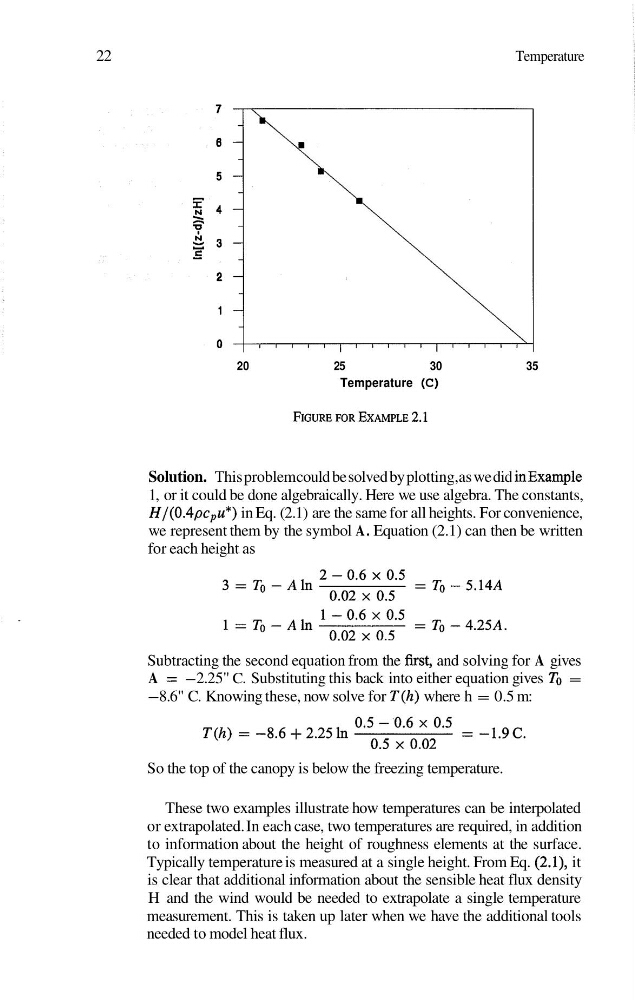
Solution. This problem could be solved by plotting, as we did inExample
1, or it could be done algebraically. Here we use algebra. The constants,
H/(0.4pcPu*) in Eq. (2.1) are the same for all heights. For convenience,
we represent them by the symbol A. Equation (2.1) can then be written
for each height as
Subtracting the second equation from the first, and solving for A gives
A = -2.25" C. Substituting this back into either equation gives To =
-8.6" C. Knowing these, now solve for T(h) where h = 0.5 m:
So the top of the canopy is below the freezing temperature.
These two examples illustrate how temperatures can be interpolated
or extrapolated. In each case, two temperatures are required, in addition
to information about the height of roughness elements at the surface.
Typically temperature is measured at a single height. From Eq. (2.1), it
is clear that additional information about the sensible heat flux density
H and the wind would be needed to extrapolate a single temperature
measurement. This is taken up later when we have the additional tools
needed to model heat flux.
Temperature
20
25
30
35
Temperature (C)
Solution. This problem could be solved by plotting, as we did inExample
1, or it could be done algebraically. Here we use algebra. The constants,
H/(0.4pcPu*) in Eq. (2.1) are the same for all heights. For convenience,
we represent them by the symbol A. Equation (2.1) can then be written
for each height as
Subtracting the second equation from the first, and solving for A gives
A = -2.25" C. Substituting this back into either equation gives To =
-8.6" C. Knowing these, now solve for T(h) where h = 0.5 m:
So the top of the canopy is below the freezing temperature.
These two examples illustrate how temperatures can be interpolated
or extrapolated. In each case, two temperatures are required, in addition
to information about the height of roughness elements at the surface.
Typically temperature is measured at a single height. From Eq. (2.1), it
is clear that additional information about the sensible heat flux density
H and the wind would be needed to extrapolate a single temperature
measurement. This is taken up later when we have the additional tools
needed to model heat flux.