

The Light Environment of Plant Canopies
approximated by the following equations:
crown depth
D = crown diameter
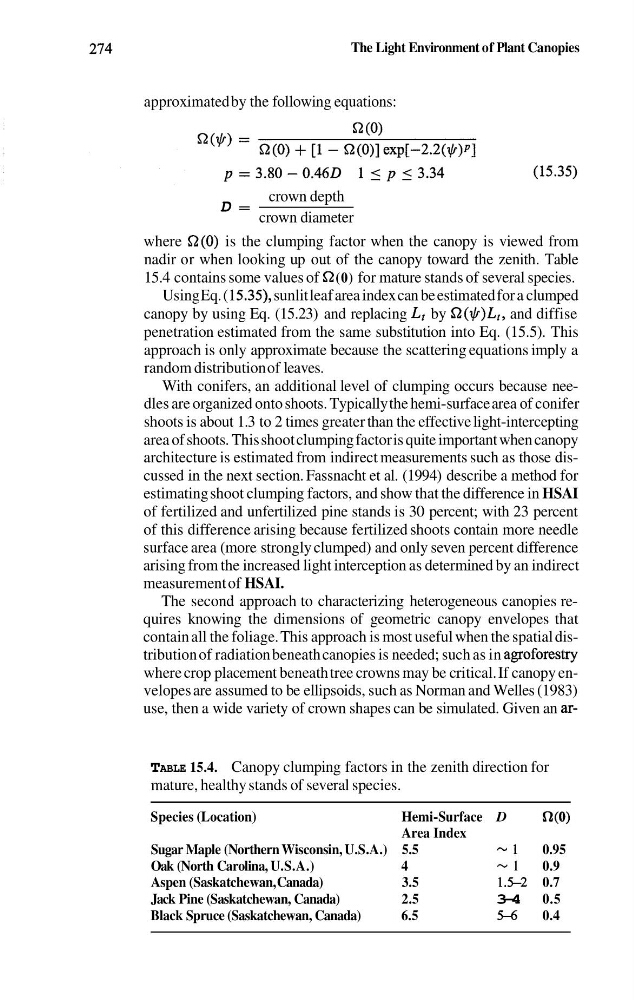
where Q(0) is the clumping factor when the canopy is viewed from
nadir or when looking up out of the canopy toward the zenith. Table
15.4 contains some values of Q (0) for mature stands of several species.
Using Eq. (1 5.35), sunlit leaf area index can be estimated for a clumped
canopy by using Eq. (15.23) and replacing L, by Q(I++)L,, and diffise
penetration estimated from the same substitution into Eq. (15.5). This
approach is only approximate because the scattering equations imply a
random distribution of leaves.
With conifers, an additional level of clumping occurs because needles are organized onto shoots. Typically the hemi-surface area of conifer
shoots is about 1.3 to 2 times greater than the effective light-intercepting
area of shoots. This shoot clumping factor is quite important when canopy
architecture is estimated from indirect measurements such as those discussed in the next section. Fassnacht et al. (1994) describe a method for
estimating shoot clumping factors, and show that the difference in HSAI
of fertilized and unfertilized pine stands is 30 percent; with 23 percent
of this difference arising because fertilized shoots contain more needle
surface area (more strongly clumped) and only seven percent difference
arising from the increased light interception as determined by an indirect
measurement of HSAI.
The second approach to characterizing heterogeneous canopies requires knowing the dimensions of geometric canopy envelopes that
contain all the foliage. This approach is most useful when the spatial distribution of radiation beneath canopies is needed; such as in agroforestry
where crop placement beneath tree crowns may be critical. If canopy envelopes are assumed to be ellipsoids, such as Norman and Welles (1983)
use, then a wide variety of crown shapes can be simulated. Given an arTABLE 15.4. Canopy clumping factors in the zenith direction for
mature, healthy stands of several species.
Species (Location)
Hemi-Surface D
n(0)
Area Index
Sugar Maple (Northern Wisconsin, U.S.A.) 5.5
- 1 0.95
Oak (North Carolina, U.S.A.)
4
-- 1 0.9
Aspen (Saskatchewan, Canada)
3.5
1.5-2 0.7
Jack Pine (Saskatchewan, Canada)
2.5
3-4 0.5
Black Spruce (Saskatchewan, Canada)
6.5
5-6
0.4
approximated by the following equations:
crown depth
D = crown diameter
where Q(0) is the clumping factor when the canopy is viewed from
nadir or when looking up out of the canopy toward the zenith. Table
15.4 contains some values of Q (0) for mature stands of several species.
Using Eq. (1 5.35), sunlit leaf area index can be estimated for a clumped
canopy by using Eq. (15.23) and replacing L, by Q(I++)L,, and diffise
penetration estimated from the same substitution into Eq. (15.5). This
approach is only approximate because the scattering equations imply a
random distribution of leaves.
With conifers, an additional level of clumping occurs because needles are organized onto shoots. Typically the hemi-surface area of conifer
shoots is about 1.3 to 2 times greater than the effective light-intercepting
area of shoots. This shoot clumping factor is quite important when canopy
architecture is estimated from indirect measurements such as those discussed in the next section. Fassnacht et al. (1994) describe a method for
estimating shoot clumping factors, and show that the difference in HSAI
of fertilized and unfertilized pine stands is 30 percent; with 23 percent
of this difference arising because fertilized shoots contain more needle
surface area (more strongly clumped) and only seven percent difference
arising from the increased light interception as determined by an indirect
measurement of HSAI.
The second approach to characterizing heterogeneous canopies requires knowing the dimensions of geometric canopy envelopes that
contain all the foliage. This approach is most useful when the spatial distribution of radiation beneath canopies is needed; such as in agroforestry
where crop placement beneath tree crowns may be critical. If canopy envelopes are assumed to be ellipsoids, such as Norman and Welles (1983)
use, then a wide variety of crown shapes can be simulated. Given an arTABLE 15.4. Canopy clumping factors in the zenith direction for
mature, healthy stands of several species.
Species (Location)
Hemi-Surface D
n(0)
Area Index
Sugar Maple (Northern Wisconsin, U.S.A.) 5.5
- 1 0.95
Oak (North Carolina, U.S.A.)
4
-- 1 0.9
Aspen (Saskatchewan, Canada)
3.5
1.5-2 0.7
Jack Pine (Saskatchewan, Canada)
2.5
3-4 0.5
Black Spruce (Saskatchewan, Canada)
6.5
5-6
0.4