

Remote Sensing of Canopy Cover and IPAR
269
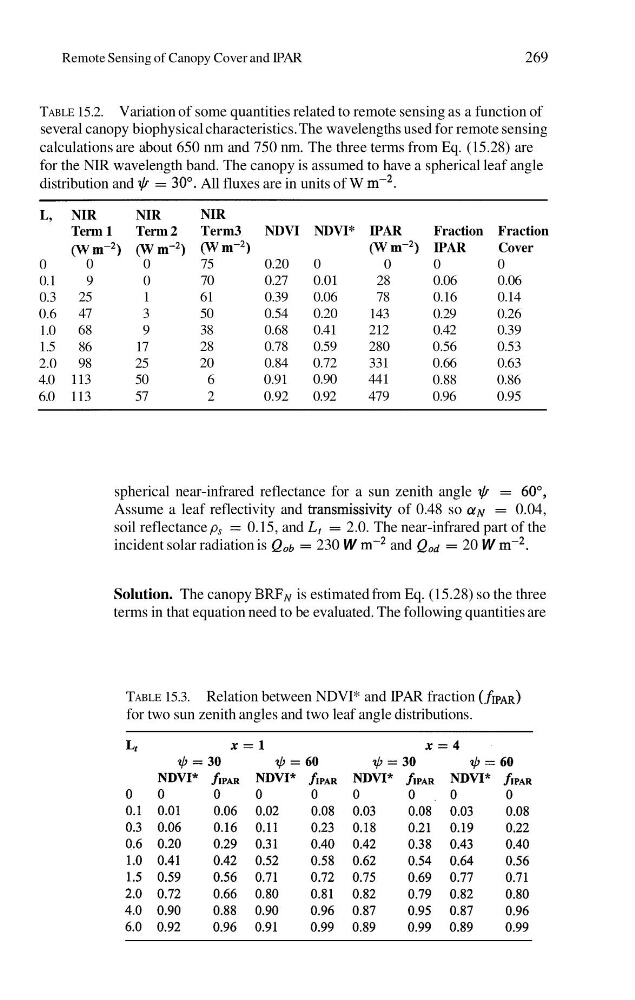
TABLE 15.2. Variation of some quantities related to remote sensing as a function of
several canopy biophysical characteristics. The wavelengths used for remote sensing
calculations are about 650 nm and 750 nm. The three terms from Eq. (15.28) are
for the NIR wavelength band. The canopy is assumed to have a spherical leaf angle
distribution and I& = 30'. All fluxes are in units of W m-2.
L, NIR
NIR
Term 1
Term 2
(W m-2) (W m-2)
0
0
0
0.1
9
0
0.3
25
1
0.6
47
3
1.0
68
9
1.5
86
17
2.0
98
25
4.0 113
50
6.0 113
57
NIR
Term3
NDVI NDVI* IPAR
(W m-2)
(W m-2)
75
0.20
0
0
70
0.27
0.01
28
6 1
0.39
0.06
78
50
0.54
0.20
143
38
0.68
0.41
212
28
0.78
0.59
280
20
0.84
0.72
331
6
0.91
0.90
441
2
0.92
0.92
479
Fraction
IPAR
0
0.06
0.16
0.29
0.42
0.56
0.66
0.88
0.96
Fraction
Cover
0
0.06
0.14
0.26
0.39
0.53
0.63
0.86
0.95
spherical near-infrared reflectance for a sun zenith angle I& = 60°,
Assume a leaf reflectivity and transmissivity of 0.48 so a~ = 0.04,
soil reflectance p, = 0.15, and L, = 2.0. The near-infrared part of the
incident solar radiation is Qob = 230 W m-2 and Qod = 20 W mP2.
Solution. The canopy BRFN is estimated from Eq. (15.28) so the three
terms in that equation need to be evaluated. The following quantities are
TABLE 15.3. Relation between NDVI* and IPAR fraction (fIPAR)
for two sun zenith angles and two leaf angle distributions.
269
TABLE 15.2. Variation of some quantities related to remote sensing as a function of
several canopy biophysical characteristics. The wavelengths used for remote sensing
calculations are about 650 nm and 750 nm. The three terms from Eq. (15.28) are
for the NIR wavelength band. The canopy is assumed to have a spherical leaf angle
distribution and I& = 30'. All fluxes are in units of W m-2.
L, NIR
NIR
Term 1
Term 2
(W m-2) (W m-2)
0
0
0
0.1
9
0
0.3
25
1
0.6
47
3
1.0
68
9
1.5
86
17
2.0
98
25
4.0 113
50
6.0 113
57
NIR
Term3
NDVI NDVI* IPAR
(W m-2)
(W m-2)
75
0.20
0
0
70
0.27
0.01
28
6 1
0.39
0.06
78
50
0.54
0.20
143
38
0.68
0.41
212
28
0.78
0.59
280
20
0.84
0.72
331
6
0.91
0.90
441
2
0.92
0.92
479
Fraction
IPAR
0
0.06
0.16
0.29
0.42
0.56
0.66
0.88
0.96
Fraction
Cover
0
0.06
0.14
0.26
0.39
0.53
0.63
0.86
0.95
spherical near-infrared reflectance for a sun zenith angle I& = 60°,
Assume a leaf reflectivity and transmissivity of 0.48 so a~ = 0.04,
soil reflectance p, = 0.15, and L, = 2.0. The near-infrared part of the
incident solar radiation is Qob = 230 W m-2 and Qod = 20 W mP2.
Solution. The canopy BRFN is estimated from Eq. (15.28) so the three
terms in that equation need to be evaluated. The following quantities are
TABLE 15.3. Relation between NDVI* and IPAR fraction (fIPAR)
for two sun zenith angles and two leaf angle distributions.