

The Light Environment of Plant Canopies
leaves (see Fig. 14.6) can vary with depth in the canopy and this variation
can be accommodated by partitioning the canopy into several layers and
estimating the sunlit and shaded leaf fractions in each layer. Usually this
is not necessary and a single, representative light assimilation response
curve can be used for the entire canopy. Obviously most of the sunlit
leaves are near the top of the canopy and most of the shaded leaves are
near the bottom; therefore, one minor adjustment might be to use slightly
different light assimilation response curves for sunlit and shaded leaves.
In our example we use a single light assimilation response relation for all
the leaves in the canopy.
Example 15.2. Estimate the canopy photosynthetic rate at 10°C (light
assimilation curve in Fig. 14.6) for a canopy with a spherical leaf angle
distribution and hemi-surface area index of 3.0, incident PAR above the
canopy on the horizontal of Qob = 2000 pmol photons m-2 s-' with
80 percent as beam and 20 percent as difise radiation, sun zenith angle
$r = 40°, and leaf absorptivity a = 0.8.
Solution. The canopy net assimilation rate An,cpy is the sum of contributions of sunlit and shaded leaves. These two contributions are added
separately because sunlit leaves will be light saturated while shaded leaves
will be in the linear portion of the light assimilation relation; thus canopy
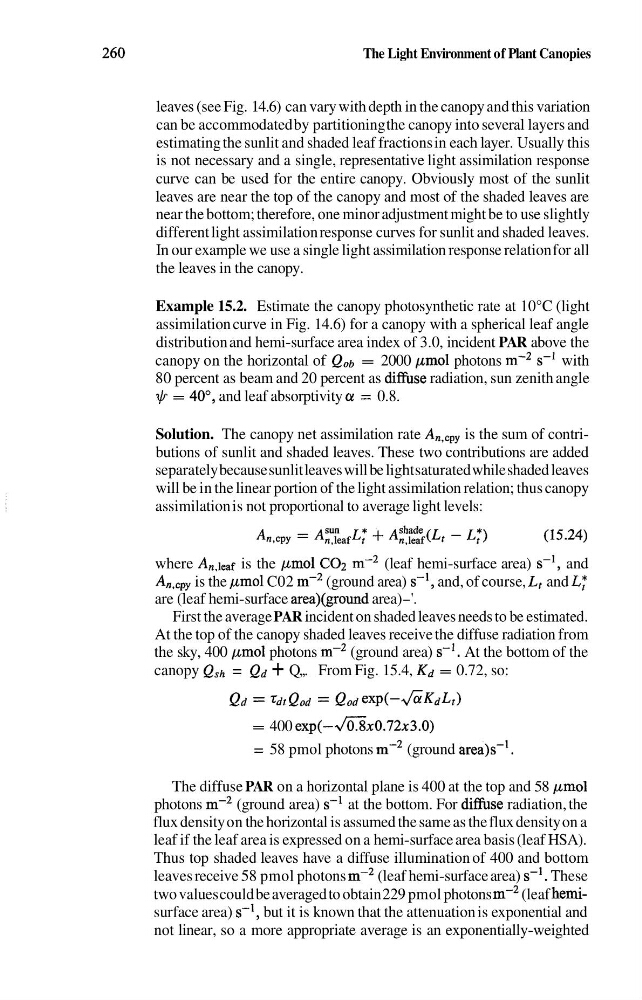
assimilation is not proportional to average light levels:
where An,leaf is the pmol CO2 m-2 (leaf hemi-surface area) s-', and
An,cpy is the ~ m o l
C02 m-2 (ground area) s-', and, of course, L, and LT
are (leaf hemi-surface area)(ground area)-'.
First the average PAR incident on shaded leaves needs to be estimated.
At the top of the canopy shaded leaves receive the diffuse radiation from
the sky, 400 pmol photons m-2 (ground area) s-I . At the bottom of the
canopy QSh = Qd + Q,,. From Fig. 15.4, Kd = 0.72, so:
Qd = Tdt Qod = Qod exp(-&KdLt)
= 400 exP(-&-ii~0.72x3.0)
= 58 pmol photons m-2 (ground area)s-I.
The diffuse PAR on a horizontal plane is 400 at the top and 58 pmol
photons m-2 (ground area) s-I at the bottom. For diffuse radiation, the
flux density on the horizontal is assumed the same as the flux density on a
leaf if the leaf area is expressed on a hemi-surface area basis (leaf HSA).
Thus top shaded leaves have a diffuse illumination of 400 and bottom
leaves receive 58 pmol photons mV2 (leaf hemi-surface area) s-' . These
two values could be averaged to obtain 229 pmol photons md2 (leaf hemisurface area) s-', but it is known that the attenuation is exponential and
not linear, so a more appropriate average is an exponentially-weighted
leaves (see Fig. 14.6) can vary with depth in the canopy and this variation
can be accommodated by partitioning the canopy into several layers and
estimating the sunlit and shaded leaf fractions in each layer. Usually this
is not necessary and a single, representative light assimilation response
curve can be used for the entire canopy. Obviously most of the sunlit
leaves are near the top of the canopy and most of the shaded leaves are
near the bottom; therefore, one minor adjustment might be to use slightly
different light assimilation response curves for sunlit and shaded leaves.
In our example we use a single light assimilation response relation for all
the leaves in the canopy.
Example 15.2. Estimate the canopy photosynthetic rate at 10°C (light
assimilation curve in Fig. 14.6) for a canopy with a spherical leaf angle
distribution and hemi-surface area index of 3.0, incident PAR above the
canopy on the horizontal of Qob = 2000 pmol photons m-2 s-' with
80 percent as beam and 20 percent as difise radiation, sun zenith angle
$r = 40°, and leaf absorptivity a = 0.8.
Solution. The canopy net assimilation rate An,cpy is the sum of contributions of sunlit and shaded leaves. These two contributions are added
separately because sunlit leaves will be light saturated while shaded leaves
will be in the linear portion of the light assimilation relation; thus canopy
assimilation is not proportional to average light levels:
where An,leaf is the pmol CO2 m-2 (leaf hemi-surface area) s-', and
An,cpy is the ~ m o l
C02 m-2 (ground area) s-', and, of course, L, and LT
are (leaf hemi-surface area)(ground area)-'.
First the average PAR incident on shaded leaves needs to be estimated.
At the top of the canopy shaded leaves receive the diffuse radiation from
the sky, 400 pmol photons m-2 (ground area) s-I . At the bottom of the
canopy QSh = Qd + Q,,. From Fig. 15.4, Kd = 0.72, so:
Qd = Tdt Qod = Qod exp(-&KdLt)
= 400 exP(-&-ii~0.72x3.0)
= 58 pmol photons m-2 (ground area)s-I.
The diffuse PAR on a horizontal plane is 400 at the top and 58 pmol
photons m-2 (ground area) s-I at the bottom. For diffuse radiation, the
flux density on the horizontal is assumed the same as the flux density on a
leaf if the leaf area is expressed on a hemi-surface area basis (leaf HSA).
Thus top shaded leaves have a diffuse illumination of 400 and bottom
leaves receive 58 pmol photons mV2 (leaf hemi-surface area) s-' . These
two values could be averaged to obtain 229 pmol photons md2 (leaf hemisurface area) s-', but it is known that the attenuation is exponential and
not linear, so a more appropriate average is an exponentially-weighted