

Continuity in the Biosphere
5
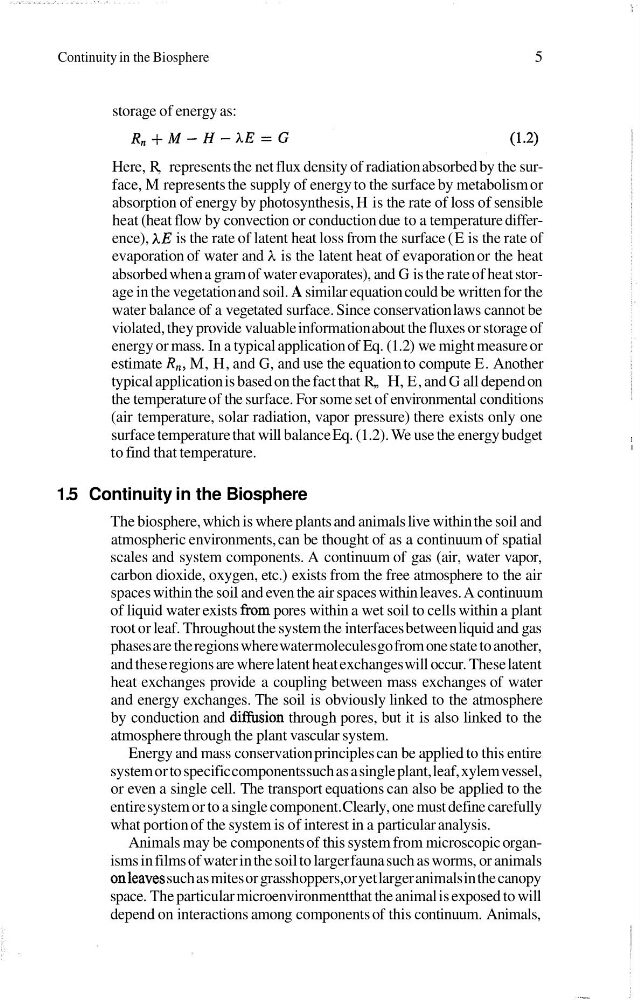
storage of energy as:
Here, R, represents the net flux density of radiation absorbed by the surface, M represents the supply of energy to the surface by metabolism or
absorption of energy by photosynthesis, H is the rate of loss of sensible
heat (heat flow by convection or conduction due to a temperature difference), hE is the rate of latent heat loss from the surface (E is the rate of
evaporation of water and h is the latent heat of evaporation or the heat
absorbed when a gram of water evaporates), and G is the rate of heat storage in the vegetation and soil. A similar equation could be written for the
water balance of a vegetated surface. Since conservation laws cannot be
violated, they provide valuable information about the fluxes or storage of
energy or mass. In a typical application of Eq. (1.2) we might measure or
estimate R,, M, H, and G, and use the equation to compute E. Another
typical application is based on the fact that R,, H, E, and G all depend on
the temperature of the surface. For some set of environmental conditions
(air temperature, solar radiation, vapor pressure) there exists only one
surface temperature that will balance Eq. (1.2). We use the energy budget
I
to find that temperature.
I
1.5 Continuity in the Biosphere
The biosphere, which is where plants and animals live within the soil and
atmospheric environments, can be thought of as a continuum of spatial
scales and system components. A continuum of gas (air, water vapor,
carbon dioxide, oxygen, etc.) exists from the free atmosphere to the air
spaces within the soil and even the air spaces within leaves. A continuum
of liquid water exists from pores within a wet soil to cells within a plant
root or leaf. Throughout the system the interfaces between liquid and gas
phases are the regions where water molecules go from one state to another,
and these regions are where latent heat exchanges will occur. These latent
heat exchanges provide a coupling between mass exchanges of water
and energy exchanges. The soil is obviously linked to the atmosphere
by conduction and diffusion through pores, but it is also linked to the
atmosphere through the plant vascular system.
Energy and mass conservation principles can be applied to this entire
system or to specific components such as a single plant, leaf, xylem vessel,
or even a single cell. The transport equations can also be applied to the
entire system or to a single component. Clearly, one must define carefully
what portion of the system is of interest in a particular analysis.
Animals may be components of this system from microscopic organisms in films of water in the soil to larger fauna such as worms, or animals
onleaves such as mites or grasshoppers, or yet larger animals in the canopy
space. The particular microenvironment that the animal is exposed to will
depend on interactions among components of this continuum. Animals,
5
storage of energy as:
Here, R, represents the net flux density of radiation absorbed by the surface, M represents the supply of energy to the surface by metabolism or
absorption of energy by photosynthesis, H is the rate of loss of sensible
heat (heat flow by convection or conduction due to a temperature difference), hE is the rate of latent heat loss from the surface (E is the rate of
evaporation of water and h is the latent heat of evaporation or the heat
absorbed when a gram of water evaporates), and G is the rate of heat storage in the vegetation and soil. A similar equation could be written for the
water balance of a vegetated surface. Since conservation laws cannot be
violated, they provide valuable information about the fluxes or storage of
energy or mass. In a typical application of Eq. (1.2) we might measure or
estimate R,, M, H, and G, and use the equation to compute E. Another
typical application is based on the fact that R,, H, E, and G all depend on
the temperature of the surface. For some set of environmental conditions
(air temperature, solar radiation, vapor pressure) there exists only one
surface temperature that will balance Eq. (1.2). We use the energy budget
I
to find that temperature.
I
1.5 Continuity in the Biosphere
The biosphere, which is where plants and animals live within the soil and
atmospheric environments, can be thought of as a continuum of spatial
scales and system components. A continuum of gas (air, water vapor,
carbon dioxide, oxygen, etc.) exists from the free atmosphere to the air
spaces within the soil and even the air spaces within leaves. A continuum
of liquid water exists from pores within a wet soil to cells within a plant
root or leaf. Throughout the system the interfaces between liquid and gas
phases are the regions where water molecules go from one state to another,
and these regions are where latent heat exchanges will occur. These latent
heat exchanges provide a coupling between mass exchanges of water
and energy exchanges. The soil is obviously linked to the atmosphere
by conduction and diffusion through pores, but it is also linked to the
atmosphere through the plant vascular system.
Energy and mass conservation principles can be applied to this entire
system or to specific components such as a single plant, leaf, xylem vessel,
or even a single cell. The transport equations can also be applied to the
entire system or to a single component. Clearly, one must define carefully
what portion of the system is of interest in a particular analysis.
Animals may be components of this system from microscopic organisms in films of water in the soil to larger fauna such as worms, or animals
onleaves such as mites or grasshoppers, or yet larger animals in the canopy
space. The particular microenvironment that the animal is exposed to will
depend on interactions among components of this continuum. Animals,