

Plants and Plant Communities
0.0
0.5
1.0
1.5
Intercepted Solar Radiation (GJlm2)
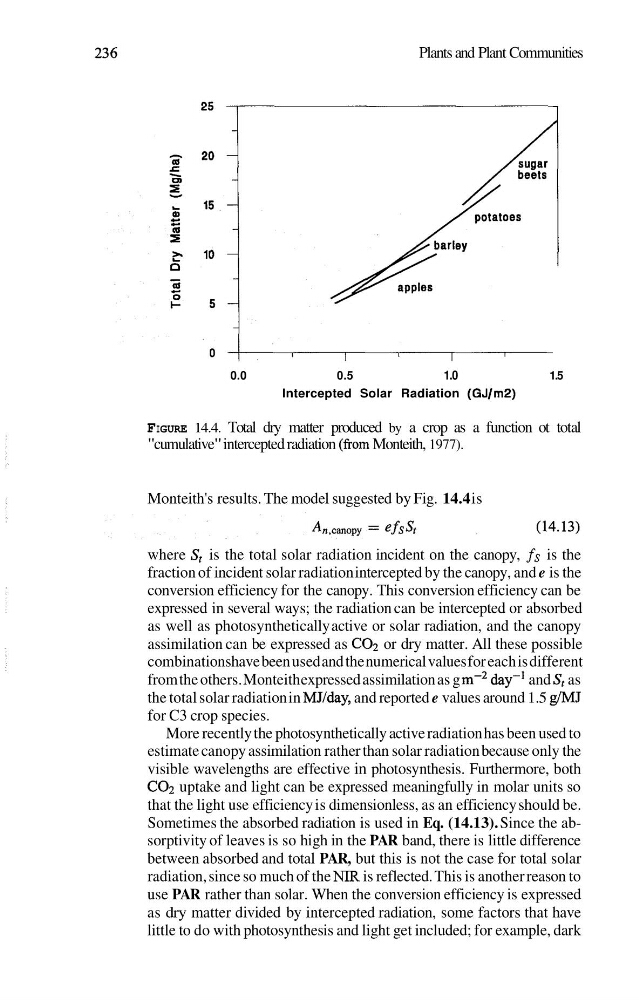
FIGURE 14.4. Total dry matter produced by a crop as a function ot total
"cumulative" intercepted radiation (from Monteith, 1977).
Monteith's results. The model suggested by Fig. 14.4 is
where S, is the total solar radiation incident on the canopy, fs is the
fraction of incident solar radiation intercepted by the canopy, and e is the
conversion efficiency for the canopy. This conversion efficiency can be
expressed in several ways; the radiation can be intercepted or absorbed
as well as photosynthetically active or solar radiation, and the canopy
assimilation can be expressed as COz or dry matter. All these possible
combinations have been used and the numerical values for each is different
from the others. Monteith expressed assimilation as g m-2 day-' and St as
the total solar radiation in MJIday, and reported e values around 1.5 g/MJ
for C3 crop species.
More recently the photosynthetically active radiation has been used to
estimate canopy assimilation rather than solar radiation because only the
visible wavelengths are effective in photosynthesis. Furthermore, both
COz uptake and light can be expressed meaningfully in molar units so
that the light use efficiency is dimensionless, as an efficiency should be.
Sometimes the absorbed radiation is used in Eq. (14.13). Since the absorptivity of leaves is so high in the PAR band, there is little difference
between absorbed and total PAR, but this is not the case for total solar
radiation, since so much of the NIR is reflected. This is another reason to
use PAR rather than solar. When the conversion efficiency is expressed
as dry matter divided by intercepted radiation, some factors that have
little to do with photosynthesis and light get included; for example, dark
0.0
0.5
1.0
1.5
Intercepted Solar Radiation (GJlm2)
FIGURE 14.4. Total dry matter produced by a crop as a function ot total
"cumulative" intercepted radiation (from Monteith, 1977).
Monteith's results. The model suggested by Fig. 14.4 is
where S, is the total solar radiation incident on the canopy, fs is the
fraction of incident solar radiation intercepted by the canopy, and e is the
conversion efficiency for the canopy. This conversion efficiency can be
expressed in several ways; the radiation can be intercepted or absorbed
as well as photosynthetically active or solar radiation, and the canopy
assimilation can be expressed as COz or dry matter. All these possible
combinations have been used and the numerical values for each is different
from the others. Monteith expressed assimilation as g m-2 day-' and St as
the total solar radiation in MJIday, and reported e values around 1.5 g/MJ
for C3 crop species.
More recently the photosynthetically active radiation has been used to
estimate canopy assimilation rather than solar radiation because only the
visible wavelengths are effective in photosynthesis. Furthermore, both
COz uptake and light can be expressed meaningfully in molar units so
that the light use efficiency is dimensionless, as an efficiency should be.
Sometimes the absorbed radiation is used in Eq. (14.13). Since the absorptivity of leaves is so high in the PAR band, there is little difference
between absorbed and total PAR, but this is not the case for total solar
radiation, since so much of the NIR is reflected. This is another reason to
use PAR rather than solar. When the conversion efficiency is expressed
as dry matter divided by intercepted radiation, some factors that have
little to do with photosynthesis and light get included; for example, dark