

204
Animals and their Environment
complexities of the animaknvironment interaction. The disadvantage is
that it provides little opportunity for understanding the physical principles
involved in the exchange processes except to the person who creates the
model.
12.10 Animals and Water
The water budget for an animal can be written in the same form as the
energy budget, namely: water in - water out = stored water. Unlike the
energy budget, the water budget can seldom be analyzed as a collection
of steady-state processes. Intake is from free-water sources, metabolism,
and water in the animal's food. Water is taken in discrete events, not
continuously. As we have shown, cutaneous and respiratory water loss
are relatively continuous, and determined largely by animal activity and
environment. Water is also lost in feces and urine, though this is often
only a small fraction of the total water loss. Water loss reduces the amount
of water stored in the blood, tissues, or digestive tract, and may decrease
the osmotic potential (increase concentration) of body fluids.
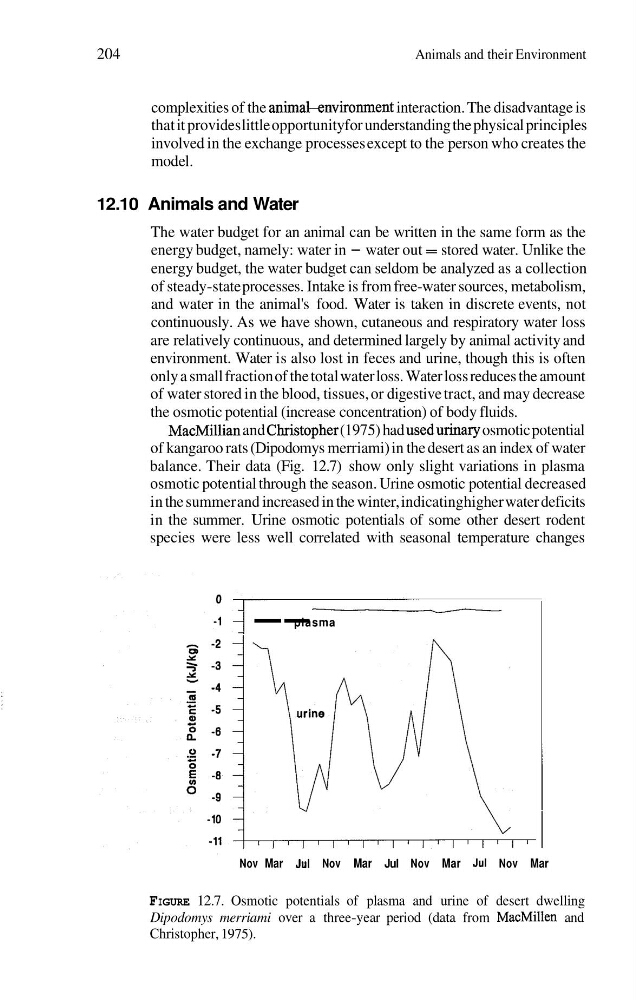
MacMillian and Christopher (1975) had usedurinary osmotic potential
of kangaroo rats (Dipodomys merriami) in the desert as an index of water
balance. Their data (Fig. 12.7) show only slight variations in plasma
osmotic potential through the season. Urine osmotic potential decreased
in the summer and increased in the winter, indicating higher water deficits
in the summer. Urine osmotic potentials of some other desert rodent
species were less well correlated with seasonal temperature changes
4 -plasma
Nov Mar Jul Nov Mar Jul Nov Mar Jul Nov Mar
FIGURE 12.7. Osmotic potentials of plasma and urine of desert dwelling
Dipodomys merriami over a three-year period (data from MacMillen and
Christopher, 1975).
Animals and their Environment
complexities of the animaknvironment interaction. The disadvantage is
that it provides little opportunity for understanding the physical principles
involved in the exchange processes except to the person who creates the
model.
12.10 Animals and Water
The water budget for an animal can be written in the same form as the
energy budget, namely: water in - water out = stored water. Unlike the
energy budget, the water budget can seldom be analyzed as a collection
of steady-state processes. Intake is from free-water sources, metabolism,
and water in the animal's food. Water is taken in discrete events, not
continuously. As we have shown, cutaneous and respiratory water loss
are relatively continuous, and determined largely by animal activity and
environment. Water is also lost in feces and urine, though this is often
only a small fraction of the total water loss. Water loss reduces the amount
of water stored in the blood, tissues, or digestive tract, and may decrease
the osmotic potential (increase concentration) of body fluids.
MacMillian and Christopher (1975) had usedurinary osmotic potential
of kangaroo rats (Dipodomys merriami) in the desert as an index of water
balance. Their data (Fig. 12.7) show only slight variations in plasma
osmotic potential through the season. Urine osmotic potential decreased
in the summer and increased in the winter, indicating higher water deficits
in the summer. Urine osmotic potentials of some other desert rodent
species were less well correlated with seasonal temperature changes
4 -plasma
Nov Mar Jul Nov Mar Jul Nov Mar Jul Nov Mar
FIGURE 12.7. Osmotic potentials of plasma and urine of desert dwelling
Dipodomys merriami over a three-year period (data from MacMillen and
Christopher, 1975).