

Operative Temperature
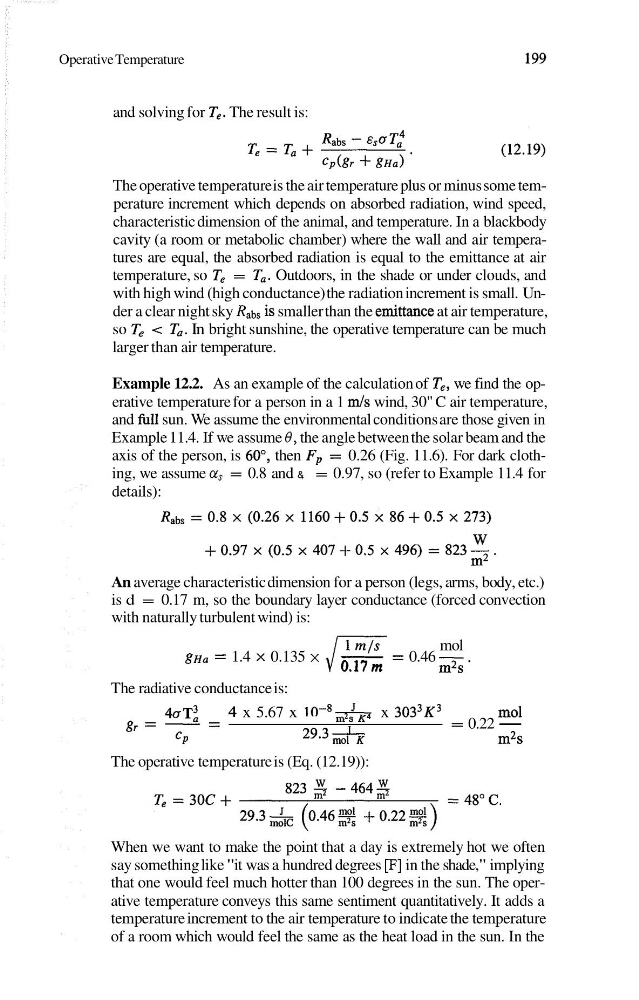
and solving for T,. The result is:
The operative temperature is the air temperature plus or minus some temperature increment which depends on absorbed radiation, wind speed,
characteristic dimension of the animal, and temperature. In a blackbody
cavity (a room or metabolic chamber) where the wall and air temperatures are equal, the absorbed radiation is equal to the emittance at air
temperature, so T, = Ta. Outdoors, in the shade or under clouds, and
with high wind (high conductance) the radiation increment is small. Under a clear night sky Rabs is smaller than the emittance at air temperature,
so T, < To. In bright sunshine, the operative temperature can be much
larger than air temperature.
Example 12.2. As an example of the calculation of T,, we find the operative temperature for a person in a 1 m/s wind, 30" C air temperature,
and full sun. We assume the environmental conditions are those given in
Example 11.4. If we assume 8, the angle between the solar beam and the
axis of the person, is 60°, then Fp = 0.26 (Fig. 11.6). For dark clothing, we assume as = 0.8 and &, = 0.97, so (refer to Example 11.4 for
details):
An average characteristic dimension for a person (legs, arms, body, etc.)
is d = 0.17 m, so the boundary layer conductance (forced convection
with naturally turbulent wind) is:
mol
gHa = 1.4 x 0.135 X JL - = 0.46 z.
0.17m
The radiative conductance is:
4aT;
4 x 5.67 x lo-*
x 3 0 3 ~ ~ ~ mol
g
,
= =
J
= 0.22 -
CP
29.3 G3-Z
m2s
The operative temperature is (Eq. (12.19)):
When we want to make the point that a day is extremely hot we often
say something like "it was a hundred degrees [F] in the shade," implying
that one would feel much hotter than 100 degrees in the sun. The operative temperature conveys this same sentiment quantitatively. It adds a
temperature increment to the air temperature to indicate the temperature
of a room which would feel the same as the heat load in the sun. In the
and solving for T,. The result is:
The operative temperature is the air temperature plus or minus some temperature increment which depends on absorbed radiation, wind speed,
characteristic dimension of the animal, and temperature. In a blackbody
cavity (a room or metabolic chamber) where the wall and air temperatures are equal, the absorbed radiation is equal to the emittance at air
temperature, so T, = Ta. Outdoors, in the shade or under clouds, and
with high wind (high conductance) the radiation increment is small. Under a clear night sky Rabs is smaller than the emittance at air temperature,
so T, < To. In bright sunshine, the operative temperature can be much
larger than air temperature.
Example 12.2. As an example of the calculation of T,, we find the operative temperature for a person in a 1 m/s wind, 30" C air temperature,
and full sun. We assume the environmental conditions are those given in
Example 11.4. If we assume 8, the angle between the solar beam and the
axis of the person, is 60°, then Fp = 0.26 (Fig. 11.6). For dark clothing, we assume as = 0.8 and &, = 0.97, so (refer to Example 11.4 for
details):
An average characteristic dimension for a person (legs, arms, body, etc.)
is d = 0.17 m, so the boundary layer conductance (forced convection
with naturally turbulent wind) is:
mol
gHa = 1.4 x 0.135 X JL - = 0.46 z.
0.17m
The radiative conductance is:
4aT;
4 x 5.67 x lo-*
x 3 0 3 ~ ~ ~ mol
g
,
= =
J
= 0.22 -
CP
29.3 G3-Z
m2s
The operative temperature is (Eq. (12.19)):
When we want to make the point that a day is extremely hot we often
say something like "it was a hundred degrees [F] in the shade," implying
that one would feel much hotter than 100 degrees in the sun. The operative temperature conveys this same sentiment quantitatively. It adds a
temperature increment to the air temperature to indicate the temperature
of a room which would feel the same as the heat load in the sun. In the