

Latent Heat Exchange
I
/
I
I
I
I
10
20
30
Air Temperature (C)
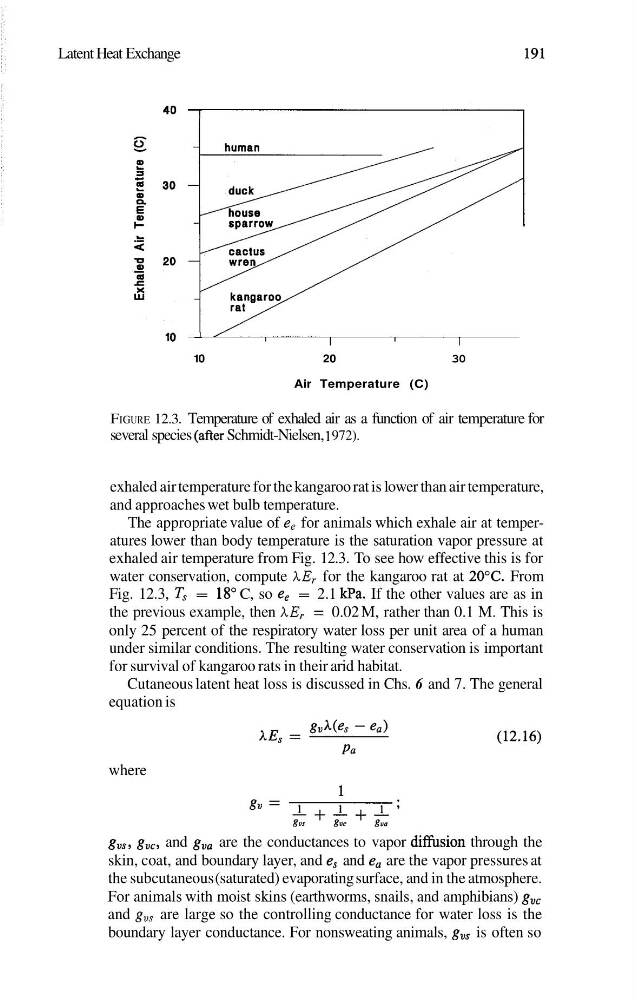
FIGURE 12.3. Temperature of exhaled air as a function of air temperature for
several species (after Schmidt-Nielsen, 1 972).
exhaled air temperature for the kangaroo rat is lower than air temperature,
and approaches wet bulb temperature.
The appropriate value of e, for animals which exhale air at temperatures lower than body temperature is the saturation vapor pressure at
exhaled air temperature from Fig. 12.3. To see how effective this is for
water conservation, compute hE, for the kangaroo rat at 20°C. From
Fig. 12.3, Ts = 18" C, so e, = 2.1 kPa. If the other values are as in
the previous example, then hE, = 0.02 M, rather than 0.1 M. This is
only 25 percent of the respiratory water loss per unit area of a human
under similar conditions. The resulting water conservation is important
for survival of kangaroo rats in their arid habitat.
Cutaneous latent heat loss is discussed in Chs. 6 and 7. The general
equation is
where
g,, g,,, and g,, are the conductances to vapor diffusion through the
skin, coat, and boundary layer, and e, and ea are the vapor pressures at
the subcutaneous (saturated) evaporating surface, and in the atmosphere.
For animals with moist skins (earthworms, snails, and amphibians) g,,
and g , , are large so the controlling conductance for water loss is the
boundary layer conductance. For nonsweating animals, g, is often so
I
/
I
I
I
I
10
20
30
Air Temperature (C)
FIGURE 12.3. Temperature of exhaled air as a function of air temperature for
several species (after Schmidt-Nielsen, 1 972).
exhaled air temperature for the kangaroo rat is lower than air temperature,
and approaches wet bulb temperature.
The appropriate value of e, for animals which exhale air at temperatures lower than body temperature is the saturation vapor pressure at
exhaled air temperature from Fig. 12.3. To see how effective this is for
water conservation, compute hE, for the kangaroo rat at 20°C. From
Fig. 12.3, Ts = 18" C, so e, = 2.1 kPa. If the other values are as in
the previous example, then hE, = 0.02 M, rather than 0.1 M. This is
only 25 percent of the respiratory water loss per unit area of a human
under similar conditions. The resulting water conservation is important
for survival of kangaroo rats in their arid habitat.
Cutaneous latent heat loss is discussed in Chs. 6 and 7. The general
equation is
where
g,, g,,, and g,, are the conductances to vapor diffusion through the
skin, coat, and boundary layer, and e, and ea are the vapor pressures at
the subcutaneous (saturated) evaporating surface, and in the atmosphere.
For animals with moist skins (earthworms, snails, and amphibians) g,,
and g , , are large so the controlling conductance for water loss is the
boundary layer conductance. For nonsweating animals, g, is often so