

Metabolism
12.2 Metabolism
The energy budget equation requires metabolic rate in terms of average
energy supplied to the animal's surface per unit area. Physiologists generally measure metabolic rates per unit mass of animal. Control of body
temperature for homeotherms and maintenance of body functions in all
animals requires a minimal or basal metabolic rate. This basal rate (Watts)
can be approximated for a wide variety of animals by the equation:
where m is the animal's mass (kg) and C is a constant between three and
five for endotherms and around five percent of this value for poikilotherms
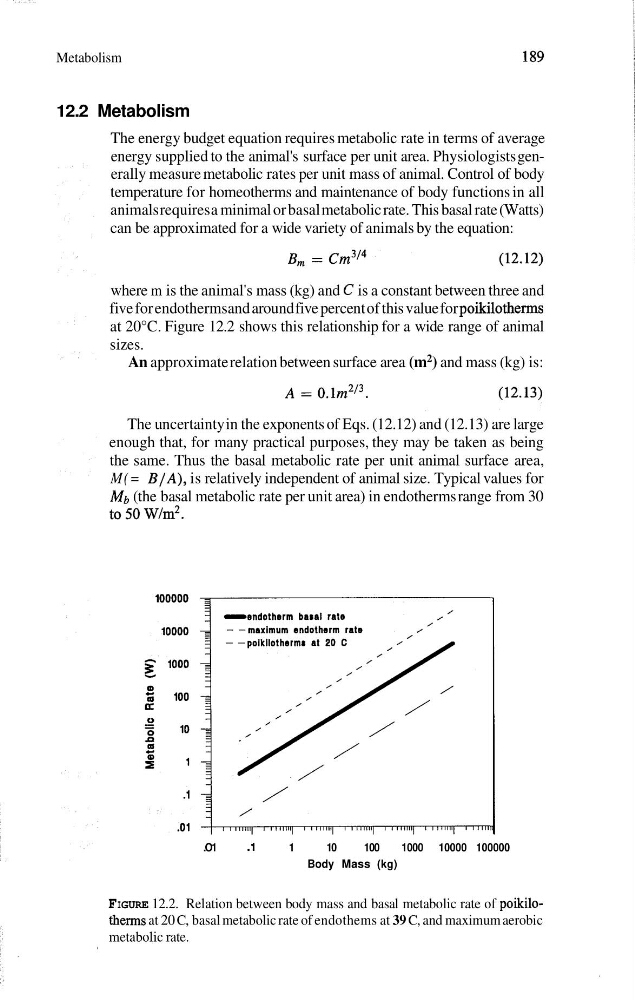
at 20°C. Figure 12.2 shows this relationship for a wide range of animal
sizes.
An approximate relation between surface area (m 2 ) and mass (kg) is:
The uncertainty in the exponents of Eqs. (12.12) and (12.13) are large
enough that, for many practical purposes, they may be taken as being
the same. Thus the basal metabolic rate per unit animal surface area,
M(= BIA), is relatively independent of animal size. Typical values for
Mb (the basal metabolic rate per unit area) in endotherms range from 30
.O1
.1
1
10
100
1000 10000 100000
Body Mass (kg)
FIGURE 12.2. Relation between body mass and basal metabolic rate of poikilothems at 20 C, basal metabolic rate of endothems at 39 C, and maximum aerobic
metabolic rate.
12.2 Metabolism
The energy budget equation requires metabolic rate in terms of average
energy supplied to the animal's surface per unit area. Physiologists generally measure metabolic rates per unit mass of animal. Control of body
temperature for homeotherms and maintenance of body functions in all
animals requires a minimal or basal metabolic rate. This basal rate (Watts)
can be approximated for a wide variety of animals by the equation:
where m is the animal's mass (kg) and C is a constant between three and
five for endotherms and around five percent of this value for poikilotherms
at 20°C. Figure 12.2 shows this relationship for a wide range of animal
sizes.
An approximate relation between surface area (m 2 ) and mass (kg) is:
The uncertainty in the exponents of Eqs. (12.12) and (12.13) are large
enough that, for many practical purposes, they may be taken as being
the same. Thus the basal metabolic rate per unit animal surface area,
M(= BIA), is relatively independent of animal size. Typical values for
Mb (the basal metabolic rate per unit area) in endotherms range from 30
.O1
.1
1
10
100
1000 10000 100000
Body Mass (kg)
FIGURE 12.2. Relation between body mass and basal metabolic rate of poikilothems at 20 C, basal metabolic rate of endothems at 39 C, and maximum aerobic
metabolic rate.