

The Energy Budget Concept
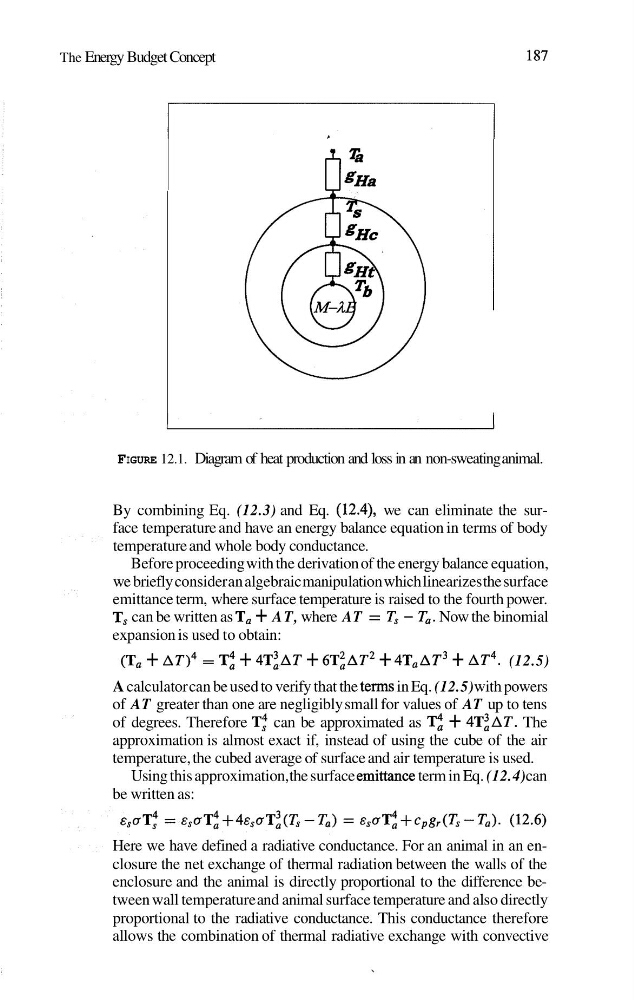
FIGURE 12.1. Diagram of heat production and loss in an non-sweating animal.
By combining Eq. (12.3) and Eq. (12.4), we can eliminate the surface temperature and have an energy balance equation in terms of body
temperature and whole body conductance.
Before proceeding with the derivation of the energy balance equation,
we briefly consider an algebraic manipulation which linearizes the surface
emittance term, where surface temperature is raised to the fourth power.
T s can be written as T , + AT, where AT = Ts - Ta. Now the binomial
expansion is used to obtain:
(T, + AT)^ = T: + ~ T ~ A T
+ ~ T : A T ~
+ ~ T , A T ~
+ AT^. (12.5)
A calculator can be used to verify that the terms in Eq. (12.5) with powers
of AT greater than one are negligibly small for values of AT up to tens
of degrees. Therefore T: can be approximated as T: + ~ T ~ A T .
The
approximation is almost exact if, instead of using the cube of the air
temperature, the cubed average of surface and air temperature is used.
Using this approximation, the surface emittance term in Eq. (12.4) can
be written as:
Here we have defined a radiative conductance. For an animal in an enclosure the net exchange of thermal radiation between the walls of the
enclosure and the animal is directly proportional to the difference between wall temperature and animal surface temperature and also directly
proportional to the radiative conductance. This conductance therefore
allows the combination of thermal radiative exchange with convective
FIGURE 12.1. Diagram of heat production and loss in an non-sweating animal.
By combining Eq. (12.3) and Eq. (12.4), we can eliminate the surface temperature and have an energy balance equation in terms of body
temperature and whole body conductance.
Before proceeding with the derivation of the energy balance equation,
we briefly consider an algebraic manipulation which linearizes the surface
emittance term, where surface temperature is raised to the fourth power.
T s can be written as T , + AT, where AT = Ts - Ta. Now the binomial
expansion is used to obtain:
(T, + AT)^ = T: + ~ T ~ A T
+ ~ T : A T ~
+ ~ T , A T ~
+ AT^. (12.5)
A calculator can be used to verify that the terms in Eq. (12.5) with powers
of AT greater than one are negligibly small for values of AT up to tens
of degrees. Therefore T: can be approximated as T: + ~ T ~ A T .
The
approximation is almost exact if, instead of using the cube of the air
temperature, the cubed average of surface and air temperature is used.
Using this approximation, the surface emittance term in Eq. (12.4) can
be written as:
Here we have defined a radiative conductance. For an animal in an enclosure the net exchange of thermal radiation between the walls of the
enclosure and the animal is directly proportional to the difference between wall temperature and animal surface temperature and also directly
proportional to the radiative conductance. This conductance therefore
allows the combination of thermal radiative exchange with convective