

Radiation Fluxes in Natural Environments
Although the sky usually is considered to be a hemisphere, it need not be
so; for example, the view factor between a leaf and the sky may be less
than one for the bottom of a mountain gorge.
In engineering, view factors usually are only used for diffise radiation;
however, in environmental biophysics we want to use them for beam and
diffise radiation so we expand the definition somewhat. Here we define
the view factor as the average flux density over the entire surface of
some object of interest divided by the flux density on a flat absorbing
surface facing the source. The surfaces of interest to us are soil surfaces,
plant canopies, individual leaves, and animals. When we say average flux
density here, we mean the number of Watts of energy absorbed, averaged
over the entire surface area of the object in question. For beam radiation
this average ratio is easily obtained (at least in principle). It is equal to
the ratio of the projected area in the direction of the solar beam (A,)
to the total surface area of the object (A). You might picture holding a
piece of paper perpendicular to the beam of solar radiation and tracing
the shadow of the object (animal, leaf, etc.) on the paper. The area of the
shadow is the A,. Thus for a flat horizontal leaf with the sun at zenith
angle @, F, = 0.5 cos + because only one side of the leaf faces the sun.
View factors for the sky and ground are for diffise radiation and was
discussed earlier. If the source of radiation (sky or ground) is assumed to
be isotropic (same intensity in all directions), then determining the view
factor essentially means that each point on the sky or ground is considered
as a source and each point on the object as a receiver. Each portion of the
source is weighted by the solid angle it subtends with each portion of the
receiver, each portion of the receiver is weighted by the fraction of the
entire receiver area it occupies, and the incident radiation is multiplied
by the cosine of the angle between the received-radiation direction and
a normal to the surface at the point of absorption. Integrating over the
entire solid angle of the source and area of the receiver gives the view
factor. For a flat horizontal plate, a sphere, or a cylinder under a diffise
sky and over a diffusely reflecting soil surface, the view factor between
the object (plate, sphere, or cylinder) and the sky hemisphere is 0.5 and
the view factor between the object and the ground is 0.5. Of course this
means that the view factor between the object and its entire view is 1 .O.
If the object were at the bottom of a deep canyon, then the view factor
between the object and the sky might be 0.4 and between the object and
the ground be 0.6 because some of the view of the top of the object is
occupied by canyon walls.
Now, we specifically consider view factors for soils and plant canopies,
animals and individual leaves. For a soil surface or a plant canopy F,, =
cos 8, Fd = Fa = F, = 1, and F, = F, = 0, where 8 is the angle
between the solar beam and a normal to the plane of the soil or canopy.
For a horizontal surface 8 = @, the zenith angle. When the surface has
slope, 8 can be computed from
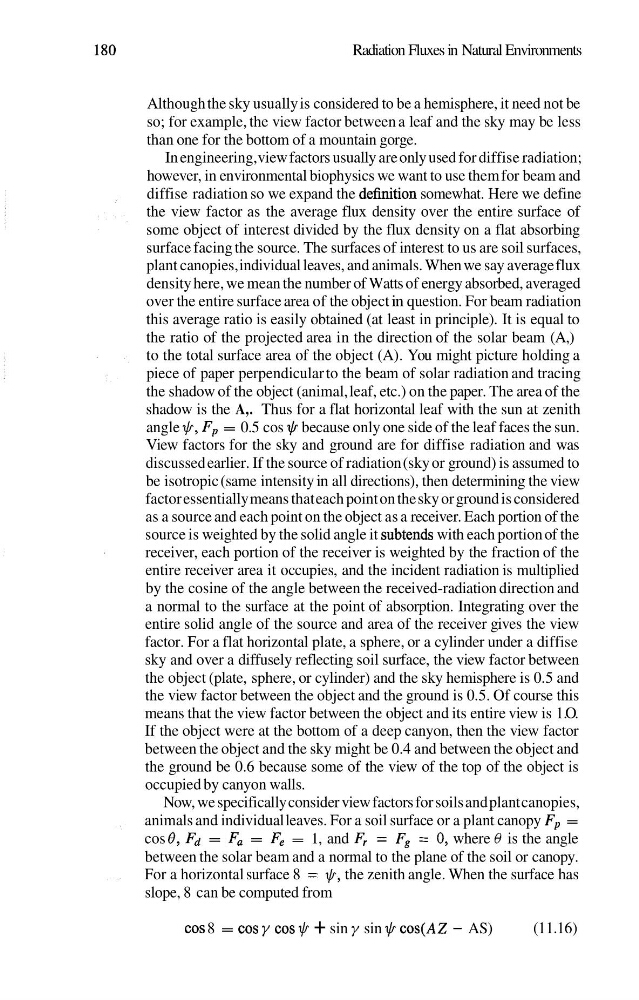
cos 8 = cos y cos @ + sin y sin @ cos(AZ - AS)
(11.16)
Although the sky usually is considered to be a hemisphere, it need not be
so; for example, the view factor between a leaf and the sky may be less
than one for the bottom of a mountain gorge.
In engineering, view factors usually are only used for diffise radiation;
however, in environmental biophysics we want to use them for beam and
diffise radiation so we expand the definition somewhat. Here we define
the view factor as the average flux density over the entire surface of
some object of interest divided by the flux density on a flat absorbing
surface facing the source. The surfaces of interest to us are soil surfaces,
plant canopies, individual leaves, and animals. When we say average flux
density here, we mean the number of Watts of energy absorbed, averaged
over the entire surface area of the object in question. For beam radiation
this average ratio is easily obtained (at least in principle). It is equal to
the ratio of the projected area in the direction of the solar beam (A,)
to the total surface area of the object (A). You might picture holding a
piece of paper perpendicular to the beam of solar radiation and tracing
the shadow of the object (animal, leaf, etc.) on the paper. The area of the
shadow is the A,. Thus for a flat horizontal leaf with the sun at zenith
angle @, F, = 0.5 cos + because only one side of the leaf faces the sun.
View factors for the sky and ground are for diffise radiation and was
discussed earlier. If the source of radiation (sky or ground) is assumed to
be isotropic (same intensity in all directions), then determining the view
factor essentially means that each point on the sky or ground is considered
as a source and each point on the object as a receiver. Each portion of the
source is weighted by the solid angle it subtends with each portion of the
receiver, each portion of the receiver is weighted by the fraction of the
entire receiver area it occupies, and the incident radiation is multiplied
by the cosine of the angle between the received-radiation direction and
a normal to the surface at the point of absorption. Integrating over the
entire solid angle of the source and area of the receiver gives the view
factor. For a flat horizontal plate, a sphere, or a cylinder under a diffise
sky and over a diffusely reflecting soil surface, the view factor between
the object (plate, sphere, or cylinder) and the sky hemisphere is 0.5 and
the view factor between the object and the ground is 0.5. Of course this
means that the view factor between the object and its entire view is 1 .O.
If the object were at the bottom of a deep canyon, then the view factor
between the object and the sky might be 0.4 and between the object and
the ground be 0.6 because some of the view of the top of the object is
occupied by canyon walls.
Now, we specifically consider view factors for soils and plant canopies,
animals and individual leaves. For a soil surface or a plant canopy F,, =
cos 8, Fd = Fa = F, = 1, and F, = F, = 0, where 8 is the angle
between the solar beam and a normal to the plane of the soil or canopy.
For a horizontal surface 8 = @, the zenith angle. When the surface has
slope, 8 can be computed from
cos 8 = cos y cos @ + sin y sin @ cos(AZ - AS)
(11.16)