

Radiation Basics
4
288 K blackbody
Wavelength (urn)
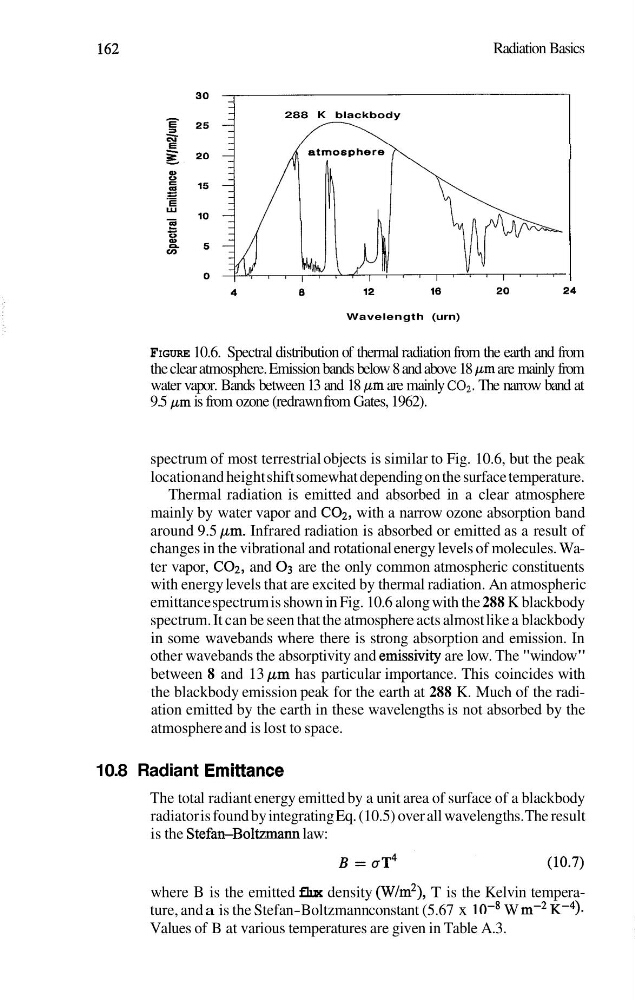
FIGURE 10.6. Spectral distribution of thermal radiation from the earth and from
the clear atmosphere. Emission bands below 8 and above 18 pm are mainly from
water vapor. Bands between 13 and 18 pm are mainly COz. The narrow band at
9.5 p m is from ozone (redrawn from Gates, 1962).
spectrum of most terrestrial objects is similar to Fig. 10.6, but the peak
location and height shift somewhat depending on the surface temperature.
Thermal radiation is emitted and absorbed in a clear atmosphere
mainly by water vapor and C02, with a narrow ozone absorption band
around 9.5 pm. Infrared radiation is absorbed or emitted as a result of
changes in the vibrational and rotational energy levels of molecules. Water vapor, C02, and O3 are the only common atmospheric constituents
with energy levels that are excited by thermal radiation. An atmospheric
emittance spectrum is shown in Fig. 10.6 along with the 288 K blackbody
spectrum. It can be seen that the atmosphere acts almost like a blackbody
in some wavebands where there is strong absorption and emission. In
other wavebands the absorptivity and emissivity are low. The "window"
between 8 and 13 pm has particular importance. This coincides with
the blackbody emission peak for the earth at 288 K. Much of the radiation emitted by the earth in these wavelengths is not absorbed by the
atmosphere and is lost to space.
10.8 Radiant Emittance
The total radiant energy emitted by a unit area of surface of a blackbody
radiator is found by integrating Eq. (10.5) over all wavelengths. The result
is the Stefan-Boltunann law:
where B is the emitted flux density (w/m2), T is the Kelvin temperature, and a is the Stefan-Boltzmann constant (5.67 x
W m-2 K - ~
1.
Values of B at various temperatures are given in Table A.3.
4
288 K blackbody
Wavelength (urn)
FIGURE 10.6. Spectral distribution of thermal radiation from the earth and from
the clear atmosphere. Emission bands below 8 and above 18 pm are mainly from
water vapor. Bands between 13 and 18 pm are mainly COz. The narrow band at
9.5 p m is from ozone (redrawn from Gates, 1962).
spectrum of most terrestrial objects is similar to Fig. 10.6, but the peak
location and height shift somewhat depending on the surface temperature.
Thermal radiation is emitted and absorbed in a clear atmosphere
mainly by water vapor and C02, with a narrow ozone absorption band
around 9.5 pm. Infrared radiation is absorbed or emitted as a result of
changes in the vibrational and rotational energy levels of molecules. Water vapor, C02, and O3 are the only common atmospheric constituents
with energy levels that are excited by thermal radiation. An atmospheric
emittance spectrum is shown in Fig. 10.6 along with the 288 K blackbody
spectrum. It can be seen that the atmosphere acts almost like a blackbody
in some wavebands where there is strong absorption and emission. In
other wavebands the absorptivity and emissivity are low. The "window"
between 8 and 13 pm has particular importance. This coincides with
the blackbody emission peak for the earth at 288 K. Much of the radiation emitted by the earth in these wavelengths is not absorbed by the
atmosphere and is lost to space.
10.8 Radiant Emittance
The total radiant energy emitted by a unit area of surface of a blackbody
radiator is found by integrating Eq. (10.5) over all wavelengths. The result
is the Stefan-Boltunann law:
where B is the emitted flux density (w/m2), T is the Kelvin temperature, and a is the Stefan-Boltzmann constant (5.67 x
W m-2 K - ~
1.
Values of B at various temperatures are given in Table A.3.