

The h a 1 transport equation that we need to consider is Darcy's law
(Eq. (6.4)). This law describes the transport of water in porous materials
such as soils. Darcy's law describes most of the water flow that takes place
in soils. Since water plays such an important role in the energy balance
of soils, plants, and animals, an understanding of at least some simple
applications of Darcy's law is important to environmental biophysicists.
The processes that are important in determining the water budget of a soil
are infiltration of applied water, redistribution of water in the soil profile,
evaporation of water from the soil surface, and transpiration of water by
plants.
We are mainly interested in applying Darcy's law to problems of
one-dimensional water flow, with flow occurring vertically upward or
downward. The components of the water potential (Ch. 4) responsible
for flow are the matric and gravitational potentials. We can therefore
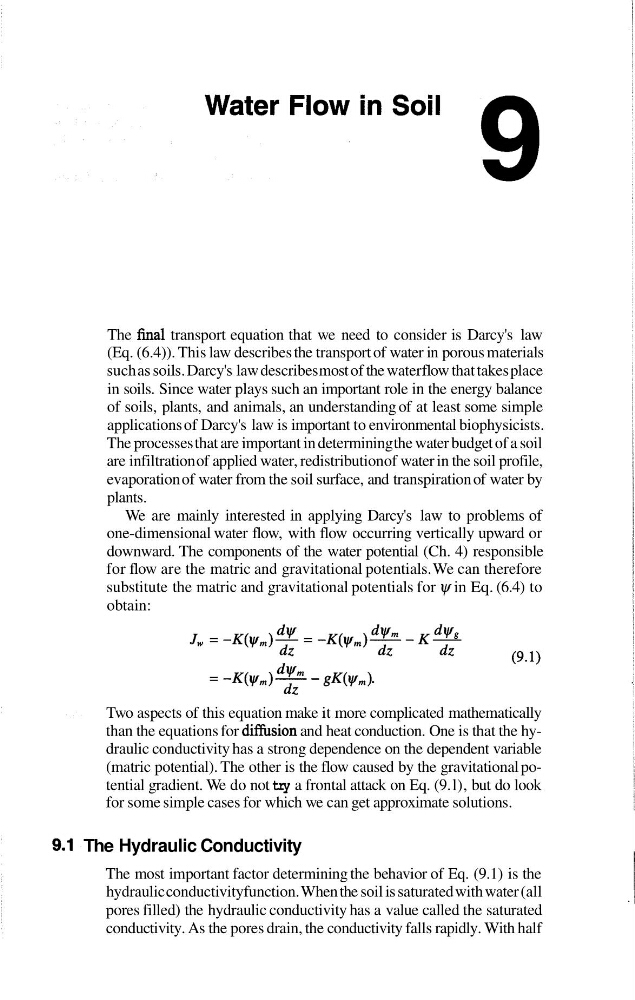
substitute the matric and gravitational potentials for y in Eq. (6.4) to
obtain:
Two aspects of this equation make it more complicated mathematically
than the equations for diffusion and heat conduction. One is that the hydraulic conductivity has a strong dependence on the dependent variable
(matric potential). The other is the flow caused by the gravitational potential gradient. We do not try a frontal attack on Eq. (9. l), but do look
for some simple cases for which we can get approximate solutions.
The Hydraulic Conductivity
The most important factor determining the behavior of Eq. (9.1) is the
hydraulic conductivity function. When the soil is saturated with water (all
pores filled) the hydraulic conductivity has a value called the saturated
conductivity. As the pores drain, the conductivity falls rapidly. With half
(Eq. (6.4)). This law describes the transport of water in porous materials
such as soils. Darcy's law describes most of the water flow that takes place
in soils. Since water plays such an important role in the energy balance
of soils, plants, and animals, an understanding of at least some simple
applications of Darcy's law is important to environmental biophysicists.
The processes that are important in determining the water budget of a soil
are infiltration of applied water, redistribution of water in the soil profile,
evaporation of water from the soil surface, and transpiration of water by
plants.
We are mainly interested in applying Darcy's law to problems of
one-dimensional water flow, with flow occurring vertically upward or
downward. The components of the water potential (Ch. 4) responsible
for flow are the matric and gravitational potentials. We can therefore
substitute the matric and gravitational potentials for y in Eq. (6.4) to
obtain:
Two aspects of this equation make it more complicated mathematically
than the equations for diffusion and heat conduction. One is that the hydraulic conductivity has a strong dependence on the dependent variable
(matric potential). The other is the flow caused by the gravitational potential gradient. We do not try a frontal attack on Eq. (9. l), but do look
for some simple cases for which we can get approximate solutions.
The Hydraulic Conductivity
The most important factor determining the behavior of Eq. (9.1) is the
hydraulic conductivity function. When the soil is saturated with water (all
pores filled) the hydraulic conductivity has a value called the saturated
conductivity. As the pores drain, the conductivity falls rapidly. With half