

Thermal Difisivity and Admittance of Soils
123
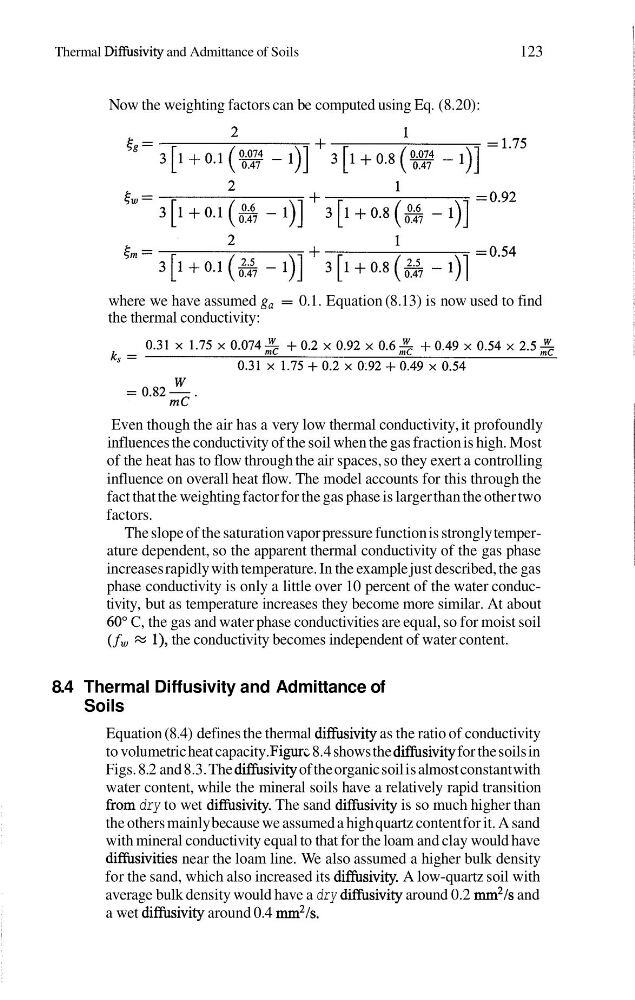
Now the weighting factors can be computed using Eq. (8.20):
where we have assumed g, = 0.1. Equation (8.13) is now used to find
the thermal conductivity:
Even though the air has a very low thermal conductivity, it profoundly
influences the conductivity of the soil when the gas fraction is high. Most
of the heat has to flow through the air spaces, so they exert a controlling
influence on overall heat flow. The model accounts for this through the
fact that the weighting factor for the gas phase is larger than the other two
factors.
The slope of the saturation vapor pressure function is strongly temperature dependent, so the apparent thermal conductivity of the gas phase
increases rapidly with temperature. In the example just described, the gas
phase conductivity is only a little over 10 percent of the water conductivity, but as temperature increases they become more similar. At about
60" C, the gas and water phase conductivities are equal, so for moist soil
( fw x I), the conductivity becomes independent of water content.
8.4 Thermal Diffusivity and Admittance of
Soils
Equation (8.4) defines the thermal difisivity as the ratio of conductivity
to volumetric heat capacity. Figuri 8.4 shows the difisivity for the soils in
Figs. 8.2 and 8.3. The difisivity of the organic soil is almost constant with
water content, while the mineral soils have a relatively rapid transition
from dry to wet difisivity. The sand difisivity is so much higher than
the others mainly because we assumed a high quartz content for it. A sand
with mineral conductivity equal to that for the loam and clay would have
difisivities near the loam line. We also assumed a higher bulk density
for the sand, which also increased its difisivity. A low-quartz soil with
average bulk density would have a dry difisivity around 0.2 mm2/s and
a wet difisivity around 0.4 mm2/s.
123
Now the weighting factors can be computed using Eq. (8.20):
where we have assumed g, = 0.1. Equation (8.13) is now used to find
the thermal conductivity:
Even though the air has a very low thermal conductivity, it profoundly
influences the conductivity of the soil when the gas fraction is high. Most
of the heat has to flow through the air spaces, so they exert a controlling
influence on overall heat flow. The model accounts for this through the
fact that the weighting factor for the gas phase is larger than the other two
factors.
The slope of the saturation vapor pressure function is strongly temperature dependent, so the apparent thermal conductivity of the gas phase
increases rapidly with temperature. In the example just described, the gas
phase conductivity is only a little over 10 percent of the water conductivity, but as temperature increases they become more similar. At about
60" C, the gas and water phase conductivities are equal, so for moist soil
( fw x I), the conductivity becomes independent of water content.
8.4 Thermal Diffusivity and Admittance of
Soils
Equation (8.4) defines the thermal difisivity as the ratio of conductivity
to volumetric heat capacity. Figuri 8.4 shows the difisivity for the soils in
Figs. 8.2 and 8.3. The difisivity of the organic soil is almost constant with
water content, while the mineral soils have a relatively rapid transition
from dry to wet difisivity. The sand difisivity is so much higher than
the others mainly because we assumed a high quartz content for it. A sand
with mineral conductivity equal to that for the loam and clay would have
difisivities near the loam line. We also assumed a higher bulk density
for the sand, which also increased its difisivity. A low-quartz soil with
average bulk density would have a dry difisivity around 0.2 mm2/s and
a wet difisivity around 0.4 mm2/s.